















The debate over the possible renaming of Kotoka International Airport to Accra International Airport has once again resurfaced. This time, it comes with glossy 3D renderings and political pronouncements meant to dazzle rather than inform. But beyond the visuals and rhetoric lies a far more troubling issue: the steady reduction of Ghana’s national discourse into mere theatre.


I am deeply worried. We appear increasingly unable to engage with serious national questions using empirical evidence, historical context, or logical reasoning.
Instead, we have replaced substance with spectacle. The ongoing argument about whether Kotoka International Airport should be renamed is a perfect example of this decline.
The reasons being offered for the proposed change are, frankly, hollow. At best, they are superficial; at worst, they are intellectually embarrassing.
The Majority Leader of parliament, Mahama Ayariga for instance, has suggested that the airport should be renamed because it is located in Accra and the land on which it sits was provided by the people of Accra. By that logic, every national institution situated in the capital should automatically bear the name “Accra.” Ministries, security installations, universities—everything. The argument collapses under the slightest scrutiny.
Is this truly how our leaders reason? Even more disturbing is the contribution from the Minority Leader of Parliament Alexander Kwamena Afenyor Markin , who frames the issue almost entirely through the lens of ethnicity.
His suggestion that renaming the airport would offend people from the Volta Region because Kotoka was Ewe reduces a national conversation to crude tribal arithmetic. This is not only dangerous; it is intellectually lazy and socially corrosive.
Are we not shocked by the level of this debate?
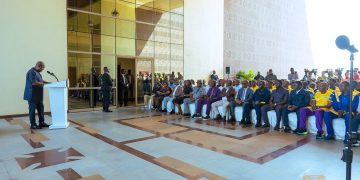
This discussion is not happening in a street corner argument or an unregulated online forum. It is unfolding in Ghana’s Parliament the highest law-making body of the Republic of Ghana. That alone should alarm every citizen who believes in reasoned governance.
What makes this entire episode even more frustrating is that the call to rename Kotoka International Airport is not new, nor is it without historical grounding. As far back as the 1960s, prominent Ghanaian intellectuals and activists including figures such as John Hansen, F.S. Hanson, and Dr. Lutterodt raised concerns about the symbolism of naming Ghana’s principal international gateway after a military figure associated with a coup.
Over the years, organizations such as the National Union of Ghana Students (NUGS), the Convention People’s Party (CPP), and international solidarity movements like the Afro-Asian People’s Solidarity Organization have all, at various times, called for a reconsideration of the name. Their arguments were rooted in ideology, history, and national identity not in geography or ethnic sentiment.
That is where the real conversation should be.
If we are to debate the name Kotoka International Airport, let us do so honestly. Let us interrogate history, symbolism, and the values we wish to project as a nation. Does the name reflect Ghana’s democratic ideals? Does it honor the kind of legacy we want to present to the world? These are legitimate questions.
But let us not insult the intelligence of Ghanaians by turning a serious national issue into a performance filled with applause lines, ethnic baiting, and shallow logic.
A nation that cannot conduct serious conversations seriously is a nation in danger of stagnation. We can do better. We must do better.
The mouth must not run faster than the mind in Leadership
Source: Isaac Justice Bediako Broadcast Journalist, EIB Network, Kumasi