





































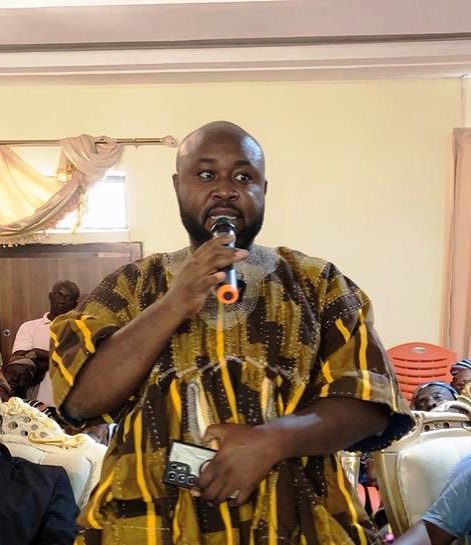
Government has secured funding for a US$300 million water project aimed at addressing the long-standing and recurring water shortages affecting Damongo, Tamale, Yendi and several surrounding communities.


The Savannah Regional Minister, Hon. Salisu Be-Awuribe, announced this while addressing the Savannah Regional House of Chiefs during its first General Meeting for 2026, held in Damongo.
“As we speak, funding arrangements have been procured, and necessary works are ongoing to commence the project,” Hon. Be-Awuribe disclosed.
He explained that the project will source water from Yape to supply Damongo, Tamale and Yendi, as well as adjoining communities including Larabanga and Mole. The intervention is expected to significantly reduce the perennial water crisis that has plagued the beneficiary towns for years.
Damongo, the Savannah Regional capital, continues to experience acute water shortages due to rapid population growth and inadequate water infrastructure. Tamale and Yendi, two of the fastest-growing urban centres in northern Ghana, are also under increasing pressure as existing water systems struggle to meet rising domestic, commercial and institutional demand.
The Minister noted that the project would not only improve access to potable water but also enhance public health, sanitation, tourism and economic activities, particularly in communities such as Larabanga and Mole, which are key tourism destinations.
Beyond water, Hon. Be-Awuribe urged traditional authorities to help reduce land and chieftaincy disputes, noting that such conflicts dominate discussions at the Regional Security Council and undermine peace and development.
He called for the modernization of the Gonjaland Constitution, which was originally drafted in the 1930s, and stressed the need for proper documentation of succession lines and customary practices.
“When you are able to have proper documentation and possibly legislation of these processes and procedures, it will make it easy for the courts to make definite pronouncements without ramifying effects,” he noted.
The Minister further emphasized that while chiefs play a critical role in dispute resolution, customary arbitration processes must comply with alternative dispute resolution laws for their decisions to be upheld by the courts. He cautioned that traditional authorities do not have criminal jurisdiction and must operate strictly within the law.
On land administration, Hon. Be-Awuribe reminded chiefs that under the Lands Act, 2020 (Act 1036), traditional authorities are recognized as fiduciaries.
“You must be fair, transparent, and accountable in how you manage lands under your jurisdiction,” he warned, adding that multiple land sales and poor record-keeping could attract civil and criminal sanctions. He encouraged the establishment and strengthening of Customary Land Secretariats to ensure proper documentation of land transactions.
The Regional Minister also assured the House that government would take seriously concerns about the absence of a permanent structure for the Savannah Regional House of Chiefs.
“I will take it up very seriously and link up with my colleague, the Minister of Local Government and Chieftaincy, so that the young Regional House of Chiefs gets its proper footing and proper standing,” he said, acknowledging that earlier attempts to construct a permanent facility had stalled.
During the meeting, the Savannah Regional House of Chiefs formally admitted five Paramount Chiefs and one Divisional Chief as new members. They are the Damongowura, Seidu Kelly Boresa I; the Kpansheguwura, F. A. Adams Borewunche I; the Kulibuwura, Osman Keli IV; the Jantongwura, Mahama Kebase I; the Tuluwera, Purgi Budon I; and the Nnaa, Solomon Dompeeh Antwi Jugboi Koro.
The meeting itself brought together paramount and divisional chiefs, government officials, judicial authorities and other key stakeholders to deliberate on chieftaincy, land administration, development and peace in the Savannah Region. It was chaired by the Vice President of the House and Paramount Chief of the Kpembe Traditional Area, Kpembewura Bambange Ndefoso IV.
Source: www.kumasimail.com