
























Ghana’s opposition New Patriotic Party (NPP) has accused the government of prioritising political messaging over substantive economic reform, as debate intensifies over the country’s economic direction and the proposed 2026 budget.


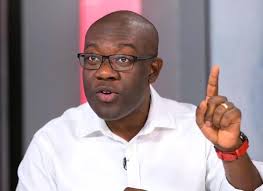
Kojo Oppong Nkrumah, a senior member of the opposition New Patriotic Party (NPP), said the governing National Democratic Congress (NDC) was focusing more on political confrontation than on learning from past policy mistakes.
Speaking on The Key Points programme on TV3 Ghana, Mr Oppong Nkrumah argued that political discourse had become increasingly polarised since the NDC returned to power following the 2024 elections.
“Due to the partisan nature of politics, the NDC is more interested in debating us than listening to our confessed mistakes,” he said, adding that the NPP had acknowledged shortcomings during its time in office in an effort to avoid repeating them.
Mr Oppong Nkrumah, who serves as ranking member on Parliament’s Economy and Development Committee, said his party was pursuing what he described as “constructive opposition” to prevent renewed cycles of economic mismanagement, rising debt and policy inconsistency.
At the centre of his criticism was the government’s flagship 24-hour economy policy. The initiative is intended to boost productivity and create jobs by encouraging businesses and institutions to operate around the clock.
Parliament passed the 24-Hour Economy Authority Bill in 2025 to oversee its implementation. However, Mr Oppong Nkrumah argued that the legislation lacks enforceable provisions requiring businesses or public institutions to operate 24 hours a day and does not clearly define how the proposed “1-3-3” shift system would function.
He warned that the new authority could become largely symbolic, projecting progress without delivering meaningful economic transformation or large-scale job creation for young people.
“It is doable, but it must be premised on effective demand,” he said. “When you have created an economy that has demand, you do not need to set up an authority to tell people to go and work 24 hours.”
Drawing a practical comparison, he added that businesses would naturally extend their hours if customer demand existed.
“If you run a cold store and, at 11:50pm, there are people in front of your shop with cash in their hands, would you close your store?” he asked. “You focus on creating the demand.”
The government has previously defended the 24-hour economy policy as a central pillar of its growth and employment strategy, particularly for young people. Ministers argue that the policy will stimulate industrial activity and expand opportunities across sectors, including manufacturing and agriculture.
The debate comes amid broader discussions in Parliament over Ghana’s economic outlook, the cocoa sector and preparations for the 2026 budget.
Source: www.kumasimail.com