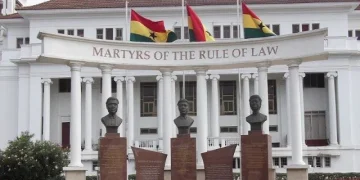


































Ghana’s Supreme Court has ruled that policies at Wesley Girls’ Senior High School restricting Muslim students from practising their faith are unconstitutional.


In a judgment delivered under the court’s original jurisdiction, the panel held that rules compelling Muslim students to attend Methodist worship and prohibiting them from wearing the hijab, fasting during Ramadan and performing Islamic prayers violate the 1992 Constitution.
The case was brought by Shafic Osman against the school’s Board of Governors, the Ghana Education Service (GES) and the Attorney-General.
Constitutional protections
Reading the opinion of the court, Justice Gabriel Pwamang said the Constitution guarantees freedom of thought, conscience and religion, as well as protection from discrimination on religious grounds.
The court cited Articles 12(2), 17(2), 21(1)(b)-(c) and 28(4) of the Constitution, which protect fundamental human rights, including the right of children not to be deprived of education because of their religious beliefs.
“The autonomy of mission schools cannot override constitutional supremacy,” the court held.
It said students should not be forced to choose between their faith and their right to education.
Applying the “Marghuy Test”
In its analysis, the court applied principles from a previous Supreme Court ruling involving Achimota School, commonly referred to as the “Marghuy Test”.
The judges found that the school’s policies interfered with genuine religious expression, deprived students of education on religious grounds and were not justified by any compelling public interest.
The defendants, the court said, failed to demonstrate that the restrictions were necessary or proportionate.
International standards
The ruling also referenced international human rights instruments, including the African Charter on Human and Peoples’ Rights and the Universal Declaration of Human Rights, both of which protect freedom of religion.
The court cited comparative decisions from Nigeria, Kenya and India, where courts have upheld students’ rights to manifest their religious beliefs in public educational institutions.
Orders issued
The Supreme Court declared the disputed policies null and void.
It issued a mandatory injunction directing Wesley Girls’ SHS to permit Muslim students to wear the hijab, fast during Ramadan and perform prayers, provided these are consistent with school discipline.
The court further directed the Ghana Education Service to develop national guidelines within six months to ensure reasonable accommodation of religious practices in all public-funded schools.
The decision is expected to have wide-ranging implications for mission schools across Ghana, many of which operate with public funding while maintaining denominational traditions.
Source:www.kumasimail.com