


































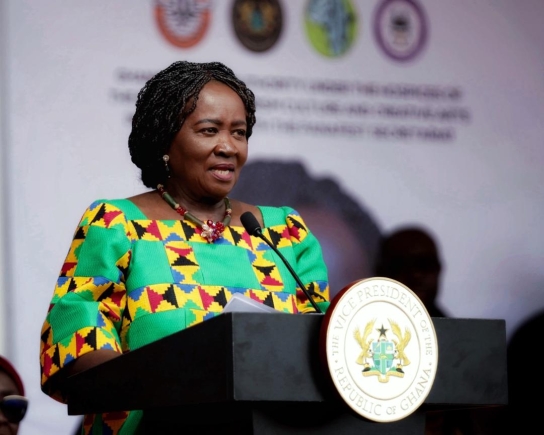
The government’s push toward a 24-hour economic system is beginning to yield encouraging results, with pilot industrial zones recording increased output and higher night-shift employment, Vice-President Professor Naana Jane Opoku-Agyemang has announced.


Speaking at the 14th Ghana Industry and Quality Awards in Accra on November 30, the Vice-President said the initiative a flagship policy of President John Dramani Mahama’s administration is proving to be an effective tool for boosting productivity, expanding employment, and stimulating economic activity.
“In pilot zones such as the Tema Light Manufacturing Belt, 24-hour operations have already resulted in significant increases in output and unit employment during night shifts,” she said. “This model multiplies capacity, maximises resource use and creates jobs.”
The awards, organised annually by the Association of Ghana Industries (AGI), honour outstanding companies across various sectors as the climax of National Industrial Week. This year’s theme was: “Creating a Conducive Business Environment & Quality Standards for Industrial Competitiveness in a 24-Hour Economy.”
Companies recognised on the night included Honeycomb Foods Ltd, Pioneer Business Investments Ltd, Eden Tree, CBI Ghana Ltd, Nexans Kabelmetal Ghana Ltd, Niche Cocoa Industry Ltd and Nestlé Ghana Ltd.
The event was supported by the Ghana Standards Authority (GSA) and the Ministry of Trade, Agribusiness and Industry (MoTAI).
Prof. Opoku-Agyemang said the 24-Hour Economy forms part of a broader industrialisation strategy aimed at enhancing resilience and strengthening Ghana’s export competitiveness.
She noted that the policy seeks to incentivise manufacturing and light industries to operate in shifts around the clock, supported by uninterrupted public services.
“We are working to ensure that ports, regulatory agencies and licensing bodies operate continuously to match the needs of a modern industrial cycle,” she said.
While praising AGI members as “champions of made-in-Ghana products,” the Vice-President acknowledged persistent obstacles confronting industry, including inconsistent power supply, limited access to credit and high utility costs.
“We are not naïve to the challenges… but we are fully committed to addressing them under a broader industrial agenda,” she assured.
She pledged improved access to raw materials through agribusiness support, preferential procurement for local producers and enhanced export opportunities driven by logistics and infrastructure upgrades — including modernised ports and the soon-to-operationalise Boankra Inland Port.
Govt committed to easing business constraints
The Minister of Trade, Agribusiness and Industry, Elizabeth Ofosu-Adjare, reaffirmed the government’s commitment to improving the business environment through ongoing regulatory reforms aimed at simplifying processes, reducing delays and enhancing transparency.
She said the digitalisation of trade systems — from business registration to customs clearance — is easing constraints and giving enterprises greater predictability.
The Minister encouraged manufacturers and exporters to support government reforms, including the new foreign exchange platform regime. She emphasised that government procurement policies demonstrate strong support for locally manufactured products, citing the procurement of sanitary pads under the Free Sanitary Pads Initiative.
Call for stronger enforcement
Outgoing AGI President Dr Humphrey Ayim Darke stressed that the success of the 24-Hour Economy depends not only on increased production, but also on fair competition and market integrity. He called for tighter border controls, stronger customs enforcement and coordinated action among regulatory agencies to curb the influx of substandard and smuggled goods.
He also urged the government to institute clear penalties and robust enforcement mechanisms to protect local industries and safeguard consumer confidence.
Source: www.kumasimail.com