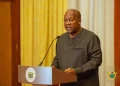


































Governor of the Bank of Ghana (BoG), Dr. Johnson Pandit Asiama, says Ghana’s macroeconomic conditions have continued to improve, but cautioned that the gains achieved so far must be carefully managed to ensure lasting stability.


Speaking at the opening of the 128th Monetary Policy Committee (MPC) meeting in Accra on Monday, Dr. Asiama noted that inflation had declined to 5.4 percent at the end of 2025, while external buffers strengthened significantly, with gross international reserves rising to US$13.8 billion—equivalent to 5.7 months of import cover.
He said the improved reserve position was supported by a current account surplus of 8.1 percent of Gross Domestic Product (GDP), adding that economic growth through the third quarter of 2025 remained strong, with leading indicators pointing to continued expansion.
“These outcomes confirm that recent policy choices are yielding results and that policy credibility has been restored,” the Governor said. However, he stressed that the meeting was not about celebrating success, but rather assessing whether current stability could be sustained in the period ahead.
Dr. Asiama observed that while global growth remains resilient, with projections of about 3.3 percent into 2026, geopolitical uncertainties persist. He cautioned that Ghana’s recent gains, partly supported by favourable external conditions such as higher gold prices, may not be permanent.
Domestically, the Governor said rapid disinflation has created policy space but also raised critical policy questions, particularly how to balance support for economic growth while preserving hard-won credibility.
He outlined four key considerations for the Committee’s deliberations: the pace and sequencing of any policy adjustment; sustaining foreign exchange stability and managing expectations; the continued role of the Domestic Gold Purchase Programme in strengthening external buffers; and the need for data integrity ahead of the International Monetary Fund (IMF) review scheduled for April 2026.
According to him, the IMF review will be based on end-December 2025 data, making the Committee one of the first bodies to rigorously assess key indicators such as inflation, reserve accumulation and adherence to zero central bank financing, including the transparent recognition of quasi-fiscal activities.
“At its core, this meeting is not about whether conditions have improved—they clearly have,” Dr. Asiama said. “It is about how we respond to that improvement, and how we ensure that decisions taken today remain robust under scrutiny tomorrow.”
The Monetary Policy Committee is expected to announce its policy decision at the end of the meeting.
Source: www.kumasimail.com