









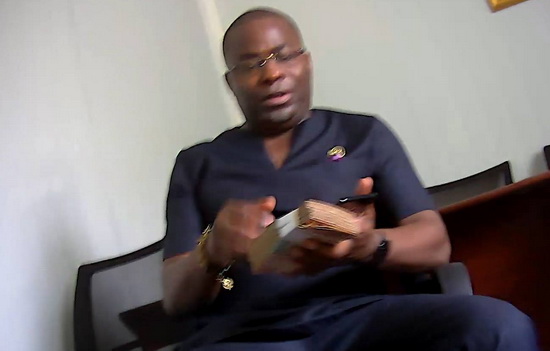
The High Court in Accra has ordered an in-camera hearing for undercover investigator, a witness of the Office of the Special Prosecutor (OSP) who is set to testify in a case in which Charles Bissue and two others are standing trial.


The order was made following the Court’s ruling on an application from the OSP for their witness, Benjamin Agyepong, an undercover investigator, citing safety concerns.
Mr. Bissue, who was the Secretary of the defunct Inter-Ministerial Committee on Illegal Mining (IMCIM), Raphael Mensah, and Dr. Naa Dedei Tagoe, are facing a total of eight counts.
Mr Bissue, (First Accused), together with Raphael Mensah, former Systems Manager of the GalamStop software, (Second Accused) and Dr. Naa Dedei Tagoe, former Project Coordinator of the IMCIM – Third Accused have variously pleaded not guilty to eight counts relating to corruption and corruption-related offences.
Ruling on the application on Monday, December 9, Justice Audrey Kocuvie-Tay said there exists a reasonable operational risk to the witness if his identity and face are exposed.
The Court also said the orders for an in-camera hearing will not impair the fair trial rights of the accused persons, who will get the opportunity to cross-examine the witness.
“Having carefully weighed the constitutional right to public hearing, the witness as undercover operative, his ongoing works, the violence against at least one investigative journalist, (Ahmed Suale), I am satisfied that this court has jurisdiction under Article 19(5) and Section 102 of the Courts Act to exclude the public and media where necessary for administration of justice and protection of the life of person,” the Court said.
“There exists reasonable operational risk of the witness if his identity and faces are exposed. The orders will not impair the fair trial right of the accused persons who will get the opportunity to cross examine the witness,” the Court said
It was the ruling of the Court that, the Evidence-in-Chief, cross examination and question put to him shall be in camera.
By this mode, the Court said, “Only lawyers for accused, accused persons, court staff and security officers will be allowed to be in the court room during the testimony of PW1.
The Court also ruled that, “Only court officials will be allowed to make audio or video recordings of the proceedings involving the testimony of PW1.
The Court further ruled that, “Accredited journalists may apply for the proceedings of the court through the normal process subject to the removal of sensitive information such as residential address and others of the witness.”
Justice Kocuvie-Tay said the Court Registrar is to make the necessary arrangements for the testimony of the PW1. The case has been adjourned to January 12, 2026 for the trial to begin.
Background
On Wednesday, October 5, 2025 before Justice Audrey Kocuvie-Tay, Maame Akua Adiyiah, the lead prosecutor in the case for the OSP while moving the motion for the potential witness to testify in-camera, said the witness has genuine fear for his safety.
She referenced the past events where Ahmed Suale was murdered fews days after his pictures weee published to the public, to buttress the point that, the potential witness being a colleague of the deceased harboured.
The OSP prosecutors argued that the court has the authority to grant protection to the witness, allowing him to testify with his face only shown to the parties involved.
They emphasized that the witness’s safety is paramount and that the court should not wait until something happens before taking action
The OSP is not asking for the witness to be put into a witness protection program but rather for the court to exercise its authority to protect the witness’s identity during testimony.
“The issue of corruption is so wide in Ghana,” the prosecutors stated, citing a UN report that many people pay bribes but only a few report it.
The OSP is not asking for the witness to be put into a witness protection program but rather for the court to exercise its authority to protect the witness’s identity during testimony.
They cited a recent Court of Appeal case, Republic vs. Kwasi Nyantakyi, to support their argument that the court should be proactive in protecting witnesses.
The OSP believes that refusing this application may deter the witness from testifying, which would not be in the interest of justice.
Opposition
Defence lawyers – Augustines Obuor, Charles Okyere and Opoku Agyei representing the first, second and third accused persons respectively took turns to oppose vehemently against the Request before the High Court presided over by Justice Audrey Kocuvie-Tay.
They argued that, the prosecution’s application for the witness to testify in-camera, citing procedural issues with the affidavit.
They also argued that the witness’s employer, TigerEyePI, is not a registered entity, and there’s no evidence to support the witness’s claim of fear.
The defense argued that the prosecution’s application is inadequate and doesn’t meet constitutional and court act criteria.
They questioned the witness’s status as an undercover investigator, noting that his employment details don’t mention this.
“Powerful in what?” The defense also pointed out that the witness’s statement was made six years ago, and there’s been no report of harm despite numerous interactions with authorities.
The defense argued that the prosecution hasn’t shown that testifying in-camera is necessary for public morality, safety, or order.
They cited constitutional provisions, including Article 126(3) and Article 19(14) and (15), which allow for exceptions to public trials.
The defense emphasized that the prosecution hasn’t demonstrated how public testimony would prejudice the public interest.
“This witness is not one whose identity should be kept away from the public,” the submitted.
Source :www.kumasimail.com