



































Vice President Prof. Jane Naana Opoku-Agyemang has declared Ghana’s energy sector to be on a firm path to stability and reform, following decisive interventions that have ended load shedding, tightened procurement controls, and revived critical energy infrastructure.


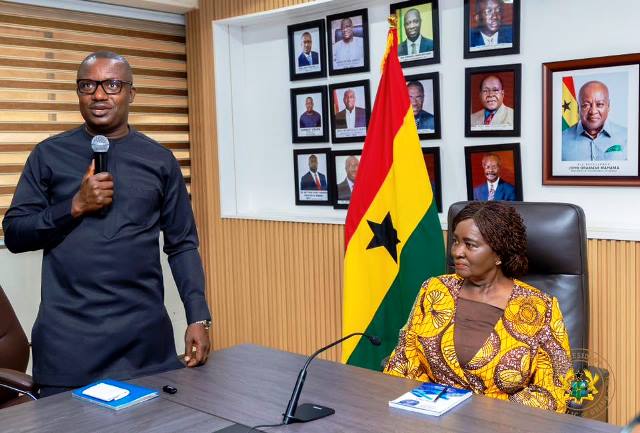
During a working visit to the Ministry of Energy and Green Transition, the Vice President was briefed by the Minister, Dr. John Abdulai Jinapor, on sweeping reforms aimed at restoring reliability, affordability and investor confidence in the sector.
At the heart of the reforms is a major clean-up at the Electricity Company of Ghana (ECG). Out of 347 contracts subjected to a value-for-money audit, 202 contracts worth US$227.6 million, £1.17 million and €4.08 million have been terminated, with the remaining 145 still under review.
“This government is demonstrating, in practical terms, that discipline, transparency and accountability are not slogans,” Prof. Opoku-Agyemang said. “We must have the courage to review what has not worked, correct it, and move forward with solutions that truly serve the Ghanaian people.”
She stressed that energy security remains central to national development, noting that reliable power underpins industry, agriculture and household livelihoods. “When the energy sector is stable, the economy breathes,” she added.
Dr. Jinapor, for his part, contrasted the current gains with what he described as a fragile sector inherited in 2024.
“We inherited an energy sector marked by persistent load shedding, fuel shortages for power generation, low investor confidence, dwindling reserves and serious challenges with the cash waterfall mechanism,” the Minister said.
He disclosed that the situation has been significantly reversed under the current administration.
“Today, Ghana has recorded over 10 months without load shedding, disbursed more than GH¢ 15 billion through the cash waterfall mechanism, increased gas supply, paid down substantial legacy debts, and restored a US$500 million Partial Risk Guarantee that had been completely depleted,” Dr. Jinapor stated.
The Ministry also reported progress in power generation and fuel supply, driven by a deliberate shift from heavy fuels to gas-based generation, alongside rising crude oil production from the Jubilee and Sankofa fields.
In a major boost to downstream operations, the Tema Oil Refinery (TOR) has resumed crude oil processing, with volumes increasing steadily – a development officials say signals renewed confidence and operational revival.
Beyond conventional energy, government is accelerating its green transition agenda, expanding solar street lighting, rolling out solar-powered irrigation pumps for agriculture, and supporting electric vehicle charging infrastructure. Measures are also underway to reduce the cost of solar technologies, particularly for rural communities.
Prof. Opoku-Agyemang praised the Ministry and its 16 agencies for steering the sector through deep-seated structural and debt challenges.
“This sector has lived too long under the threat of power disruptions,” she said. “What we are seeing now is improved planning, stronger discipline and renewed confidence from investors and consumers alike.”
She assured the Ministry of the Presidency’s full backing as it consolidates reforms, accelerates the green transition and delivers energy solutions to drive growth and improve living standards nationwide.
“Our commitment is clear,” the Vice President said. “Reliable and sustainable energy is not optional – it is essential to Ghana’s future.”
Source: www.kumasimail.com