




































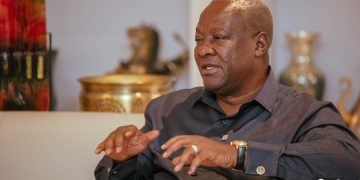



The High Court in Accra has dismissed an application by lawyers for former Director-General of the National Signals Bureau (NSB), Kwabena Adu-Boahene, seeking to strike out portions of the Attorney-General’s reply to the submission of no case.


The application was dismissed as without merit by Justice Francis Apangabonu Achibonga, a Justice of the Court of Appeal sitting as an additional High Court judge.
Lead counsel for Adu-Boahene, Samuel Atta Akyea, moved the motion and argued that the prosecution had imported evidence that was not borne out by the record of proceedings.
The Deputy Attorney-General opposed the application and urged the court to dismiss it, describing it as alien to the rules of court and practice.
In his ruling, Justice Francis Apangabonu Achibonga, a Justice of the Court of Appeal sitting as an additional High Court judge, agreed with the prosecution and dismissed the application.
Kwabena Adu-Boahene, and his wife Angela Agyei Boateng are facing a combined eleven counts charges in relation to alleged misused of the sum of GHc49.1 million earn-marked for the purchase of a cybersecurity defenceZ
They have pleaded not guilty and are standing trial. The prosecution through the Deputy Attorney General have closed their case after calling four witnesses.
The accused have filed submissions of no case and the AG has replied but accused alleged importation of evidence and filed a motion to have same expunged but the court dismissed it.
Alleged non-existent evidence
Moving the motion, lead counsel for the accused persons, Samuel Atta Akyea, asked the court for an order to strike out portions of the prosecution’s submission filed on October 9, 2026, in opposition to the accused persons’ submission of no case.
He told the court he was moving in terms of the motion paper and the supporting affidavit.
Mr. Atta Akyea argued that the prosecution had filed no affidavit in opposition to the factual matters undergirding the application. The legal effect, he said, was that the matters deposed to in the affidavit in support had been admitted.
He relied on the Supreme Court decisions in Francis Asuming and 640 Others v Divestiture Implementation Committee and Republic v Court of Appeal, Ex parte Tsatsu Tsikata, to support that position.
The core of the application, he said, was based on a principle of law on truth as the foundation of justice delivery, as pronounced by the Supreme Court in Middle Faith World Outreach Centre and 2 Others v Registrar General and 4 Others.
According to counsel, the Attorney-General, in his submissions annexed to the motion, had imported non-existent material not borne out by the record of proceedings.
He said the prosecution had attributed statements to witnesses on matters they never spoke about, and had also stated the content of an exhibit in a manner not permitted by the rules of court, the rules of evidence, and the ethics of the legal profession.
He said the matters complained about were graphically stated in paragraph 10 of the affidavit in support.
Mr. Atta Akyea warned of the risk and danger of not bringing the matters before the court for possible expungement, arguing that they could deceive the court in its judgment and occasion a miscarriage of justice.
He added that it would be a matter of grave concern if the court found extra-judicial material not borne out by the evidence and the record, yet glossed over it without being prompted on the implications of falsification of the record.
He drew a distinction between submissions based on inferences grounded in adduced evidence, which he said counsel is permitted to make, and submissions based on non-existent evidence, which he described as the improvisation of a lawyer at the Bar.
He argued that if the issue had arisen during viva voce (oral) engagement, counsel would have been permitted to rise and challenge it for the court to rule on. That, he said, applied even more to written submissions, which form part of the record of proceedings.
He contended that there was a real and material risk that, if not expunged, the impugned portions could be relied upon, and the applicants would suffer a material miscarriage of justice, given that their innocence was at stake in the criminal trial.
He also drew the court’s attention to Rule 63(2)(e), (f) and (g) of the Legal Profession (Professional Conduct and Etiquette) Rules, 2020 (L.I. 2423).
He concluded that it was the court’s bounden duty to ensure the sanctity of the record of proceedings and to deny lawyers any attempt to import material into the record under the guise of written submissions.
Alien application
Opposing the application, the Deputy Attorney-General, Dr. Justice Srem-Sai, argued that the motion invoked no known jurisdiction of the court.
On the point of law, he relied on Tutu v Gogo, an unreported Court of Appeal judgment of April 28, 1969, where Olennu J.A. stated that there are two ways of traversing an allegation of fact: by cross-examination or an affidavit in opposition, and by adducing evidence to contradict the allegation.
Dr. Srem-Sai said the motion was about the accuracy of the court record. Where the evidence is already on record, he argued, an affidavit in opposition is not needed to traverse an allegation that the record is being misrepresented, because the prosecution is entitled to point to the record even without an affidavit in opposition.
He said the submission of the prosecution does not invoke any known jurisdiction of the court. A court, he argued, has no jurisdiction to expunge an argument made by counsel in a written submission.
What the court has power to do, he said, is to evaluate the argument against the record before it and decide whether to accept or reject it.
He explained that where the court has jurisdiction to strike out or expunge, the law expressly provides for it. He cited, for example, the court’s power to strike out pleadings under Order 11 of C.I. 47 and portions of affidavits. He said there is no jurisdiction for the court to expunge a written submission merely because a party disagrees with it.
Relying on Kole v The Republic, a Court of Appeal ruling of June 5, 2008, by Apau J.A. (as he then was), Dr. Srem-Sai said a submission of no case is merely assistance offered from the Bar to assist the judge to decide, and it is the power of the judge to decide.
He argued that the application did not take away the judge’s power to review the records of the trial and decide whether the accused person has a case to answer.
He further argued that the parties have an opportunity to comment on the written submissions of their opponents. That, he said, was why the court gave the accused persons an opportunity to reply to the prosecution’s opposition, an opportunity they had taken advantage of by filing a reply of about 20 pages.
That reply, he said, was the proper place for the accused persons to express their views on the prosecution’s submission and its treatment of the evidence.
Dr. Srem-Sai described the motion as prejudicial to the court’s power to determine the submission of no case, because it assumed that the judge had no capacity to decide the case on its merits.
He described the application as alien to criminal procedure and practice and urged the court to dismiss it, saying it was another way of seeking to get the court to decide the submission of no case even before a decision is made on it. He also relied on Tsatsu Tsikata v Republic on the power of the court to decide a submission of no case.
Written address cannot replace evidence
In his ruling, Justice Achibonga held that a written address is a document filed by counsel to assist or persuade a judge on the law and the facts. He said it is by no stretch of the imagination a substitute for the evidence on record.
He explained that if counsel, in a written submission, relies on non-existent evidence, that submission has no probative value. What matters to the court, he said, is the evidence on record.
The judge stated that in deciding a matter, he will rely solely on the evidence or testimony of witnesses on record and exhibits that have been properly admitted.
The court further held that even if counsel makes representations or misrepresentations of the evidence in a written address, it is of no moment in the court’s decision.
Justice Achibonga said where counsel on the other side feels strongly that opposing counsel relied on non-existent evidence, counsel is not without recourse. He pointed out that under the practice of filing addresses, the applicant had a right to file a reply to the address filed by the respondent.
He noted that counsel for the applicant had already made use of that opportunity and filed a reply on October 19, 2026, to the prosecution’s submission. In paragraph 3 of that reply, he said, counsel dealt extensively with the alleged reliance by the prosecution on non-existent evidence.
In the view of the court, the duty of counsel is to bring it to the attention of the court that the other side has misrepresented or relied on non-existent evidence, and counsel for the applicant had already done so.
In sum, Justice Achibonga held that it is not the duty of the court to inquire whether or not a written submission filed by counsel is a true reflection of the evidence led, or to strike it out because counsel relied on non-existing evidence.
He said it is rather the duty of counsel on the other side to draw the court’s attention to such misrepresentation, and for the court, whether its attention has been drawn or not, to rely solely on the evidence properly led at the trial and exhibits properly admitted, in order to arrive at a fair and just conclusion.
On that basis, the judge said he was unable to go into the merits of the application and dismissed it.
The court is expected to rule on the substantive submission of no case on November 5, 2026.
Source: www.kumasimail.com