
































The Minority Caucus in Parliament has accused the government of breaching the 1992 Constitution through the issuance of the 2025 District Assemblies Common Fund (DACF) Guidelines and the continued accumulation of arrears in transfers to Metropolitan, Municipal and District Assemblies (MMDAs).


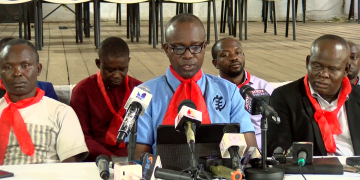
Addressing a press conference, the Minority Chief Whip, Frank Annoh-Dompreh, said the guidelines issued by the Ministry of Local Government and approved by Cabinet were inconsistent with the 2025 DACF Formula approved by Parliament.
He described the matter as “not a technical quarrel” but a constitutional and governance issue that threatens parliamentary authority and the integrity of decentralised development.
Citing Article 252 of the Constitution, Mr Annoh-Dompreh said only Parliament has the authority to determine the formula for sharing the Common Fund.
Parliament, he noted, approved a GH¢7.51 billion allocation for 2025 based on a data-driven formula that distributes funds according to equality, need and service pressure indicators.
However, he argued that the ministerial guidelines introduce fixed national expenditure percentages — including 25% for 24-hour economy markets, 10% for CHPS compounds, 10% for school blocks, 10% for boreholes, 10% for sanitation, 5% for administration and 20% for legacy projects — which do not appear in the parliamentary formula.
“These percentages are not supplementary. They are substitutive,” he said, adding that the Executive had overstepped its authority.
The Minority maintains that under Section 126(1) of the Local Governance Act, 2016 (Act 936), the Minister may issue guidelines to facilitate implementation but cannot redesign or override Parliament’s approved allocation structure.
Beyond the guidelines, the Minority also raised concerns about what it described as persistent underfunding and arrears in DACF transfers.
Mr Annoh-Dompreh referenced the Supreme Court ruling in Benjamin Komla Kpodo & Richard Quashigah v Attorney-General (2019), which held that not less than 5% of Ghana’s total revenue must be allocated to the DACF, as stipulated in Article 252(2) of the Constitution.
He claimed that transfers in recent years have fallen below the constitutional threshold and that arrears for 2024 alone amount to approximately GH¢7.33 billion.
According to him, delayed disbursements have led to stalled projects, unpaid contractors and weakened local governance structures.
He contrasted the situation with what he described as timely releases to other statutory funds, including the Ghana Education Trust Fund (GETFund) and the National Health Insurance Fund (NHIF), in early 2025.
The Minority called for the immediate withdrawal or revision of the 2025 DACF Guidelines to align strictly with Parliament’s approved formula.
It also proposed legislative amendments to the Public Financial Management Act to make DACF allocations an automatic first-line charge, mandatory quarterly reporting on revenue inflows and transfers, and a structured plan to clear arrears over a three-to-five-year period.
Additionally, the caucus urged stronger parliamentary oversight, greater transparency in DACF disbursements and administrative reforms within the Ministry of Finance to prevent what it termed “discretionary sequencing” of payments.
Mr Annoh-Dompreh said the Minority’s intervention was not opposition to development priorities but a defence of constitutional order and parliamentary supremacy in public finance.
“We are not opposed to development. We are opposed to illegality,” he said, adding that constitutional provisions must not be diluted by administrative directives.
Source: www.kumasimail.com