
















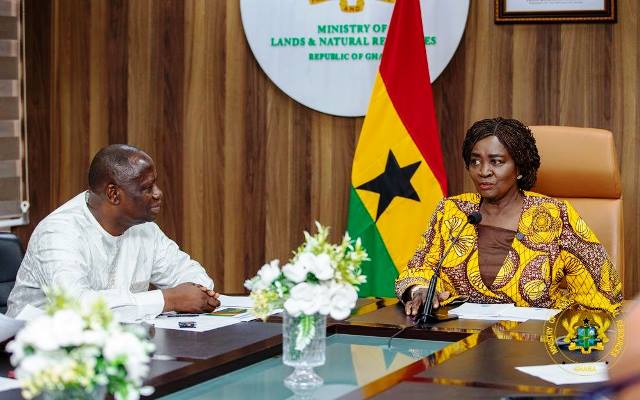
Vice President Professor Jane Naana Opoku-Agyemang has reaffirmed government’s full backing for the Ministry of Lands and Natural Resources, describing the protection of Ghana’s land, forests and water bodies as a matter of national survival rather than choice.


She gave the assurance on Tuesday, January 27, 2026, during a working visit to the Ministry, where she received a detailed briefing on the state of the sector and ongoing interventions to reverse environmental degradation caused largely by illegal mining.
“This fight is not only a moral obligation; it is about our survival as a nation. Protecting the environment is protecting ourselves,” the Vice President stressed.
The briefing revealed that as of early 2025, 41 out of 228 forest reserves had been invaded by illegal mining, particularly in the Ashanti, Western and Western North Regions, leading to severe land degradation and dangerously high turbidity levels in major water bodies—forcing the shutdown of some water treatment plants.
In response, government has rolled out a series of coordinated measures. In March 2025, the Tree for Life Reforestation Initiative was launched, targeting the planting of 30 million trees nationwide to restore degraded forests and lands. Joint operations by the Forestry Commission and security agencies have also led to the reclamation of nine “red zone” forest reserves previously occupied by armed illegal miners.
Additionally, over 1,000 excavators have been seized, with unregistered machines undergoing decommissioning and affected lands earmarked for reclamation.
Professor Opoku-Agyemang commended the Ministry for confronting the scale of destruction head-on, noting that leadership requires engaging directly with those implementing policy. “We are not somewhere far away receiving reports written by faceless people. We need to see the faces and understand the work being done,” she said.
She also highlighted Ghana’s global leadership in forest governance, following the country’s launch of the Forest Law Enforcement, Governance and Trade (FLEGT) licensing system in August 2025, making Ghana the first African country and only the second globally to issue EU-certified legal timber export licenses.
The Vice President further underscored the importance of digitisation and decentralisation in land administration, describing them as critical tools for improving access, transparency and accountability.
“Effective service delivery must go beyond Accra. Many of the problems we are trying to solve exist at the community level,” she noted, while calling for deliberate inclusion of women in land reforms. “If we consciously reserve portions of land banks for women, especially women farmers, they can significantly contribute to the economy.”
Earlier, the Minister for Lands and Natural Resources, Hon. Emmanuel Armah-Kofi Buah, outlined reforms across the lands, forestry and mining sub-sectors, emphasizing that sustainable natural resource management remains central to economic growth, food security and environmental protection.
“As custodians of Ghana’s lands, forests, minerals and wildlife, our responsibility goes beyond revenue generation—it is about safeguarding livelihoods today and for future generations,” the Minister said.
He disclosed that government is aggressively decentralising the Lands Commission to district levels, reviewing all public land allocations, and digitising land administration services to reduce bureaucratic delays and curb corruption. Several fraudulently acquired licenses, he added, have already been revoked under a tightened regulatory regime.
On water protection, the Minister pointed to the Blue Water Initiative, under which more than 1,600 trained water guards have been deployed nationwide to protect rivers and water bodies from illegal mining, supported by closer collaboration with the Ghana Geological Survey Authority and the Attorney-General’s Department.
The Vice President assured the Ministry of continued support from the highest levels of government. “We have your back and will support you every step of the way,” she said, urging staff to remain committed despite the challenges.
She concluded that while progress has been made, sustained discipline, coordination and political will are required to reclaim Ghana’s lands, protect its waters and restore environmental integrity.
Source: www.kumasimail.com