






































Samsung raised the ante in the foldable smartphone market on Tuesday with the introduction of the Galaxy Z TriFold.


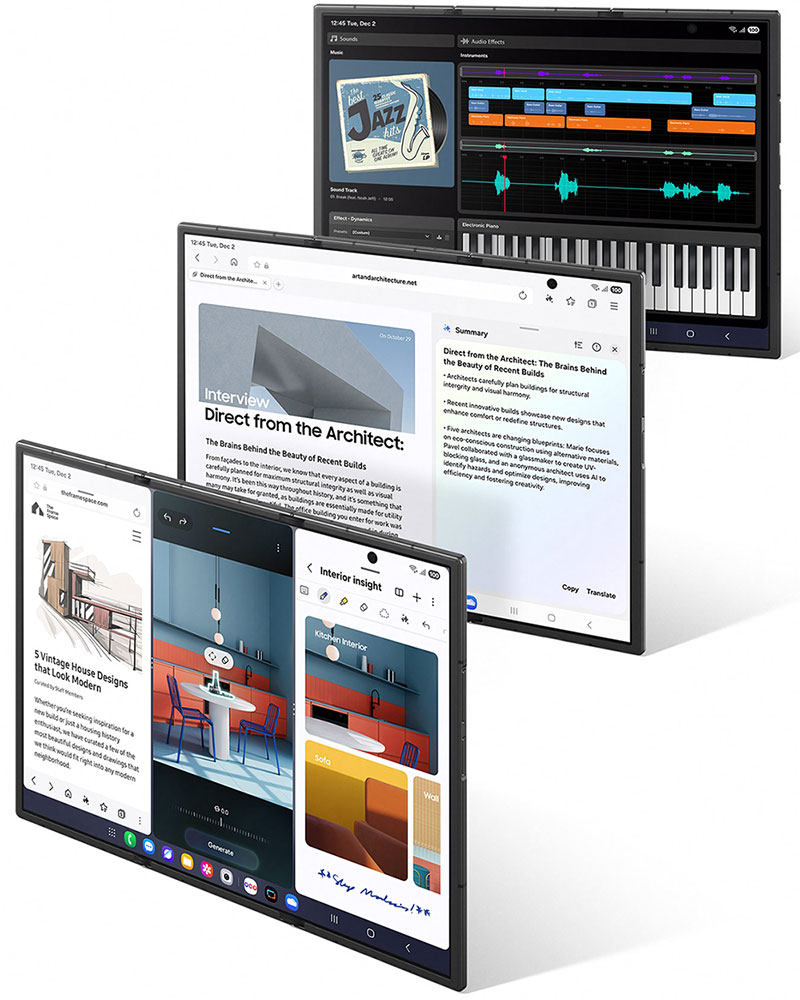
The three-panel phone folds out to create a 10-inch QXGA+ display (2160 x 1584) with a peak brightness of 1600 nits and a 120Hz refresh rate.
The phone’s two side panels fold inward to protect the main screen, and there’s an auto-alarm system that alerts a user when the device is being folded incorrectly.
The device can run three portrait-sized apps simultaneously — one in each panel — or a single app across all three panels. The phone also supports an external monitor.
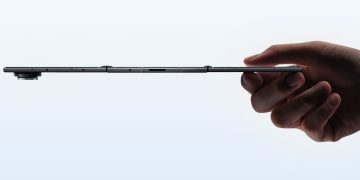
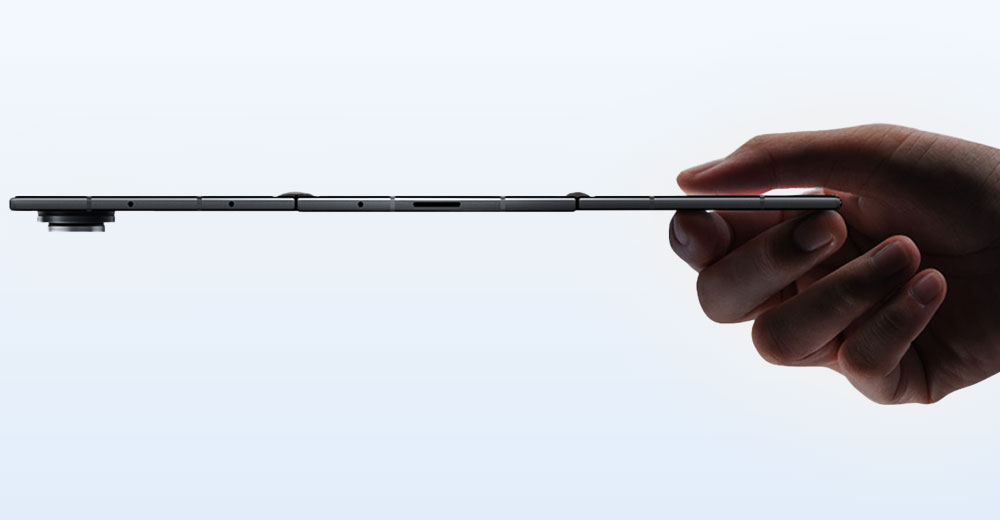
When folded, the phone is 12.9 mm thick. Unfolded, it’s 3.9 mm thick at its thinnest point. By comparison, an iPhone 17 Pro is 8.75 mm thick, and an iPhone Air, Apple’s thinnest phone, is 5.64 mm thick.
The phone, available only in black, will be offered with 16GB of memory and either 1TB or 512GB of storage. There is no MicroSD support.
Under the hood, the phone features a custom Snapdragon 8 Elite Mobile processor and a 5,600 mAh three-cell battery, with one cell in each display panel.
At the rear of the phone, there’s a 12MP ultra-wide camera, 200MP wide-angle snapper, and 10MP telephoto unit with 3x optical zoom and 30x digital zoom.
There are two 10MP cameras on the front of the unit — one on the screen cover and one on the main screen.
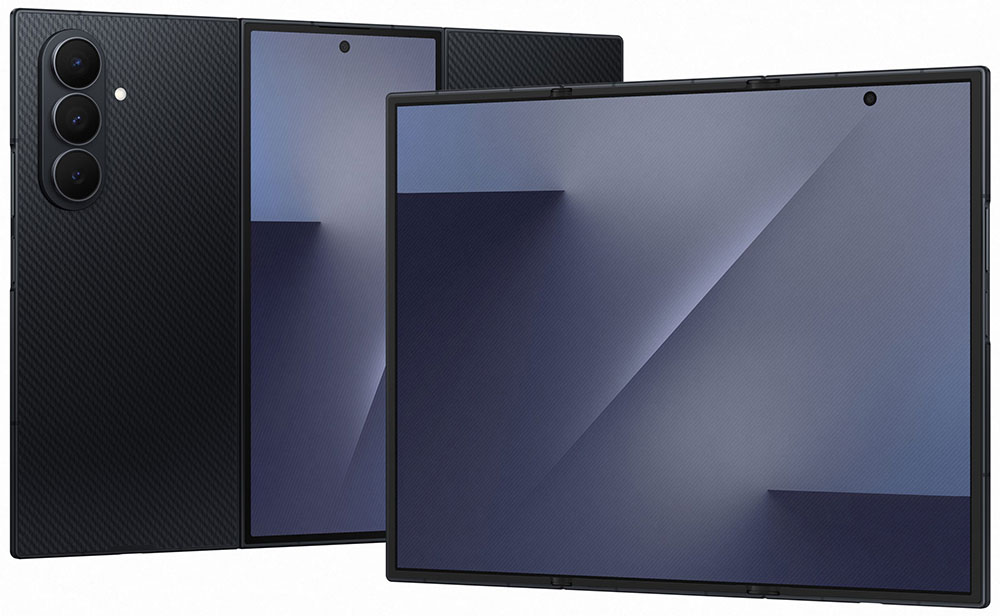
Samsung calls the TriFold its most advanced foldable, pairing a redesigned dual-hinge system with a reinforced display and stronger exterior materials, including a titanium hinge housing and Advanced Armor Aluminum frame. It will debut in Korea on Dec. 12 before rolling out to other markets, including the United States. The phone will reportedly sell for $2,440.
Better Replacement Device
A tri-fold smartphone is an overall better two-in-one device than a bi-fold, explained Kristen Hanich, director of research at Parks Associates, a market research and consulting company specializing in consumer technology products, in Dallas.
“The design allows the user to more easily access the device in its phone form-factor, while also supporting a larger tablet screen when unfolded,” she told TechNewsWorld. “It’s better as a phone replacement and better as a tablet replacement.”
A tri-fold lets you carry something that behaves like a 10-inch tablet in a pocketable phone footprint, noted Mark N. Vena, president and principal analyst at SmartTech Research, a technology advisory firm, in Las Vegas.
“It gives power users more room for side-by-side apps, content creation, and productivity than even today’s book-style foldables,” he told TechNewsWorld. It is less about basic phone tasks and more about replacing your secondary device.
Tri-folds also have benefits for the approximately 34 million American users of reading glasses. The larger screen allows you to enlarge the typeface and still get a lot of words on the same screen, explained Rob Enderle, president and principal analyst with the Enderle Group, an advisory services firm, in Bend, Ore.
“It is also better for video content for those who travel a lot,” he told TechNewsWorld. “And it is still unique enough to convey a bit of status, since tri-folds are relatively rare.”
Niche Market
Tim Bajarin, president of Creative Strategies, a technology advisory firm, in San Jose, Calif., maintained that the market has not shown any demand for tri-fold smartphones. “The Galaxy TriFold is designed to show off Samsung’s design prowess and innovation,” he told TechNewsWorld.
The challenge with the foldable phone market is that there isn’t a killer app, or a suite of apps, that delivers high enough value for these devices to be adopted by a large segment of users, contended Tuong Huy Nguyen, director analyst for emerging technologies and trends at Gartner, a research and advisory company based in Stamford, Conn.
“The challenge for the foldable market isn’t a technical [or] engineering challenge. It’s a market challenge,” he told TechNewsWorld. “What content, apps, and services are available to support it, and are they high-value enough? Foldables are lacking an ecosystem to support them in a way that’s unique to this form factor.”
“Until foldable phones come down in price substantially, or deliver utility and value that justify their cost, they will continue to be a niche product,” he said.
Bajarin acknowledged that foldable phones are a niche at the moment, but argued that they could change rapidly. If Apple decides to bring out a folding iPhone and bless this category, the potential for demand for folding smartphones could rise significantly, he predicted.
“Apple will not release a folding smartphone unless it has the technology perfected to Apple’s standards,” he added. “But if and when they do bring one to market, Apple’s marketing and innovation engine will kick in, and interest in this category will be heightened.”
Apple’s Edge With Developers
In addition to marketing prowess, Apple could bring something else to the foldable table. Developers have historically been more willing to update their software to take better advantage of Apple’s hardware, explained Ross Rubin, the principal analyst at Reticle Research, a consumer technology advisory firm, in New York City.
“We saw that over many years with the iPad, where apps that had originally been iPhone apps were optimized more for the iPad than Android phone apps were for Android tablets,” he told TechNewsWorld.
He added that Samsung’s timing of the TriFold introduction is also interesting. Samsung is coming out with this larger phone surface at the same time that Google is looking at merging Android and elements of Chrome OS. A large part of that would be better support for larger screens.
“There is a perception that Apple is behind the proverbial eight ball in the foldable space because Samsung now has book-style, flip-style, and tri-fold hardware on the market while Apple is still all-in on slabs,” added SmartTech’s Vena. “Strategically, though, Apple tends to wait until it can solve durability, thickness, and app experience in a way that feels invisible to users.”
“The bigger question is whether customers will still care about foldables by the time Apple finally jumps in,” he added. “Interestingly, I contend that Samsung wants Apple to jump into the category to validate foldable phones with the consequence that ‘a rising tide lifts all boats.’”
Tablet Cannibals
Vena asserted that tri-folds are less about chasing a gimmick and more about testing the upper limits of the phone as a primary computer. The real unlock will come when software and AI actually exploit the extra canvas with smarter multitasking, not just bigger icons, he said. In the meantime, this category will be a fascinating test bed for what next-generation mobile devices look like.
“I carry a Google Pixel Fold 10 and have used foldable phones since the Microsoft Duo came out,” Enderle noted. “I don’t think I could go back to a non-foldable phone.”
“However,” he continued, “a tri-fold may be a bridge too far for me, both because of cost and because in a tri-fold the flexible screen is more exposed than a dual-fold and has more mechanical vulnerability.”
Foldables aren’t for everybody, maintained Anshel Sag, a senior analyst for mobility, 5G and XR at Moor Insights & Strategy, a technology analyst and advisory firm based in Austin, Texas.
“I think they are an ultra-premium niche today that will eventually cannibalize even more of the tablet market than foldables have to date,” he told TechNewsWorld. “I personally almost never use a tablet, but having a foldable has become central to my daily use.”
Parks’ Hanich added: Tri-folds are an exciting development in mobile computing, serving as both a smartphone and tablet replacement — and potentially a laptop replacement, as well.
Source: The images featured in this article are credited to Samsung