






























The Eastern Region is being positioned as a major production and export hub under the government’s 24-Hour Economy and Accelerated Export Development Programme, with investments planned across agriculture, agro-processing, manufacturing, transport and tourism.


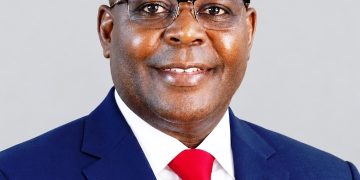
Presidential Adviser on the 24-Hour Economy and Accelerated Export Development, Goosie Augustus Obuadum Tanoh, said the region could become one of the key anchors of Ghana’s second wave of industrialisation by connecting local production centres to domestic and regional markets.
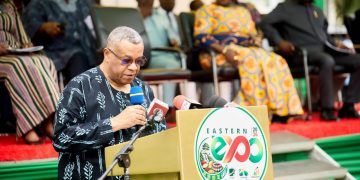
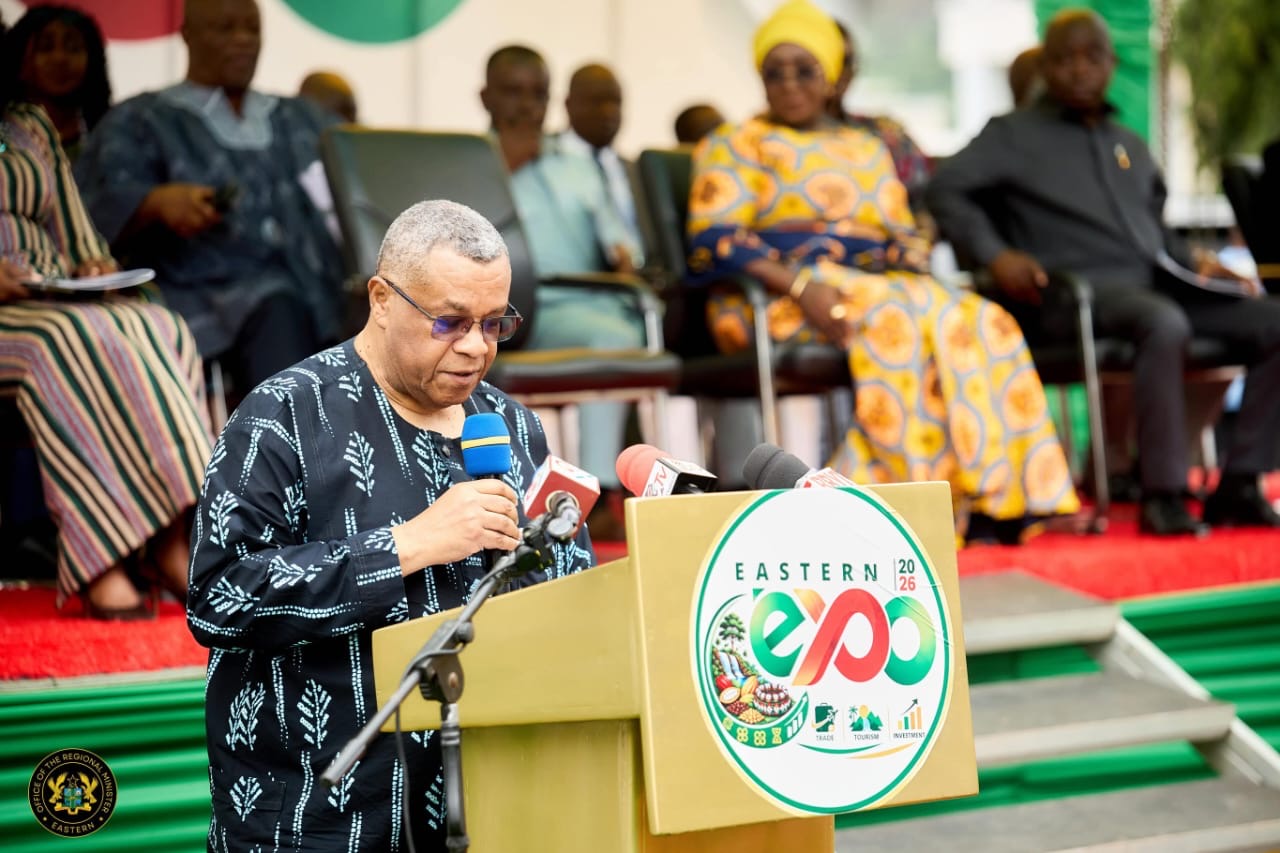
Speaking on behalf of President John Dramani Mahama at the opening of the Eastern Expo 2026 in Koforidua, Mr. Tanoh said the strategy was aimed at changing Ghana’s longstanding dependence on the export of raw materials by expanding domestic processing and manufacturing.
“For a hundred years, we sold cocoa and bought back chocolate. We sold timber and bought back furniture. The 24H+ Programme is ending that pattern,” he said.
Eastern Region at centre of production corridor
Mr. Tanoh identified the Volta Economic Corridor as a major component of the government’s industrialisation strategy.
The corridor covers 75 districts, including 10 in the Eastern Region, and is expected to connect production areas such as Kwahu Afram Plains, Asuogyaman, Manya, Kwahu East and Kwahu South, Fanteakwa and Yilo Krobo to major markets.
He said improved roads, rail and water transport would be critical to reducing the cost of moving agricultural and industrial goods.
The new railway connection to Mpakadan, together with the Volta Lake Transport System, is expected to provide an alternative route for transporting goods from production communities to markets and rail connections.
According to Mr. Tanoh, transporting goods by water could reduce freight costs by as much as 60 percent. He cited fish from Asuogyaman and yam from the Afram Plains as examples of commodities that could reach Accra at lower costs through improved water transport.
The planned Accra-Kumasi Expressway is also expected to strengthen the region’s role as a production and trade corridor, with proposed interchanges at Adeiso, Asamankese, Akyem Oda and Ofoase.
Afram Plains to host three industrial parks
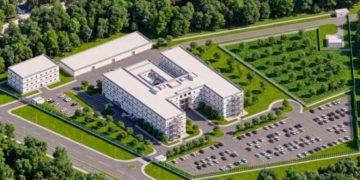
The Kwahu Afram Plains is expected to become a major centre for agro-industrial development, with three industrial parks being developed under the 24H+ Programme.
Mr. Tanoh said GB Foods, producers of Gino and Pomo tomato products, would anchor a food and beverage industrial park and provide a ready market for locally produced tomatoes.
He said the development could help reduce post-harvest losses while encouraging farmers to increase production.
Pilot farms operated by GB Foods, he noted, had increased tomato yields from approximately seven tonnes per hectare to 20 tonnes per hectare.
Two additional agroecological parks are expected to be anchored by Pitiku and Africa Golden Foods, while Koforidua has been identified as a potential centre for regional garment manufacturing.
From raw materials to finished products
Mr. Tanoh said the 24H+ initiative was not simply about keeping factories open during the night. Rather, it was intended to remove the constraints that prevent businesses from increasing production.
He identified reliable and affordable electricity, efficient supply chains, access to raw materials, safe transportation for night workers, working capital and skilled labour as essential requirements.
Access to larger markets, including the African Continental Free Trade Area, would also be necessary for companies to expand from one production shift to two or three shifts.
The government has set a target of reducing unemployment to below five percent by 2035 while increasing manufacturing’s contribution to the national economy from about 10 percent towards 20 percent, Mr. Tanoh said.
Tourism also part of 24H+ strategy
Beyond agriculture and manufacturing, tourism is expected to form part of the Eastern Region’s 24H+ economic activities.
Mr. Tanoh described tourism as an export that generates income for local businesses and communities.
He cited attractions including Boti Falls, Umbrella Rock, Aburi Gardens, Krobo bead-making, Asesewa kente weaving, the Kwahu paragliding festival, the Atewa Range and the Bunso Arboretum.
Under the SHOW24 initiative, he said, the government would work with stakeholders in the region to improve tourism sites, access roads and related services.
Communities to retain land ownership
The government also plans to introduce a land-partnership model under which communities providing land for industrial and other investments would retain ownership while receiving rent and dividends from projects established on their lands.
Mr. Tanoh encouraged investors to provide capital, technology and expertise while partnering with Ghanaian businesses and sourcing raw materials from local farmers.
He said the Eastern Region had more than 1.5 million people of working age who could benefit from the expansion of factories, industrial parks and tourism enterprises.
The long-term vision, he said, was to process tomatoes in Kwahu rather than lose them after harvest, manufacture garments in Koforidua for markets including Abidjan and Lagos, and move agricultural produce from the Afram Plains through the Volta Lake to rail connections at Mpakadan and eventually to the ports.
Private sector critical to transformation
Mr. Tanoh stressed that the government alone could not deliver the proposed economic transformation.
“Government can build the corridor, the parks and the roads. Government cannot farm a hectare, process a tonne, sew a garment, host a visitor or run a night shift,” he said.
He said farmers, producers and entrepreneurs would ultimately drive production, while the government’s responsibility was to create the infrastructure and economic conditions needed to make businesses competitive.
Mr. Tanoh subsequently declared the Eastern Expo 2026, which began on September 26 and ends on October 3, officially opened on behalf of President Mahama.
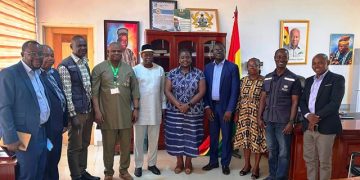
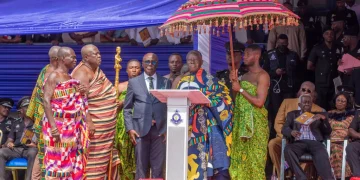
The launch was attended by Minister for Tourism, Culture and Creative Arts Abla Dzifa Gomashie; Deputy Minister of Trade Sampson Ahi; Eastern Regional Minister Rita Akosua Adjei Awatey; Presidential Adviser on the Economy Seth Tekper, who represented the Chief of Staff; Omanhene of New Juaben, Daasebre Kwaku Boateng III; and Kwahumanhene Daasebre Akuamoah Agyepong II, who chaired the occasion.
Source: www.kumasimail.com