







































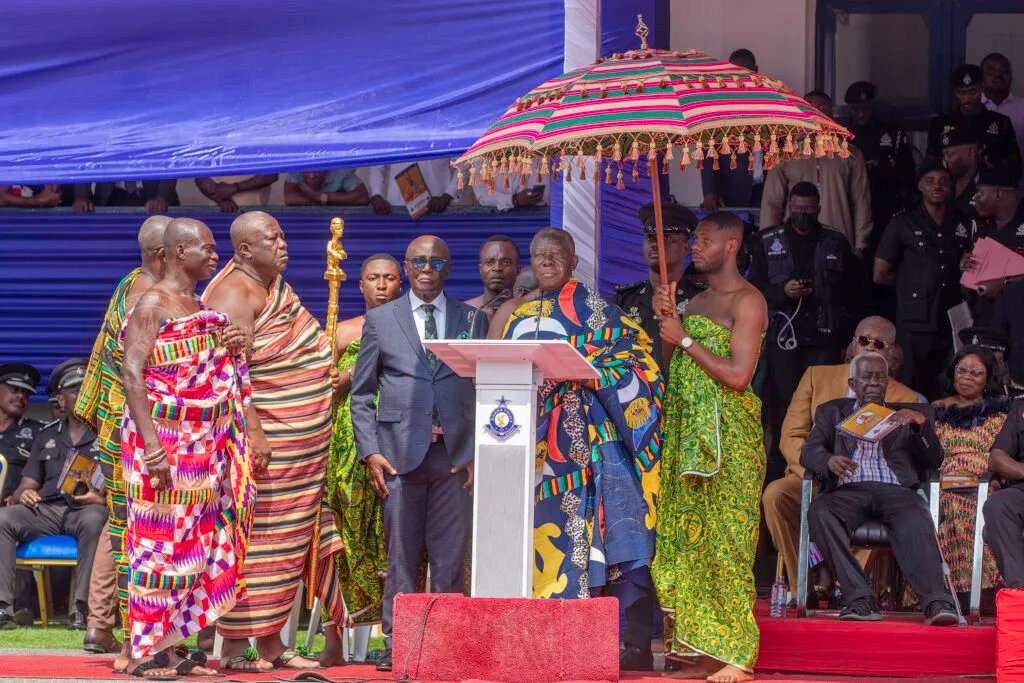
The Asantehene, Otumfuo Osei Tutu II, has called on the Ghana Institute of Management and Public Administration (GIMPA) to strengthen its commitment to ethical leadership, inclusive digital transformation and institutional reforms to address the country’s evolving governance and development challenges.


He said the institution must move beyond its established reputation for academic excellence and position itself as a leading national centre for practical research, policy development and the training of transformational leaders.
Delivering an address as guest speaker at GIMPA’s anniversary celebration, the Asantehene emphasised that the future of the institution must be built on the values of integrity, innovation, collaboration and service to the common good.
According to him, the rapid advancement of technology presents significant opportunities for national development but also creates the risk of deepening existing inequalities if access to digital infrastructure, education and services is not made inclusive.
He observed that the economic cost of digital participation remains beyond the reach of many people, making deliberate investment in infrastructure, education and accessible digital services necessary.
“We must ensure that the benefits of technology reach our farmers, traders, artisans, teachers and health workers, particularly those in rural communities,” he stated.
Otumfuo cautioned against a situation in which technological advancement creates a divide between people who have access to digital opportunities and those who are left behind.
“A truly digital Ghana must not become a nation divided between those who are connected and those who are forgotten. Rather, it must be a nation in which technological advancement becomes an instrument of shared progress,” he added.
Education must drive digital inclusion
The Asantehene, drawing on his commitment to education through the Otumfuo Education Fund and the Otumfuo Foundation, described education as one of the most powerful instruments for transforming individuals, families and communities.
He said his experience had demonstrated how educational opportunities could change the circumstances of individuals and entire communities, stressing that the same principle must inform Ghana’s approach to digital development.
He urged policymakers and educational institutions to ensure that technological advancement does not come at the expense of vulnerable communities but instead creates opportunities for broader participation in national development.
On higher education, Otumfuo said universities and professional institutions must reconsider their traditional approaches to teaching and learning to prepare graduates for an increasingly unpredictable and technology-driven world.
He argued that educational institutions could no longer focus solely on transmitting established knowledge but must equip students with critical thinking, problem-solving, interdisciplinary collaboration and adaptability.
According to him, graduates must also recognise that learning does not end with the award of a degree, as changing technologies and professional demands require continuous learning and skills development.
He identified this as an opportunity for GIMPA to strengthen its historic mandate of professional development by equipping public servants, business executives and institutional leaders with the competencies needed to respond effectively to emerging challenges.
Calls for integrity in public service
Beyond technological advancement and professional competence, the Asantehene stressed the importance of character and integrity in leadership and public administration.
He warned that technological sophistication and professional qualifications would have little value if dishonesty, indiscipline and corruption became accepted practices within public institutions.
“No amount of technological sophistication can compensate for dishonesty and indiscipline,” he stated.
Otumfuo maintained that public service must be treated as a position of trust, urging public officials to prioritise competence over personal connections, service over privilege and national interest over personal advantage.
He noted that the effectiveness of public institutions depended not only on the technical knowledge of their managers but also on their integrity and willingness to place the common good above personal interests.
He therefore challenged GIMPA to make ethical and transformational leadership central to its institutional development and training programmes.
Challenges GIMPA to deepen research and collaboration
As part of his recommendations for the institution’s future, the Asantehene outlined several priority areas he believes should guide GIMPA’s next phase of development.
These include the development of ethical and transformational leaders, strengthening public administration through practical research and institutional reforms, promoting digital governance and responsible innovation, and advancing inclusive development.
He also called for stronger partnerships among government, industry, academia, traditional institutions and international organisations.
According to him, the challenges confronting modern societies have become too complex for individual institutions to address independently, making collaboration, knowledge-sharing and the pooling of expertise essential.
He urged universities and other institutions to move beyond institutional isolation and embrace partnerships that would generate practical solutions to national and global challenges.
“GIMPA must continue to position itself not only as a centre of academic excellence but also as a national institution capable of providing practical solutions to the challenges of governance and development,” he said.
He further stressed that the institution’s research must inform public policy, its graduates must contribute to improving public and private institutions, and its leadership must exemplify the standards of integrity and excellence it seeks to promote.
He added that GIMPA’s reputation should be measured not only by its academic standing but also by the quality of its administration, the integrity of its processes and the tangible impact of its work on society.
Calls for preservation of GIMPA’s legacy
Reflecting on the anniversary theme, “The Legacy of Excellence, the Future of Digital Transformation,” Otumfuo said the two concepts should be viewed as complementary responsibilities rather than separate ambitions.
He explained that the institution’s legacy provides the values, experience and foundations upon which its future must be built, while digital transformation offers opportunities to expand its relevance and impact.
He cautioned that technology without values could produce efficiency without justice, while tradition without renewal could preserve institutions that gradually lose their relevance.
He therefore urged GIMPA to preserve what is valuable, reform what is inadequate, embrace beneficial innovations and reject practices that undermine human dignity and the common good.
Drawing on the Asante understanding of inheritance, the King said institutions must recognise that preserving a legacy requires more than celebrating past achievements.
He explained that an inheritance must be protected, strengthened and handed over to future generations in better condition.
Applying this principle to GIMPA, he said the institution had inherited decades of academic and institutional achievements, a distinguished reputation and the confidence of generations of public servants, professionals and national leaders.
He challenged its leadership and stakeholders to ensure that future generations inherit an institution that is stronger, more relevant and more respected.
Looks ahead to GIMPA’s centenary in 2061
The Asantehene also turned attention to GIMPA’s centenary, expected in 2061, observing that the world would have undergone significant technological and social changes by then.
He said new technologies, emerging governance challenges and opportunities would undoubtedly reshape the global landscape, making the decisions taken by current leaders particularly important.
He challenged the institution’s present leadership to make choices that would serve the interests of future generations and create opportunities beyond what can be fully imagined today.
“What future generations will say about the decisions we make today” should remain an important consideration in the institution’s planning and development, he suggested.
He urged the GIMPA community to allow past achievements to inspire present responsibilities and ensure that today’s decisions become the foundation for a greater future.
Concluding his address, Otumfuo congratulated GIMPA on its years of service to Ghana and humanity, expressing the hope that the institution would continue to grow in wisdom, breadth and excellence.
He said its contribution to leadership, governance and national development should become even greater in the years ahead.
Source: www.kumasimail.com