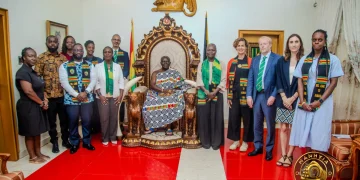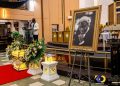









































Asantehene Otumfuo Osei Tutu II has paid his final respects to the late Omanhene of the Agogo Traditional Area, Nana Kwame Akuoko Sarpong II, during the traditional funeral rites in Agogo in the Ashanti Region.


Otumfuo, on Wednesday night, November 25, 2026, led an array of traditional rulers to the Dɔte Yie of the late Agogomanhene, where rich Asante cultural traditions were observed in honour of the departed chief.
The Asantehene solemnly filed past the mortal remains of Nana Akuoko Sarpong, who died on March 26, 2026, at the age of 87, bringing to an end more than five decades of traditional leadership.
The funeral rites, which began on November 24 and are scheduled to conclude on November 26, have drawn traditional rulers, political leaders, government officials, family members and other mourners from across the country to Agogo to celebrate the life and legacy of the revered chief.
Nana Akuoko Sarpong ascended the Agogo stool in 1975 and reigned for 51 years, making him one of the longest-serving traditional rulers in the area.
Beyond his traditional leadership, he was a lawyer, politician and statesman who served Ghana in several important public positions.
During the Provisional National Defence Council (PNDC) era, he served as Secretary for Health, Secretary for Internal Affairs and Secretary for Chieftaincy Affairs, contributing to public administration and national governance.
He was also a Member of Parliament for Asante-Akim North during the Third Republic and later served on the Council of State under the Fourth Republic during the administration of the late President John Evans Atta Mills.
His political and public service career was closely associated with the political tradition that evolved into the National Democratic Congress (NDC).
His death was widely regarded as the end of an era in Agogo and Asanteman, given his decades of service to traditional leadership and national development.
The three-day Dɔte Yie provides an opportunity for the people of Agogo, Asanteman and the wider Ghanaian community to honour the late Omanhene and celebrate his contributions to chieftaincy, governance and the development of his traditional area.
Otumfuo’s presence at the funeral underscores the significance of the late chief’s place in Asante traditional leadership and the enduring bonds among traditional authorities within the kingdom.
Source: www.kumasimail.com