




































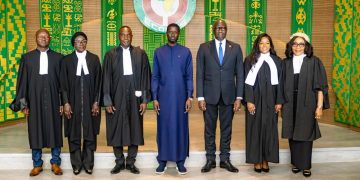





The question of who should lead Ghana’s Judiciary is one that deserves serious national discussion. At a time when public confidence in state institutions, judicial independence and accountability remain critical to our democracy, the choice of the next Chief Justice must be guided by competence, integrity, experience and a clear vision for reform.


Justice Senyo Dzamefe is a name worthy of consideration in this conversation.
With decades of experience in the legal profession and service at various levels of the Judiciary, Justice Dzamefe brings considerable judicial experience to the table. His career, which has taken him through the High Court, Court of Appeal and Supreme Court, provides a foundation for considering his suitability for the highest judicial office in Ghana.
But the question is not simply whether Justice Dzamefe has the experience. The bigger question is whether he possesses the leadership qualities required to guide Ghana’s Judiciary through the challenges confronting it today.
GHANA NEEDS A CHIEF JUSTICE WHO CAN RESTORE AND STRENGTHEN PUBLIC CONFIDENCE
The Judiciary is one of the pillars of our constitutional democracy. It must be independent, impartial and accessible to every Ghanaian, regardless of political affiliation, social status or financial standing.
A Chief Justice must therefore be someone who can inspire confidence in the courts, ensure that justice is not delayed unnecessarily, and demonstrate that the law applies equally to the powerful and the ordinary citizen.
Justice Dzamefe’s experience places him in a position to understand the institutional challenges confronting the Judiciary. If given the opportunity to lead, Ghanaians would expect him to translate that experience into practical reforms that improve the administration of justice.
THE NEED FOR JUDICIAL REFORMS
One of the persistent concerns about Ghana’s justice delivery system is the delay in resolving cases. For many citizens, the cost of litigation, prolonged court proceedings and difficulties accessing legal services remain significant barriers to justice.
The next Chief Justice must be prepared to confront these challenges through effective case management, greater use of technology, improved court infrastructure and stronger administrative accountability.
Justice Dzamefe would need to demonstrate that his leadership can move the Judiciary beyond discussions about reform towards measurable improvements in how quickly, fairly and efficiently cases are handled.
The objective must be simple: justice should not become a privilege reserved for those who can afford to wait or pay.
INDEPENDENCE MUST BE MORE THAN A SLOGAN
Perhaps the most important test for any Chief Justice is the ability to protect the independence of the Judiciary.
In Ghana’s politically competitive environment, court decisions involving elections, public appointments, constitutional disputes and government actions can attract intense scrutiny. The Chief Justice must ensure that judges can perform their duties without fear, favour or political pressure.
Justice Dzamefe, like any other candidate for the position, must be judged by his record, professional conduct, demonstrated independence and commitment to the Constitution.
No political party should determine who the Chief Justice serves. His or her ultimate responsibility must be to the Constitution, the law and the people of Ghana.
SHOULD SENIORITY DETERMINE WHO BECOMES CHIEF JUSTICE?
This is another important issue in the debate.
While experience and seniority matter, they should not automatically be the only considerations. Leadership ability, integrity, administrative competence, sound judgment and a willingness to reform the justice delivery system must also be examined.
The selection process must be transparent, constitutionally compliant and capable of commanding public confidence. Justice Dzamefe should neither be dismissed without fair consideration nor declared the best candidate merely because of his professional credentials.
Ghanaians deserve a serious assessment of the available candidates based on evidence and merit.
THE FINAL QUESTION: WHY JUSTICE SENYO DZAMEFE?
The case for Justice Dzamefe rests on his judicial experience, familiarity with the legal system and the potential to contribute to the reforms Ghana needs. These are legitimate reasons to consider him.
However, the real test will be whether he can protect judicial independence, improve access to justice, reduce delays in court proceedings and strengthen public trust in the institution he would lead.
Ultimately, Ghana does not merely need a new Chief Justice. It needs a Chief Justice who can make the Judiciary more effective, more accountable, more independent and more responsive to the constitutional rights of the people.
If Justice Senyo Dzamefe can demonstrate that he is the person capable of delivering these outcomes, then his candidature deserves serious consideration.
The debate must, however, remain rooted in merit, evidence and constitutional principles rather than partisan interests.
DOK CASH WRITES: The next Chief Justice must not be chosen simply because of who he is, whom he knows or which interests support him. The person must be chosen because he has the character, competence and courage to defend the Constitution and ensure that justice remains the foundation of our democracy.
Disclaimer: This is an opinion piece, not an announcement of an official nomination or appointment. The arguments presented are considerations for public debate and should not be interpreted as a verified endorsement by any judicial or constitutional authority.