








































For decades, Ghana’s natural resource economy has followed a familiar pattern: extracting raw minerals for export while importing finished products at a higher cost.


In the aluminium value chain, the absence of a domestic alumina refinery has remained a significant gap between the country’s bauxite reserves and its ambition to build an integrated aluminium industry.
That gap could begin to close following a landmark financing arrangement between Ghana Bauxite Company Limited (GBC) and Ecobank Ghana PLC, under which Ecobank will structure and syndicate up to $250 million in financing to support the development of Ghana’s bauxite and aluminium sector.
The deal represents a significant step towards strengthening domestic mineral processing, expanding industrial capacity and retaining more value from Ghana’s natural resources. It also places renewed attention on the strategic role of the Awaso bauxite mine in the country’s long-term industrialisation agenda.
Awaso at the Centre of the Transformation
At the heart of the initiative is GBC’s historic bauxite mine at Awaso, where increased production is expected to support the next phase of the company’s development.
Under the leadership of Isaac Ofori-Poku, Executive Chairman of GBC and Chairman of the IOP Group, the mine has undergone a significant operational turnaround, supported by investments in modern surface-mining technology and improved production capacity.
According to the figures provided by the company, bauxite exports increased from 773,213 metric tonnes in 2022 to nearly 2.07 million metric tonnes in 2025. The growth reflects a substantial expansion in the mine’s output and strengthens the case for further investment in the infrastructure needed to sustain production.
The proposed financing is expected to support critical improvements in material-handling infrastructure, transport logistics and operational efficiency. These upgrades are intended to reduce bottlenecks, improve the movement of ore and help keep production costs competitive in international markets.
For GBC, the immediate priority is to consolidate the gains made at Awaso. The broader objective, however, is to establish the operational and financial foundation for a more integrated aluminium industry in Ghana.
The Missing Link: A Domestic Alumina Refinery
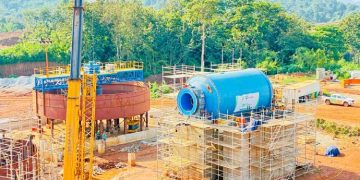
While expanding bauxite production is important, the proposed development of an alumina refinery at Awaso represents the more transformative element of the plan.
Bauxite is the principal ore used to produce alumina, which is then processed into aluminium metal through smelting. Without sufficient domestic refining capacity, countries that export raw bauxite risk losing opportunities to capture additional value through processing, industrial development and related services.
The IOP Group’s refinery proposal is intended to address this gap by introducing alumina production closer to the source of the raw material.
The planned facility is expected to have an initial production capacity of 500,000 metric tonnes of alumina annually, with a long-term target of 1.5 million metric tonnes. If realised, the project could significantly expand Ghana’s domestic mineral-processing capacity and create a stronger link between bauxite mining and downstream aluminium production.
Metallurgical evaluations are ongoing to determine the most appropriate processing methods for the different ore grades found at Awaso. These assessments will be important in identifying suitable technologies, improving recovery rates and determining how best to maximise the long-term potential of the deposits.
The refinery’s development will also depend on the successful completion of technical, financial and infrastructure planning. Nevertheless, the proposed capacity targets signal the scale of the industrial ambition behind the initiative.
African Capital for African Industrialisation
Beyond its financial value, the GBC-Ecobank arrangement highlights the role of African financial institutions in mobilising capital for large-scale industrial projects.
Speaking at the signing ceremony, Mr Ofori-Poku emphasised the importance of local leadership in Africa’s industrial transformation. He noted that Ghanaian enterprises possess the technical competence to manage complex industrial infrastructure and contribute meaningfully to the development of strategic sectors.
His remarks reflect a broader argument that Africa’s industrial future should be shaped not only by its natural resource endowment but also by its capacity to develop, finance and operate the industries that convert those resources into higher-value products.
Abena Osei-Poku, Managing Director of Ecobank Ghana PLC, similarly underscored the responsibility of African financial institutions to support the continent’s economic development by financing businesses and projects capable of driving sustainable growth.
Ecobank’s role in structuring and syndicating up to $250 million in financing could help mobilise the resources required to support GBC’s expansion plans. The arrangement also illustrates how domestic and regional financial institutions can contribute to industrial development by connecting investment capital with strategic economic opportunities.
Jobs, Investment and Economic Value
The potential benefits of the initiative extend beyond mining and refining. An expanded bauxite operation and a future alumina refinery could create employment opportunities across mining, engineering, transport, equipment maintenance and industrial services. The development could also stimulate demand for local suppliers and contractors, while attracting further investment into supporting infrastructure.
More importantly, domestic alumina production could enable Ghana to capture a greater share of the value generated along the aluminium supply chain.
For a country seeking to diversify its economy, strengthen exports and reduce its dependence on imported manufactured goods, the ability to process minerals locally offers an opportunity to deepen industrial capacity and develop specialised technical skills.
However, these benefits will depend on effective project execution, reliable infrastructure, competitive energy costs, environmental safeguards and the creation of strong linkages with local businesses. The refinery’s eventual contribution to the economy will also depend on its commercial viability and ability to operate efficiently over the long term.
The proposed development therefore represents both an opportunity and a substantial undertaking, requiring sustained investment, technical expertise and careful implementation.
A New Chapter for Ghana’s Aluminium Ambitions
The partnership between GBC and Ecobank comes at a time when the question of how Ghana can derive greater economic value from its natural resources remains central to its industrial development agenda.
By combining expanded bauxite production with plans for domestic alumina refining, the initiative seeks to move the country beyond the traditional model of exporting raw materials towards a more integrated approach to mineral development.
The immediate focus is on strengthening operations at Awaso and improving the infrastructure needed to support growth. The longer-term ambition is more far-reaching: to establish the foundations of a domestic aluminium value chain capable of supporting industrial investment, job creation and increased economic value retention.
The proposed $250 million financing arrangement is an important step in that direction, although the full impact will depend on how successfully the funding is mobilised and the planned projects are delivered.
If the refinery and associated infrastructure developments materialise as envisaged, Awaso could become a pivotal centre in Ghana’s effort to transform its bauxite resources into a broader industrial asset.
For Ghana, the significance of the initiative lies not simply in producing more bauxite, but in building the capacity to process more of it at home. That shift could help redefine the country’s relationship with its mineral wealth and bring its long-standing ambition of an integrated aluminium industry closer to reality.
Source: www.kumasimail.com