







































Ghana will prohibit commercial rice imports by 2030 under an ambitious agricultural transformation programme that will progressively restrict import licences and compel public institutions to prioritise locally grown food.


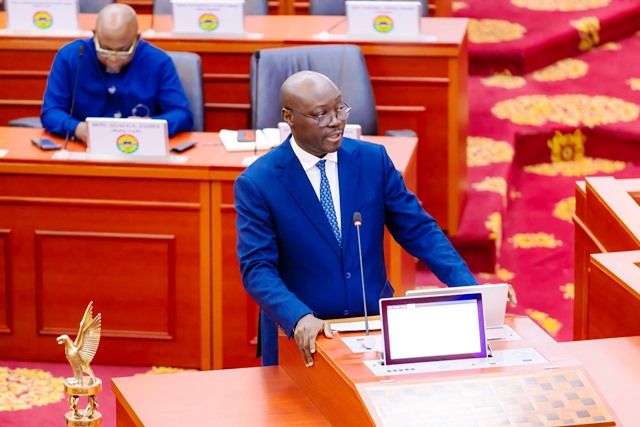
Finance Minister Dr Cassiel Ato Forson announced the policy on Thursday, November 12, when he presented the 2027 Budget Statement and Economic Policy to Parliament, outlining a US$3 billion investment in commercial agriculture under the government’s four-year New Economy programme.
Under the proposed arrangement, rice import licences will be tied to purchases from verified Ghanaian farmers and millers beginning in 2027, with the proportion of local purchases expected to increase as domestic production expands.
The government intends to progressively reduce import quotas before completely prohibiting commercial rice imports by 2030.
Dr Forson said the policy would be supported by investments in domestic production, milling, storage, quality assurance and distribution to ensure that the country does not create food shortages while restricting imports.
The announcement represents one of the most consequential interventions in the budget’s agricultural pillar, with significant implications for rice farmers, importers, millers, consumers and businesses across the food supply chain.
The government is also proposing amendments to public procurement laws to require schools, hospitals and other public institutions to purchase only foodstuff grown in Ghana using public funds.
This means government-funded rice purchases for school feeding programmes, hospitals and other public institutions would increasingly become a guaranteed market for domestic producers.
To support the transition, the budget provides for the establishment of Rice Development Hubs in the Afram Plains, Volta Basin, Western Ghana and Northern Ghana.
These hubs are expected to bring an additional 100,000 hectares of land under rice cultivation, with targeted yields of five to six metric tonnes per hectare.
The government projects that the initiative could support approximately 125,000 jobs.
The hubs will be organised around irrigation, mechanisation, silos, modern milling facilities, packaging and logistics, while targeted tax incentives will cover investments in these areas.
The intervention is part of a wider agricultural strategy that also targets sugar, poultry, maize and soya feed, aquaculture, oil palm, vegetables and cocoa value addition.
Dr Forson said Ghana spends billions of dollars annually importing food and agricultural products that could be competitively produced locally, weakening the cedi and exposing the economy to external price shocks.

However, the proposed rice import prohibition raises important questions about whether domestic production can expand quickly enough to meet national demand without creating shortages or pushing prices upwards.
The success of the policy will depend on farmers having access to affordable financing, improved seeds, irrigation, machinery, reliable markets and adequate storage facilities.
It will also require domestic rice millers to consistently meet quality standards and compete with imported varieties in terms of price and consumer preference.
For consumers, the ultimate test will be whether the shift towards local rice production delivers affordable and quality rice rather than simply restricting the supply of imported alternatives.
The government says its objective is to ensure that public spending supports Ghanaian farmers, creates domestic employment and reduces the country’s food import bill.
Source: www.kumasimail.com