








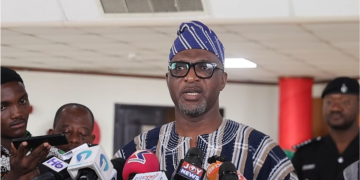






















As the contest over the Ga Mantse stool continues to stir debate, Nokoyedzen-Larteiman Mantse Nii Lartei Nokoyedzen II urges restraint, a fair hearing of competing claims, spiritual discernment and a collective commitment to putting the Ga State above personal and factional interests.


The Ga State is confronting a difficult chapter in its traditional leadership, one marked by competing claims to the Ga Mantse stool, legal battles, divided loyalties and growing calls for clarity. At the heart of the controversy are two men, both claiming the mantle of kingship, both backed by supporters who insist their claim is rooted in tradition, history and legitimacy.
For many within the Ga community, the dispute has become more than a contest over a traditional throne. It is a question of identity, unity, heritage and the future of a people whose cultural institutions remain central to their collective life.
In an appeal for reconciliation and a search for truth, Nii Lartei Nokoyedzen II, Nokoyedzen-Larteiman Mantse, has called on the Ga people to approach the dispute with restraint, respect and a willingness to accept the outcome of a legitimate determination of the matter.
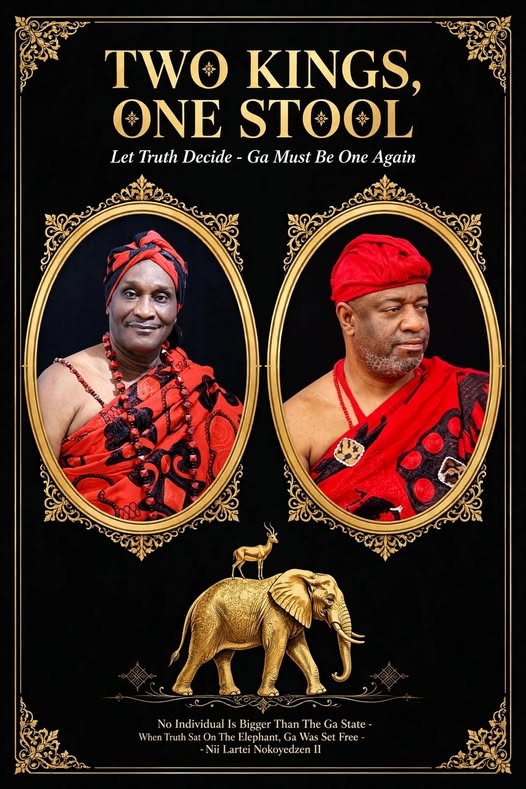
In a reflection titled “Two Kings, One Stool: Let Truth Decide,” he cautions against turning the dispute into a battle of insults, political interests or factional hostility, arguing that the two claimants should not be treated as enemies but as sons of Ga whose competing claims must be resolved in the interest of the traditional state.
“The two men both carry the name of King. Two men who both love Ga. Two men who both believe they were chosen. Two palaces. Two followings. Two stories. And one people — Ga — caught in the middle, confused, tired, and wounded,” he writes.
He maintains that the dispute demands a sober and respectful approach, one that acknowledges the gravity of the traditional institution while allowing the truth to emerge without intimidation or prejudice.
Two claims to the Ga Mantse stool
The dispute involves HRM King Tackie Teiko Tsuru II and HRM King Tackie Adama Latse II, both of whom have supporters advancing arguments in favour of their respective claims to the Ga Mantse stool.
King Tackie Teiko Tsuru II was formally enstooled on May 9, 2020, following earlier processes, including an initial installation attempt in August 2015 and additional customary rites in October 2017. His supporters maintain that his claim is rooted in royal lineage and Ga customary practices, and point to endorsements from traditional and spiritual authorities, including the late Ga Manye, Naa Dedei Omaedru II.
The Ga Manyemɛi and Asafoianyɛmɛi have also publicly reaffirmed their support for him, insisting that his enstoolment followed the appropriate customary procedures.
On the other hand, King Tackie Adama Latse II maintains that he was installed as Paramount Chief of the Ga Traditional Area on June 11, 2011, following the demise of Boni Nii Amugi, and that his name was entered into the National Register of Chiefs in April 2014.
His supporters have argued that his removal from the register was not supported by evidence of a valid destoolment, abdication or death, a position that featured prominently in the legal proceedings surrounding his registration.
For Nii Lartei Nokoyedzen II, the competing claims must be approached with respect for both sides, without resorting to personal attacks or attempts to silence either claimant.
“Two men. Two claims. Both must be heard. Neither must be silenced by insults,” he writes.
The court decisions and the unresolved customary question
A central part of the debate has been the interpretation of court decisions concerning the Ga Mantse stool, particularly proceedings involving the National Register of Chiefs.
In November 2021, the High Court ordered the National House of Chiefs to restore Nii Tackie Adama Latse II’s name to the register as Ga Mantse. The Court of Appeal subsequently upheld the decision on June 12, 2025.
However, the Supreme Court, on July 23, 2025, quashed the order for restoration, with the ruling centred on procedural and constitutional considerations, including the right of King Tackie Teiko Tsuru II to be heard in the proceedings.
Nii Lartei Nokoyedzen II argues that the various court proceedings must be understood within their proper legal context and not presented as conclusively resolving every aspect of the customary dispute.
He points to the distinction between proceedings concerning the National Register of Chiefs and the substantive chieftaincy dispute, which, according to the position outlined in his article, remains pending before the Judicial Committee of the Greater Accra Regional House of Chiefs in Dodowa.
The substantive petition, filed on May 29, 2019, reportedly seeks a declaration that Nii Tackie Adama Latse II is the legitimate Ga Mantse and asks that King Tackie Teiko Tsuru II vacate the Stool House and Palace.
He argues that the determination of the substantive chieftaincy dispute must be left to the appropriate traditional judicial institutions, rather than public commentary, political pressure or social media debates.
The Office of the Ga Mantse, in a statement following the Court of Appeal ruling in June 2025, had also maintained that the ruling did not settle the substantive question of who rightfully occupies the Ga Mantse stool, noting that the matter remained pending before the Judicial Committee of the Greater Accra Regional House of Chiefs.
Graphic Online
For Nokoyedzen II, recognising the limits of judicial decisions in particular proceedings is essential to preventing misinformation and ensuring that the Ga people are not misled by partial interpretations of the legal process.
Beyond the courts: The search for lasting peace
While acknowledging the role of the courts and traditional judicial institutions in resolving the dispute, Nokoyedzen II argues that a legal verdict alone may not be enough to heal the divisions within the Ga State.
He believes that lasting reconciliation must also be rooted in a willingness among the people to listen, accept truth, relinquish personal interests and place the collective wellbeing of Ga above individual ambitions.
“A paper peace is not peace. A forced peace is not peace,” he writes, arguing that genuine reconciliation must begin with a change in mindset and a willingness to accept the outcome of a fair process.
He further calls on the various factions, traditional leaders, political actors, media practitioners and members of the Ga community to prioritise the interests of the traditional state over their loyalties to individuals.
“No individual is bigger than the Ga State. Not Teiko Tsuru II. Not Adama Latse II. Not any chief. Not any blogger. Not any politician. Not me,” he states.
He describes the Ga State as an enduring institution that existed before the present generation and will continue to exist long after it, urging those involved in the dispute to see themselves as custodians rather than owners of its heritage.
A call to the spiritual leadership
Beyond the legal and customary processes, Nokoyedzen II places considerable emphasis on the role of the spiritual leadership of the Ga State, whom he describes as having a responsibility to guide the people through the crisis.
Drawing parallels with the biblical prophet Samuel, who anointed David as king after being guided by God, he urges the two spiritual heads of the Ga State to seek divine and ancestral guidance in discerning the rightful occupant of the stool.
He believes that spiritual consultation, prayer, fasting and reflection could help the traditional leadership arrive at a resolution that commands broader acceptance among the Ga people.
“You are the Samuels of our time. You are the ones God and our ancestors set aside to hear what the rest of us cannot hear, to see what the rest of us cannot see,” he writes.
He urges the spiritual leaders not to remain silent in the face of the divisions, but to provide guidance grounded in truth, wisdom and impartiality.
“Speak. Speak the truth. Speak it in love, but speak it without fear or favour,” he appeals.
The Elephant, the Antelope and the covenant of Ga
In a symbolic illustration of his vision for the Ga State, Nokoyedzen II invokes what he describes as a covenant from Ayawaso, using the imagery of an elephant and an antelope to represent the relationship between the Ga people and their traditional leadership.
In his analogy, the elephant represents the strength of the Ga people, while the antelope symbolises the wisdom of the king.
He argues that when the right leader is accepted by the people and the spiritual authorities, the elephant will be calm and able to walk majestically, symbolising harmony, stability and collective progress.
Conversely, he suggests that uncertainty over leadership creates unrest, division and instability within the traditional state.
He therefore urges the spiritual heads to consult deeply and guide the people towards a resolution that will restore confidence in the traditional institution and unite the various factions.
The imagery, he says, reflects his belief that leadership in the Ga State must be rooted not merely in appearances, influence or political strength, but in wisdom, acceptance and a genuine commitment to the people.
A message to the two kings and the Ga people
In his concluding appeal, Nokoyedzen II addresses both claimants directly, urging them to place the future of Ga above their individual interests and ambitions.
He calls on them to demonstrate humility, wisdom and a willingness to submit to the truth, whether that truth emerges through the appropriate customary and judicial processes or through spiritual discernment.
“History will not remember the man who held the stool the longest. History will remember the man who saved Ga,” he writes.
He also appeals to chiefs, elders, families, bloggers, journalists and the wider Ga community to refrain from hostility and prepare to accept a resolution that prioritises unity.
For him, the ultimate objective should not be to strengthen one faction at the expense of another, but to restore the dignity, stability and cohesion of the Ga State.
“Let us say: ‘Ga first. My interest second,’” he urges.
He concludes with a call for reconciliation, insisting that the restoration of the Ga State must be built on truth, spiritual guidance, humility and a willingness to surrender individual interests for the greater good.
Signed in the name of Ataa Naano Nyongmo, the ancestors and truth, the appeal by Nii Lartei Nokoyedzen II is ultimately a call for the Ga people to resolve their leadership dispute without losing sight of the unity and heritage that bind them together.
Source: www.kumasimail.com