


















A Small-Scale Miner, Henry Okum, has told the High Court in Accra that the mining concessions in Samraboi in the Western Region were handed over to him by the Ashanti Regional Chairman of the New Patriotic Party, Bernard Antwi Boasiako, to mine.


Henry Okum, who is testifying as the second prosecution witness, said that, prior to Mr Boasiako, popularly known as Chairman Wontumi, handing over the place to him, he tasked him to do two things, including covering the mined area to plant coconuts.
“I was the one that Chairman Wontumi handed the place over to, so I was dealing directly with Chairman Wontumi,” the Witness told the Court about the Samraboi Concession.
Chairman Wontumi, (1st Accused) Kwame Antwi, a Director of Akonta Mining (currently at large – 2nd Accusad), and Akonta Mining, the company itself (3rd Accused), are currently standing trial for six counts. The charges comprise three counts each of assignment of mineral rights without approval and purposely facilitating an unlicensed mining operation.
They have pleaded not guilty, been granted bail, and are standing trial before the High Court presided over by Justice Audrey Kocuvie-Tay.
Under further cross-examination from lawyers of Chairman Wontumi, led by Andy Appiah Kubi, on January 15, 2026, Henry Okum has been addressing the Court on his license status and how he got access to the Samreboi Concession from Chairman Wontumi, who owned Akonta Mining.
Counsel for Wontumi had suggested to the Witness that he was mining at Samraboi without a license, but the Witness disagreed. He explained that, “because the license I was using there is (from) Akonta Mining,” and that “Before I went to Samreboi, I went to the Minerals Commission to do a search about the area.”
He added that, upon his search, he was told that, “the area belongs to Akonta Mining Company, and within the search, it also shows that Akonta Mining Company has a mining lease on the land, so that pushed me to go to Chairman to ask him whether I can work there.”
For this reason, he said, “the license I was using there is Akonta Mining license.”
Mr Okum, testifying as the Second Prosecution Witness, said, “when you go to Samreboi, nobody knows Akonta Mining Board of Directors,” and though he is also not a director or board member of Akonta Mining, “what I know is that Chairman Wontumi owns Akonta Mining, and Akonta Mining is Chairman Wontumi.”
He told the Court that, before he went to Samraboi, “it was Chairman Wontumi who went to do the operation on the ground for me through the Regional Security Council (REGSEC), and the letter that we wrote to REGSEC was on Akonta Mining Letter Head and that was signed by Chairman Wontumi.”
The Witness disagreed with Counsel for the Accused persons that Akonta Mining was responsible for the letter and not Chairman Wontumi.
Abandoned pits
The Witness, while responding to the question as to whether the concession he entered was a “land all virgin,” answered in the negative, saying, “the land was not virgin.”
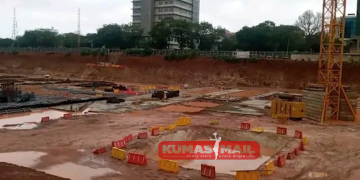
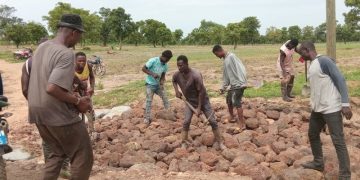
He explained further that, “it was an already mined area, so there are a lot of abandoned pits on the land.”
The Witness said, “that is why Chairman made me understand that there are illegalities on the land,” and that “if I want to go on the land to work, he had two things that I had to do for him.”
The Witness told the Court that, the first thing Chairman Wontumi asked me to do was “to cover the abandoned pit,” and to excavate the area, while “the waste will be put at a certain area for me to have access to the gravel which contains the gold.”
For the area that had been mined, Mr Okum said, “I had to push the waste from the pit before I can have access to a fresh land and work.”
The Witness also disagreed with Counsel that the complaints of Chairman Wontumi (first accused) to REGSEC were in respect of illegal mining on that land. He explained that, “Because of the discussion that I had with Chairman (Wontumi), he also brought out that, these are the issues on the land, and so yes, it can be a factor,” and also, “it opens space for me to get access to the area and work because there are a lot of Galamseyers on the land, and it will not make my work easy.”
REGSEC action
He told the Court that the presence of illegal miners on the site left him worried when asked by Counsel for the accused. It was the Witness’s further testimony to the Court, “I was because, if Chairman did not go and sack them (illegal miners), it would make my work difficult.”
He said, when Chairman wrote that letter, REGSEC came to the site to sack them, saying, “they came, led by the Regional Commander at Tarkwa, to drive everybody on the land away, and they seized every excavator that was working there.”
Asked if these seized excavators and equipment belonged to the illegal miners, he responded in the positive, adding that, “they belonged to the illegal miners.”
License procurements
While apprising the Court on how to acquire a small-scale mining license, when asked to share his experience with “us as you went through the process of acquiring a mining license,” the Witness did, “I can only speak on small-scale mining license and not large scale.”
He went on to explain that, “If you want to become a small-scale miner, the first thing you need to do is go to the Minerals Commission.”
He said, “Every small-scale area has a place that the Government releases as a block out for small-scale mining.”
The Witness said, “when you go to the Commission, the areas are being painted green – meaning it is for small-scale mining,” and “after you have identified that area, you need to go to the ground and pick the coordinate of the area in question.”
It was his explanation that, after “you come back to the Minerals Commission and give the coordinate to the Minerals Commission to find out whether that area had already been given to a different person or if the place is free for you to apply.”
From that point, he said, “if the place is free, they will ask you to go and buy a form,” and “If it is not, they will tell you that the place has been taken. If it is free, you will fill the form with your information and then the name of the enterprise or the venture that you want to use to apply for that area. And from there, it becomes a process.”
Site Plan
Touching on the process to the end, he said, “the first thing you need to do is get the site plan of the area, and then we will continue, and the Commission will call you after you have presented the site plan showing the area of interest.”
The Witness explained that, “Before you even go onto the land to do anything on the land, you have to pass through that system.”
“You need to pay for stool land, EPA, Water Resource, and then have the mining lease, which is the final certificate, before you can do any mining activities in that area. And again, when it comes to small scale, we have Regional Branches of the Minerals Commission, so all these processes are done at the Regional Offices,” he explained.
“You can also go to the District Assembly, and then they will place a notice for 21 days at the town that you want to operate, so that if the chiefs and the people have any objection at that place, they will let you know.
“After the 21 days and there is no objection, then the Assembly will approve that you can go there and undertake your mining activities,” he said.
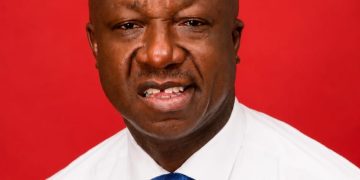
Except of – Henry Okum, a Small Scale Miner, who is testifying as the 2nd Prosecution Witness in Chairman Wontumi trial
Source :www.kumasimail.com