




































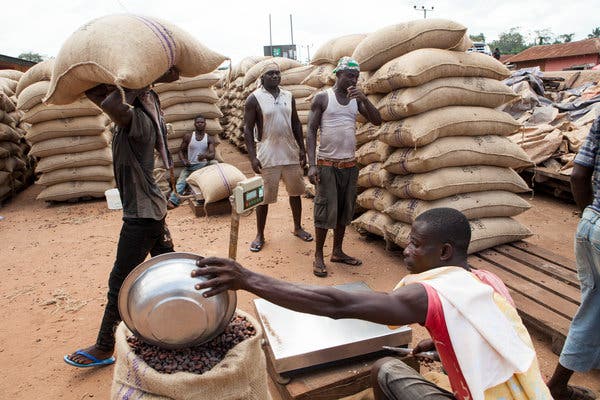
Recent reports by Reuters indicate that Ivory Coast will pay cocoa farmers between 800 and 1,000 CFA francs per kilogramme for the mid-crop season starting March 1 — equivalent to approximately GH¢980 to GH¢1,225 per 64kg bag. In Ghana, by contrast, cocoa farmers are currently paid GH¢2,587 per 64kg bag.


The stark difference raises important questions — and exposes the political rhetoric surrounding cocoa pricing in Ghana for what it is: selective outrage.
In recent weeks, elements within the New Patriotic Party (NPP) have sought to incite cocoa farmers against the government over adjustments in the local producer price. Yet the facts suggest a more complex global and economic reality, one that cannot be reduced to political sloganeering.
Global Market Volatility
Cocoa pricing is not determined in isolation. Ghana, like Ivory Coast, operates within the dynamics of the global commodities market. International cocoa prices have experienced significant volatility over the past two years, driven by:
- Supply fluctuations in West Africa due to climate variability and crop disease.
- Speculative trading on international futures markets.
- Currency movements, particularly the strength of the US dollar.
- Global demand shifts amid economic uncertainty.
While international prices may spike, governments must balance current market gains with forward sales commitments and long-term price stability mechanisms.
Forward Sales and Stabilisation Policy
Ghana’s cocoa pricing model relies heavily on forward sales through COCOBOD to guarantee farmers a stable and predictable income. When global prices fall or fluctuate sharply, previously negotiated forward contracts can constrain immediate upward price adjustments.
Price revisions are therefore not always a direct reflection of spot market movements but rather of averaged forward sales and hedging strategies designed to protect farmers from extreme downturns.
Fiscal Pressures and Sector Sustainability
Another factor is fiscal sustainability. The cocoa sector depends on a delicate balance between farmer payments, operational costs, input subsidies, road infrastructure, extension services, and debt servicing obligations within COCOBOD.
In recent years, macroeconomic pressures — including currency depreciation, inflation, and high public debt servicing — have constrained the government’s fiscal space. While producer prices must remain competitive, they must also be financially sustainable.
Overpricing cocoa without corresponding revenue backing risks:
- Accumulation of debt within COCOBOD.
- Delays in payments to farmers.
- Disruptions in input supply and extension services.
- Long-term instability in the sector.
Regional Competitiveness
Comparatively, Ghana’s current farmgate price remains significantly higher than that of Ivory Coast when measured per 64kg bag. This undermines claims that Ghanaian farmers are being uniquely disadvantaged.
If anything, Ghana’s pricing remains regionally competitive, even amid economic adjustments.
The Politics of Cocoa
Cocoa has always been politically sensitive in Ghana. It is tied not only to livelihoods but to national identity and rural electoral politics. However, turning complex commodity pricing decisions into partisan attacks risks misleading farmers and undermining confidence in sector management.
Constructive engagement — rather than inflammatory rhetoric — is what the cocoa sector requires. Farmers deserve transparent communication about pricing mechanisms, global market conditions, and sustainability challenges.
A Call for Responsibility
Political actors must resist the temptation to weaponise cocoa pricing for short-term gains. The focus should instead be on:
- Strengthening productivity through improved inputs and disease control.
- Expanding local value addition.
- Enhancing price transparency.
- Ensuring fiscal discipline within COCOBOD.
Cocoa farmers deserve facts, not theatrics. And in the current global environment, responsible governance requires balancing immediate expectations with long-term sector stability.
The numbers speak for themselves.
By: Kwame Boamah