




























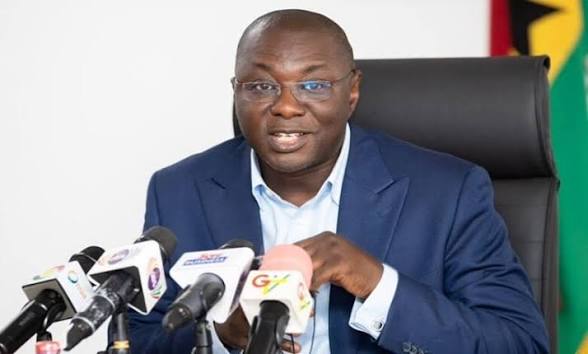
The Minority has criticised the government’s 2027 Budget Statement, accusing it of placing a greater economic burden on households and businesses despite improvements in key macroeconomic indicators.


In a press statement issued in Accra on Friday, November 13, 2026, in response to the 2027 Budget presented by the Minister for Finance on November 12, the Minority argued that the government’s economic gains had not translated into meaningful improvements in the living conditions of ordinary Ghanaians.
Under the title “The Paper Economy Gains, the Pocket Economy Pays,” the Minority acknowledged improvements in headline inflation, Treasury bill rates, the primary balance and Ghana’s credit ratings but insisted that the budget failed to address unemployment, the cost-of-living crisis and the financial difficulties confronting businesses.
It said the government had failed to meet three key expectations ahead of the budget: addressing the country’s unemployment challenges, accounting for jobs created under the 24-Hour Economy programme and providing relief to households struggling with the cost of living.
The Minority questioned the government’s decision to introduce a New Economy programme without providing a comprehensive account of the achievements and employment figures under the existing 24-Hour Economy initiative.
It argued that the New Economy largely repackaged existing programmes under different names, with several flagship projects yet to move beyond their planning and feasibility stages.
According to the statement, six of the eight pillars of the New Economy correspond to existing sub-programmes under the 24-Hour Economy initiative, raising questions about whether the new programme represents a significant departure from previous government policies.
The Minority further questioned the financing arrangements for the proposed US$10 billion New Economy programme, arguing that the government had not adequately explained how it intended to mobilise the required resources.
It noted that while the May 2026 Fiscal Strategy projected GH¢53.4 billion for the programme in 2028, the 2027 Budget had reduced the indicative allocation to GH¢30.9 billion.
The opposition also expressed concern about the government’s projected inflation rate of 8 per cent by the end of 2027, compared with 5.5 per cent recorded in October 2026.
On public debt, the Minority said the debt-to-GDP ratio had increased from 44.7 per cent at the end of 2025 to 47.5 per cent by October 2026, despite the debt restructuring exercise undertaken by the government.
It argued that the country’s interest payment obligations of approximately GH¢61 billion exceeded combined allocations to several critical growth-enhancing sectors, including agriculture, energy, the Big Push infrastructure programme, youth development, industry and tourism.
The statement said the combined allocations to those sectors amounted to approximately GH¢37.87 billion, leaving a difference of more than GH¢23 billion in favour of debt servicing.
It further observed that interest payments exceeded the entire allocations to education and health, which stood at GH¢48 billion and GH¢40.3 billion respectively.
The Minority warned that continued reliance on borrowing and high debt-servicing costs could undermine the government’s growth ambitions if more resources were not directed towards productive sectors.
On the cost of living, the opposition criticised the proposed reduction in transfers to social intervention programmes, including the Livelihood Empowerment Against Poverty (LEAP) programme, school feeding and the capitation grant.
According to the statement, allocations to the programmes would fall from GH¢3.46 billion in 2026 to GH¢2.26 billion in 2027, representing a reduction of approximately 35 per cent.
Although it welcomed the increase in LEAP grants, the Minority argued that increasing payments to existing beneficiaries while reducing the overall allocation would leave many vulnerable households without adequate support.
It also raised concerns about the continued energy sector shortfall payments, which it said stood at GH¢13 billion for 2027 and GH¢7.8 billion for 2028.
The opposition argued that the continued shortfall contradicted earlier expectations that the energy sector financing gap would be eliminated by 2028.
It further cited revenue from the Energy Sector Shortfall and Debt Repayment Levy, popularly known as the Dumsor Levy, which generated GH¢11.9 billion against a target of GH¢8.7 billion.
The Minority also challenged the government’s assertion that the 2027 Budget introduced no new taxes, arguing that increased fees and charges would impose additional financial obligations on individuals and businesses.
It said projected revenue from fees and charges would rise from GH¢1.3 billion in 2026 to GH¢6.1 billion in 2027, representing an increase of approximately 354 per cent.
The statement also projected that taxes on domestic goods and services would increase by 22.8 per cent, while Pay-As-You-Earn (PAYE) collections would rise by 15.6 per cent in 2027.
It argued that the projected increase in PAYE collections, alongside rising fees and charges, would place additional pressure on workers and households, particularly as inflation is expected to rise.
On employment, the Minority said the New Economy programme, scheduled to run from 2027 to 2030, did not provide an immediate response to the unemployment challenges facing young people.
It noted that the government’s target of reducing unemployment to below eight per cent was scheduled for 2030, while several major projects under the programme were expected to deliver results between 2028 and 2032.
The opposition cited the proposed thermal power plant, the Pwalugu multipurpose dam project, oil palm development and textile manufacturing initiatives as examples of projects whose timelines would delay their expected employment benefits.
Although it acknowledged the Youth Employment Agency’s engagement of 73,537 young people and its target of reaching 100,000 in 2027, the Minority said the figures remained inadequate in addressing the scale of the unemployment challenge.
The statement also expressed concern over the performance of the agricultural sector, particularly the slowdown in agricultural growth from 6.8 per cent to 3.9 per cent and a reported 22.5 per cent contraction in fishing.
It criticised the proposed rice import restrictions, which would tie import licences to purchases from verified local farmers and millers from 2027, with a planned prohibition on commercial rice imports by 2030.
While acknowledging the government’s intention to promote local rice production, the Minority argued that the policy failed to address the underlying challenges of farm-gate prices, production costs and affordability for consumers.
It also raised concerns about the cocoa sector, particularly the reduction in producer prices and COCOBOD’s reported GH¢30.55 billion debt.
The opposition further questioned the introduction of a three per cent discount on gold purchases from small-scale miners, arguing that the measure could shift additional costs onto local miners.
On infrastructure, the Minority said several commitments made under previous budgets remained unfulfilled, citing delays in the Accra-Kumasi Expressway, the Women’s Development Bank, Farmer Service Centres and other flagship projects.
It also questioned discrepancies in some expenditure and economic figures presented in the 2027 Budget, including variations in reported international reserves, Big Push allocations and capital expenditure.
The Minority called on the government to provide further explanations on the figures and demonstrate how the proposed economic programmes would be financed and implemented.
It maintained that although the government could point to improvements in macroeconomic indicators, the real test of economic recovery should be whether households could afford basic necessities, businesses could expand and young people could secure employment.
“The paper economy has been celebrated, and we acknowledge it. But Ghanaians do not live on paper. They live on what is in their pockets, on the price of rice, on the fare to work and on whether their children can find a job,” the statement said.
The Minority pledged to continue holding the government accountable for its economic policies and their impact on the livelihoods of Ghanaians.
Tighten the story for publicationLead with the strongest budget criticismClarify attribution throughout the report