





































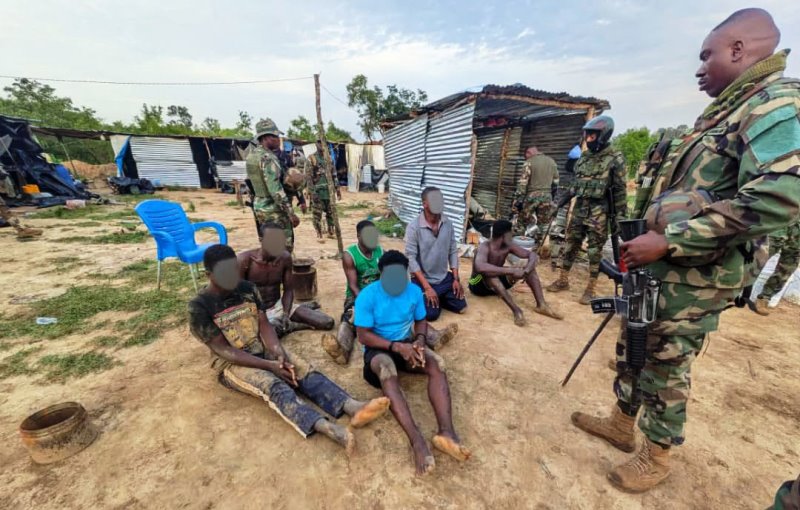
Ten suspected illegal miners, including three Chinese nationals, have been arrested after security forces stormed an illegal mining site at Kpali, near Gbiniyiri, in the Sawla-Tuna-Kalba District of the Savannah Region, uncovering extensive environmental destruction and recovering firearms and heavy-duty mining equipment.


The operation, carried out from August 25 to 27, 2026, by the National Anti-Illegal Mining Operations Secretariat (NAIMOS), in collaboration with the Northern Command of the Ghana Army and the Ghana Police Service, resulted in the seizure of two excavators, three excavator monitors, a Toyota Hilux vehicle, a fuel bowser and other equipment allegedly being used for illegal mining.
Three firearms and 25 rounds of live ammunition were also recovered from the site, adding a serious security dimension to an operation that authorities say was primarily aimed at stopping the destruction of the environment through illegal mining.
The suspects comprise seven Ghanaians and three Chinese nationals.
The crackdown followed a reconnaissance mission conducted on August 19, which confirmed intelligence reports of active illegal mining at the location.
When the joint security team returned to the site, it encountered people actively engaged in mining and observed what it described as extensive environmental degradation.
Land ripped apart, environment desecrated
The Kpali operation provides another stark picture of the environmental cost of Ghana’s illegal mining crisis.
Across mining communities, the uncontrolled use of excavators and other heavy machinery has transformed once-productive land into dangerous pits and degraded landscapes, destroying vegetation and undermining agricultural activity.
The consequences extend beyond the immediate mining sites.
The destruction of forests and farmlands threatens food production and the livelihoods of rural communities, while mining activities close to rivers and streams raise concerns over the contamination and degradation of water sources.
For a country already battling the effects of illegal mining on its natural resources, every additional mining site carved out without regard for environmental regulations adds to the cost of restoring degraded land and protecting water resources.
The discovery of firearms at the Kpali site also highlights another dimension of the galamsey problem: its potential to intersect with wider criminal and security concerns.
Security forces dismantle galamsey camp
Determined to prevent the illegal miners from simply returning after the operation, the task force dismantled 15 makeshift structures at the site and destroyed a generator used to support the mining activities.
The suspects and recovered exhibits were subsequently handed over to the Savannah Regional Police Command in Damongo for further investigation and appropriate legal action.
The seized heavy equipment was also secured at designated holding sites.
The operation is part of a wider national campaign by the government to confront illegal mining, which has increasingly become one of Ghana’s most damaging environmental and governance challenges.
Government steps up galamsey war
Government, through NAIMOS and its security partners, has intensified operations against illegal mining sites across the country, deploying military and police personnel to mining hotspots to disrupt operations and seize or immobilise equipment used in unlawful mining.

The enforcement strategy has increasingly focused on disrupting the machinery that makes large-scale illegal mining possible, including excavators, fuel supplies and other logistical support.
The campaign has also involved intelligence-led reconnaissance and joint operations designed to identify illegal mining locations before security teams move in.
The renewed crackdown reflects growing concern over the destruction of Ghana’s forests, farmlands and water bodies, as well as the economic and social consequences of illegal mining.
While illegal mining provides income to some individuals and communities, the unregulated exploitation of mineral resources comes with significant long-term costs — from degraded agricultural land and polluted water sources to the financial burden of reclaiming destroyed landscapes.
No let-up — NAIMOS
NAIMOS says the Kpali operation will not be an isolated intervention.
The Secretariat says it will continue collaborating with the Ghana Armed Forces, Ghana Police Service and other relevant institutions to identify and disrupt illegal mining operations and protect vulnerable areas across the Savannah Region.
The message from the operation is increasingly clear: the fight against galamsey is moving beyond warnings and rhetoric to sustained security operations aimed at taking the machinery, manpower and logistics out of illegal mining sites.
But as security forces intensify the crackdown, the bigger national challenge remains how to ensure that degraded lands are restored, water bodies are protected and mining communities have sustainable economic alternatives that do not destroy the natural resources on which future generations depend.
Source: www.kumasimail.com