



































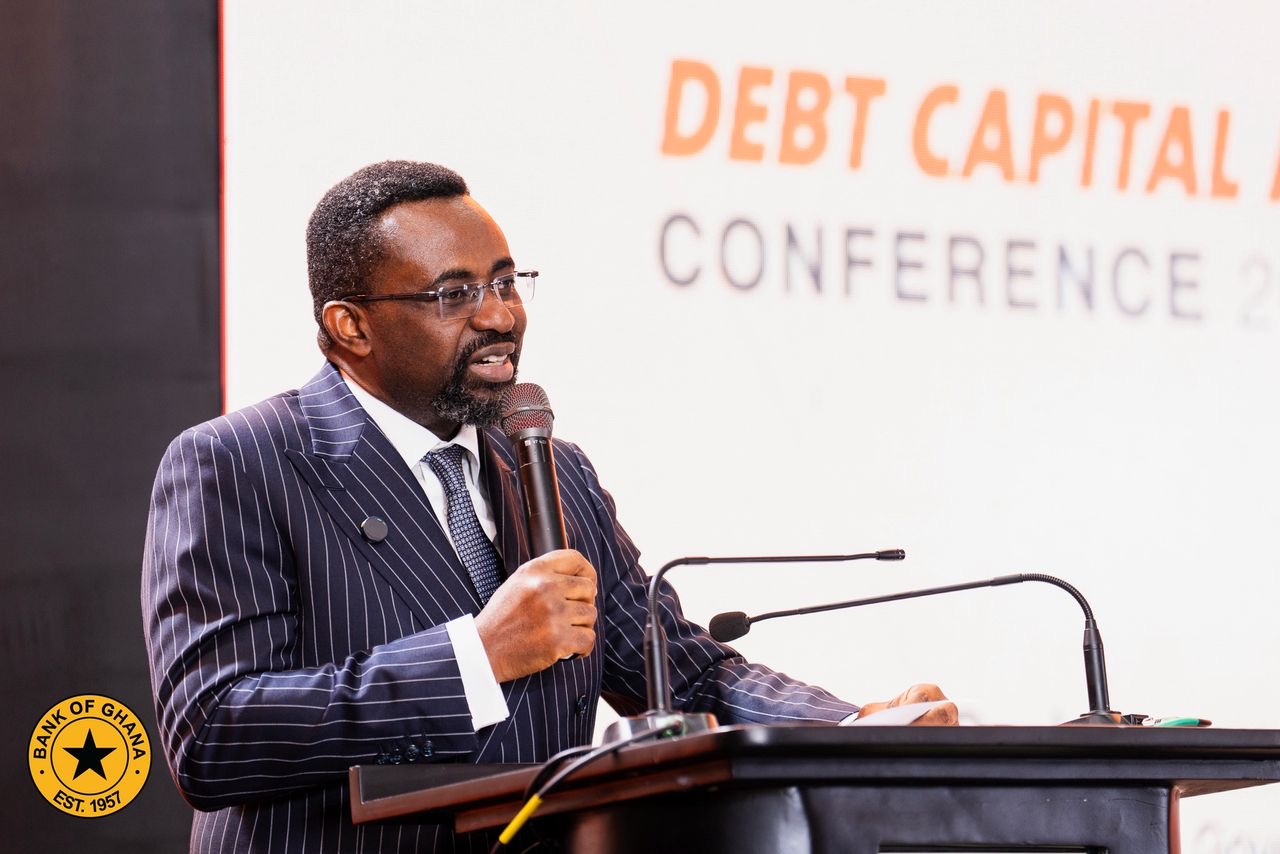
Governor of the Bank of Ghana (BoG), Dr Johnson Pandit Asiama, says Ghana’s improving macroeconomic conditions have created an opportunity to deepen and diversify the country’s debt capital market to support long-term economic growth.


According to him, the restoration of macroeconomic stability, declining inflation, improved fiscal conditions and renewed investor confidence are providing the foundation for a stronger and more resilient fixed-income market.
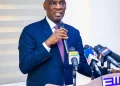
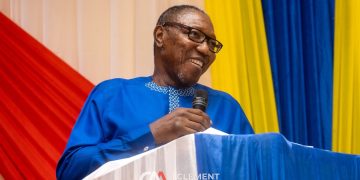
Dr Asiama made the remarks on Thursday, August 27, 2026, when he delivered the keynote address at the Fidelity Bank Debt Capital Market Conference at The Palms by Eagles in Accra.
He said Ghana’s experience during the economic crisis of 2022 and 2023 demonstrated the importance of macroeconomic stability to the effective functioning of financial markets.
During that period, elevated inflation, exchange-rate volatility, tightening global financial conditions and debt vulnerabilities contributed to Ghana losing access to international capital markets.
The resulting pressure on the domestic bond market led to sharply higher yields, declining asset values, reduced liquidity and unsuccessful government auctions, placing significant pressure on government financing.
“The lessons from this period were clear and profound: macroeconomic stability is a fundamental prerequisite for the efficient and effective functioning of financial markets,” Dr Asiama said.
Economic recovery
The Governor said the economy had since made significant progress, supported by coordinated fiscal and monetary policies, structural reforms and the implementation of Ghana’s IMF-supported programme.
Real GDP growth strengthened to about six per cent in 2025, from 2.8 per cent in 2023, with services and agriculture providing strong support while mining and other industrial activities recovered.
He said the recovery had continued into 2026, with real GDP growth reaching 6.4 per cent in the first quarter, compared with 6.2 per cent during the corresponding period in 2025.
Growth is expected to remain around six per cent in the second half of the year as the recovery matures, he added.
Ghana’s external position has also improved, with strong gold and cocoa receipts generating a trade surplus of about US$8.8 billion in the first half of 2026.
Gross international reserves stood at US$12.9 billion at the end of June, equivalent to about five months of import cover.
Dr Asiama said the cedi, which appreciated by 40.7 per cent in 2025, had remained broadly stable in 2026, helping to ease imported inflation and strengthen confidence in the economy.
Inflation falls sharply
The Governor described the reduction in inflation as one of the country’s most significant economic achievements in recent years.
Headline inflation declined from a peak of 54.1 per cent in December 2022 to 4.6 per cent in July 2026, placing it below the Bank of Ghana’s medium-term target band of 8±2 per cent.
He attributed the disinflation to tight monetary conditions, the appreciation of the cedi, fiscal consolidation, easing global commodity pressures and improved inflation expectations.
Dr Asiama, however, cautioned that quarterly utility tariff adjustments and renewed geopolitical tensions in the Middle East could pose upside risks to inflation.
Despite those risks, he said inflation was expected to remain within the target band through 2026.
Domestic bond market reopens
A major development highlighted by the Governor was the reopening of Ghana’s domestic bond market following the expiry of the three-year restriction imposed under the Domestic Debt Exchange Programme.
He said the government returned to the domestic bond market in March 2026, issuing a seven-year cedi-denominated bond that settled in April.
Dr Asiama described the development as an important transition from crisis management to active and orderly debt management.
He said the framework for Primary Dealers and Bond Market Specialists had also been strengthened, with the new bonds trading on the Ghana Fixed Income Market (GFIM).
The improvement in market conditions was also reflected in Treasury bill yields, with the 91-day rate falling from above 35 per cent in early 2023 to single-digit levels in 2026.
He said strong demand at government auctions during late 2025 and early 2026 reflected increased liquidity in the banking sector and renewed investor appetite for government securities.
More recently, however, the market had experienced periods of softer demand and modestly higher yields, which the Governor described as a healthy normalisation process rather than a return to market distress.
Push for private-sector participation
Dr Asiama said the Bank of Ghana expected greater participation from corporate and quasi-government issuers as economic conditions continued to improve.
He cited the Ghana Cocoa Board’s intention to finance its 2026/2027 crop season operations through commercial paper issuances targeting US$1 billion in three phases as an indication of the potential of the Ghana Fixed Income Market as an alternative source of financing.
He said the debt capital market should gradually move beyond its current heavy reliance on government securities to accommodate more private-sector issuers through commercial papers and corporate bonds.
“Government securities currently dominate Ghana’s debt capital market,” he said, adding that improving economic conditions and moderating interest rates should create room for greater private-sector participation.
He called for continued efforts to address structural and regulatory constraints that could discourage companies from accessing market-based financing.
Technology and diaspora savings
The Governor also identified technology as a key driver of the next phase of development in Ghana’s debt market.
He said financial technology could be used to develop platforms integrated with the Central Securities Depository to facilitate seamless exchanges of funds and securities.
Such systems, he said, could improve transparency, efficiency and convenience while encouraging greater participation in the secondary debt market.
Dr Asiama further called for increased mobilisation of domestic and diaspora savings into long-term investments.
He said ongoing institutional collaborations were seeking to create safer and more efficient channels through which Ghanaians at home and abroad could invest in debt instruments and productive sectors of the economy.
He noted that the Bank of Ghana was leading initiatives under the Remit2Invest programme to channel a greater proportion of diaspora remittances into sustainable, long-term investments.
Policy priorities
Dr Asiama outlined three key priorities for the Bank of Ghana for the remainder of 2026: maintaining macroeconomic and price stability, safeguarding financial-sector stability, and implementing institutional reforms while deepening financial markets.
He said monetary policy would remain forward-looking and data-driven, while the central bank would continue strengthening supervision and resilience within the banking sector.
The recent bank recapitalisation exercise and other prudential measures, he said, had strengthened bank balance sheets and improved liquidity, with positive implications for banks’ participation in the debt capital market.
He also reaffirmed the Bank’s commitment to safeguarding its independence and developing new regulations, including a framework for Virtual Asset Service Providers following the passage of the relevant legislation.
The central bank is also developing a framework to incentivise banks to list on the equity market to improve access to long-term capital for productive investment.
Dr Asiama said the Bank’s new Foreign Exchange Operations Framework had enhanced the transparency and predictability of its foreign exchange operations, while efforts to rebuild external buffers were continuing under the Ghana Accelerated National Reserve Accumulation Policy (GANRAP), in coordination with the Ministry of Finance.
Building a credible yield curve
The Governor stressed that a deeper fixed-income market would serve purposes beyond government financing, describing it as a key channel for monetary policy transmission, a benchmark for pricing risk and an important source of long-term capital.
He said the Bank of Ghana’s objective was to rebuild a credible yield curve that could serve as a benchmark for pricing corporate bonds, infrastructure instruments and other forms of private debt.
“Liquidity is central to that endeavour, and it remains a priority of the Bank of Ghana,” he said.
Dr Asiama concluded by urging continued collaboration among policymakers, regulators, investors and market participants to strengthen market infrastructure, investor protection, transparency and financial literacy.
He said the ultimate measure of a deeper debt capital market should be its ability to translate financial resources into productive economic activity, including financing power projects, factories, housing developments and small and medium-sized enterprises.
“The proof of a deeper debt capital market will not be found only on an auction sheet,” he said. “It will be found in that power project that was completed, that factory that expanded, the housing development that was financed and the SME that finds room on a bank’s balance sheet because the right capital reached the right use.”
Source: www.kumasimail.com