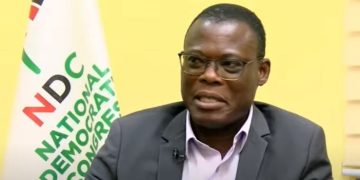







































National Vice Chairmanship hopeful of the National Democratic Congress (NDC), Samuel Addo Otoo, has unveiled a package of policy proposals aimed at strengthening the party’s grassroots structures, improving the welfare of members and creating sustainable economic opportunities for its rank and file.


The lawyer, economist and finance professional, who is emerging as a leading contender in the race, says his focus will be on building a stronger, more economically empowered and inclusive party capable of sustaining itself beyond election cycles.
A key proposal is an amendment to the NDC constitution to make former party executives delegates to the party’s elections.
Mr Addo Otoo argues that former executives who have devoted years to the party should retain a voice in its decision-making processes, similar to the arrangement under which former MCEs, DCEs and government appointees retain voting rights.
He also proposes the establishment of a party-backed insurance company to provide welfare support for members, particularly those injured while undertaking party activities.
Under the proposal, the scheme would also cater for party elders aged 65 years and above who have served the party for at least 15 years but have no regular source of income.
Such members, he said, would receive periodic stipends and assistance with medication, with pharmaceutical companies brought in as strategic partners.
Mr Addo Otoo further proposes an Enterprise Growth and Development Fund to mobilise capital from diverse sources and invest in viable projects and strategic businesses.
He proposes that profits from the fund be distributed, with 50 per cent going towards national campaign activities, 30 per cent supporting regional and constituency campaigns, and the remaining 20 per cent channelled into a grassroots enterprise fund to provide grants and soft loans to members seeking to establish micro-enterprises.
Another major plank of his agenda is the establishment of cooperative enterprises and cooperative credit unions in every constituency or district.
According to him, the initiative would create jobs, strengthen local economies and position party structures to contribute meaningfully to the government’s development agenda.
Mr Addo Otoo said additional policies would be announced later.
Credentials
His campaign is also drawing heavily on his extensive academic and professional background.
A product of the Kwame Nkrumah University of Science and Technology (KNUST) and the University of Cape Coast (UCC), Mr Addo Otoo holds qualifications spanning law, economics, finance, banking, accounting and education.
His academic credentials include an LLB, LLM, MSc in Economics, MBA in Banking and Finance and a Bachelor of Education in Economics and Accounting. He also holds a Barrister-at-Law certificate from the Ghana School of Law.
He is a member of the Ghana Bar Association and the Institute of Directors, a Fellow of the Chartered Institute of Credit Management and Administration and a Chartered Certified Economic Policy Analyst, among other professional affiliations.

He is currently pursuing doctoral studies in Law and Finance and has built a professional career spanning legal practice, academia, finance, investment, banking, consultancy and enterprise development.
Mr Addo Otoo is a lecturer at the Faculty of Law of Central University and Managing Partner of Atta Poku Law Consult, a firm of barristers and solicitors of the Supreme Court of Ghana.
He is also the immediate past Board Chairman of Yaa Asantewaa Rural Bank Plc and chairs the Ashanti Regional Finance Committee of the NDC. He was appointed to the governing board of the Komfo Anokye Teaching Hospital in May 2025.
His campaign presents the combination of his grassroots engagement, professional experience and academic credentials as a key selling point in his bid for the NDC National Vice Chairmanship.
The policy proposals, particularly the focus on member welfare, cooperative businesses and grassroots enterprise financing, are intended to shift the party’s support system from largely election-driven mobilisation towards a more sustainable institutional model.
Source: www.kumasimail.com