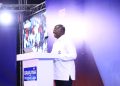




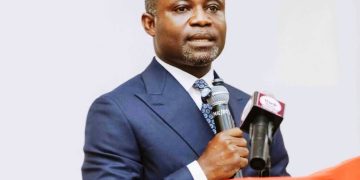










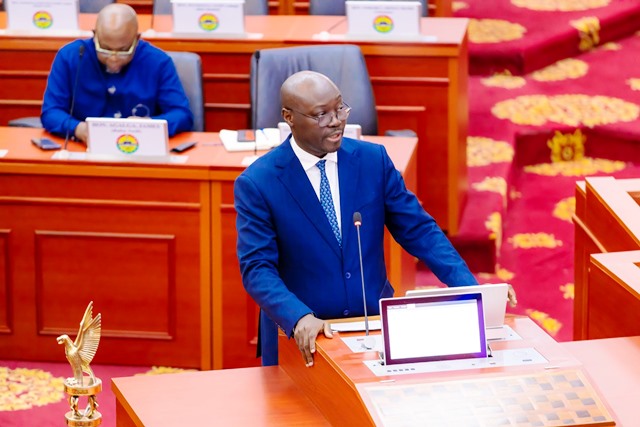
Finance Minister Dr. Cassiel Ato Forson has announced that Ghana will no longer require an International Monetary Fund (IMF) financial bailout “in the foreseeable future,” declaring that the country has moved from economic crisis management to a new phase of stability and reform-driven growth.


Addressing Parliament on Thursday, Dr. Forson said Ghana had successfully concluded the final review of its current IMF-supported Extended Credit Facility programme, pending approval by the IMF Executive Board.
“Ghana has moved from the intensive-care unit (ICU) to the wellness center,” the Finance Minister declared.
He announced that Ghana’s future engagement with the IMF would now shift from a financing arrangement to a non-financing Policy Coordination Instrument (PCI), which he said would support reforms, strengthen investor confidence, and provide regular policy assessments without additional bailout funding.
“For Ghana, this marks an important shift — from seeking financial bailout to engaging as a credible reform partner,” Dr. Forson told lawmakers.
The Finance Minister described the development as “a consequential moment” in President John Dramani Mahama’s Reset Agenda, saying it signified “Ghana’s passage from crisis management to stability, from dependence on financial bailout to partnership in reform, and from uncertainty to renewed confidence in our economic future.”
Dr. Forson used the address to recount the depth of Ghana’s 2022 economic crisis, blaming what he described as the previous administration’s “gross mismanagement of the economy” for pushing the country into fiscal, debt and balance of payments crises.
He recalled that the cedi came under severe pressure, inflation surged beyond 50 percent, investor confidence collapsed, and Ghana lost access to international capital markets after multiple sovereign credit downgrades by Moody’s, Fitch and S&P.
The Finance Minister also revisited the controversial Domestic Debt Exchange Programme (DDEP) introduced in December 2022, saying it imposed painful haircuts on bondholders, pensioners, banks and financial institutions.
“Ordinary Ghanaians bore the heaviest burden of that crisis,” he said, citing rapid depreciation of the cedi, soaring inflation, job losses, business distress and rising poverty.
Dr. Forson said the Mahama administration responded after assuming office by recalibrating the IMF programme and introducing fiscal discipline measures aimed at restoring confidence and debt sustainability.
Among the reforms he listed were reductions in the number of ministers and ministries, amendments to the Public Financial Management Act, removal of taxes such as the E-Levy and Betting Tax, establishment of an Independent Fiscal Council, and operationalization of a sinking fund to manage future debt obligations.
According to him, the measures have yielded “clear and measurable results.”
He told Parliament that Ghana recorded 6 percent GDP growth in 2025, while non-oil GDP growth hit 7.6 percent — the highest in 14 years. He added that Ghana’s economy crossed the US$100 billion mark for the first time in 2025 and is now ranked the eighth largest economy in Africa.
Dr. Forson further announced that inflation had dropped sharply from 23.8 percent in December 2024 to 3.4 percent in April 2026, while the public debt-to-GDP ratio fell from 61.8 percent in 2024 to 44.7 percent in 2025 — surpassing the IMF target years ahead of schedule.
He also said the cedi appreciated by 40.7 percent against the US dollar in 2025, while Treasury bill rates and the monetary policy rate declined significantly.
“These results affirm a simple but enduring truth: fiscal prudence and discipline always deliver results,” the Finance Minister stated.
Quoting President Mahama’s remarks at the 77th Annual New Year School earlier this year, Dr. Forson reiterated the government’s determination to avoid future IMF bailouts.
“It must be the 17th and the last time that Ghana goes for a bailout from the IMF,” he quoted the President as saying.
Dr. Forson stressed that although Ghana would continue collaborating with the IMF under the PCI arrangement and Article IV consultations, the country would no longer “go on our knees to beg for a bailout.”
Looking ahead, he disclosed that government would unveil a new economic blueprint dubbed “The New Economy” in the 2027 Budget, aimed at driving long-term transformation, job creation, productivity and resilience.
“We will continue the hard work of building the Ghana We Want,” he said.
Source: www.kumasimail.com