


































The government has suspended major public sector negotiations on salaries and conditions of service for 2026, opting instead for limited improvements in selected allowances as it prepares to establish an Independent Emoluments Commission (IEC) to reform Ghana’s public sector pay system.


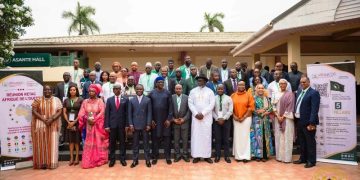
The announcement, made by Vice President Prof. Jane Naana Opoku-Agyemang on behalf of President John Dramani Mahama, headlined the opening of the 2026 National Labour Conference in Ho, where government also reaffirmed its commitment to preventing industrial unrest through dialogue and comprehensive labour reforms.
The three-day conference was on the theme: “Strengthening Industrial Harmony as a Catalyst for Accelerated Economic Growth and National Development.”
Prof. Opoku-Agyemang said the proposed Independent Emoluments Commission would provide the institutional framework needed to address longstanding distortions in Ghana’s compensation system.
“The establishment of the Independent Emoluments Commission is a deliberate intervention to stabilise the compensation system and build strong institutional foundations while ensuring continuity and industrial harmony,” she said.
She explained that, in the interest of fiscal discipline and economic stability, government had proposed that 2026 would not be a year for major renegotiation of conditions of service across the public sector.
Instead, she said, government would implement targeted and modest improvements in two selected allowances while work on the new emoluments framework is completed.
“The rationale is to help manage expectations and preserve industrial harmony,” she told delegates.
The Vice President said persistent disparities in public sector pay, recurring labour agitations and fragmented governance of emoluments have placed significant pressure on the economy despite the introduction of the Single Spine Salary Structure more than a decade ago.
She also called on stakeholders to broaden national labour discussions beyond the formal economy, noting that about 78 percent of Ghana’s workforce is employed in the informal sector.
“Who should speak for them?” she asked, urging government, employers and organised labour to use the conference to reflect on a new social contract that leaves no worker behind.
Labour, Jobs and Employment Minister Dr. Rashid Pelpuo described industrial harmony as “a strategic national interest,” saying government is strengthening mechanisms for dialogue to resolve labour disputes before they develop into disruptive industrial actions.
“Our role is to ensure that workers’ concerns are heard, the legitimate interests of employers are recognised, and disputes are resolved through fair, lawful and credible mechanisms in the national interest,” he said.
Dr. Pelpuo commended organised labour for helping to maintain relative industrial peace over the past year and a half, adding that government remained committed to working with social partners to minimise strikes and sustain a stable labour environment.
He also highlighted the launch of the Ghana Decent Work Country Programme III (2026–2030), developed with the International Labour Organisation (ILO), which focuses on job creation, social protection, and labour rights and compliance.
The Labour Minister further disclosed that Parliament and tripartite stakeholders would soon begin deliberations on the Labour Bill 2026, which is expected to modernise Ghana’s labour laws by addressing emerging workplace challenges, including the growing influence of Artificial Intelligence (AI).
Providing further details on the proposed Independent Emoluments Commission, Chief Executive of the Fair Wages and Salaries Commission, Dr. George Smith-Graham, said the body would be established as an independent, accountable constitutional institution with a transparent methodology for determining public sector pay.
According to him, the Commission will be responsible for conducting job evaluation and grading, monitoring allowances, certifying public sector emoluments before payment, maintaining a national emoluments register, and advising Parliament, Cabinet, the Minister for Finance and other public institutions on compensation policy.
Dr. Smith-Graham said the proposed Commission was designed after lessons learnt from both the Ghana Universal Salary Structure (GUSS) and the Single Spine Salary Structure, adding that it would ultimately become a constitutional body after approval through a national referendum.
The planned reforms are expected to create a more transparent, equitable and sustainable compensation system while reducing labour disputes and strengthening industrial harmony as government pursues broader economic recovery and public sector reforms.
Source: www.kumasimail.com