














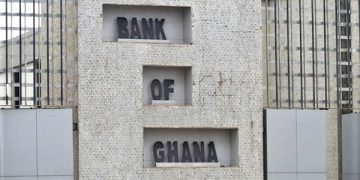

























The Bank of Ghana (BoG) has maintained its Monetary Policy Rate at 14.0 percent, citing broadly balanced risks to inflation and economic growth despite continuing uncertainty in the global economy.


The decision was taken at the 132nd Monetary Policy Committee meeting held from September 23 to 24, 2026, and announced by Governor Dr. Johnson Pandit Asiama at a meeting with heads of banks in Accra on Tuesday, October 6.
According to Dr. Asiama, Ghana’s economy continued to show resilience, with real Gross Domestic Product (GDP) growing by 6.0 percent in the second quarter of 2026, driven mainly by the services and industry sectors.
Although the growth rate was lower than the 6.6 percent recorded during the corresponding period in 2025, the Governor said underlying economic activity remained strong, with consumer and business confidence staying positive.
Headline inflation, however, increased modestly to 5.0 percent in August from 4.6 percent in July, largely reflecting utility tariff adjustments and higher crude oil prices.
Dr. Asiama said core inflation and inflation expectations continued to moderate, while headline inflation remained below the lower bound of the Bank’s medium-term target band of 8 ± 2 percent.
Lending rates fall
The Governor said easing domestic financial conditions had continued to support the transmission of monetary policy, particularly through the credit market.
The average lending rate of the banking sector fell sharply to 15.9 percent in August 2026, down from 24.2 percent during the same period in 2025.
The decline in lending rates, coupled with an easing in banks’ credit stance and a recovery in demand for credit, contributed to a strong expansion in private-sector lending.
Private-sector credit grew by 35.5 percent in August 2026, compared with 13.3 percent a year earlier. In real terms, credit growth reached 29.0 percent, compared with 1.7 percent over the same period last year.
Dr. Asiama said the banking sector had also remained resilient, with total banking-sector assets increasing on the back of robust deposit mobilisation and growth in other funding sources.
He added that the sector remained well capitalised, while asset quality had improved.
BoG to tighten credit risk oversight
Despite the growth in lending, the Bank of Ghana said banks must ensure that rapid credit expansion is supported by sound underwriting standards and effective risk-management systems.
The Governor said the Bank would soon issue a Credit Risk Management Directive to complement the Non-Performing Loans (NPL) Notice issued last year.
The directive will cover credit origination, administration, monitoring, measurement and recovery, with the aim of strengthening banks’ credit-risk frameworks and ensuring that credit expansion remains sustainable.
Dr. Asiama said the NPL ratio had declined significantly but remained elevated relative to regulatory thresholds, urging banks to continue strengthening credit-risk management and comply fully with existing NPL guidelines.
The central bank will also issue a Liquidity Coverage Ratio Directive, which will introduce the first prudential benchmark for banks’ liquidity and require banks to maintain adequate high-quality liquid assets to withstand significant liquidity stress over a 30-day period.
Banking sector faces emerging risks
The Governor further urged banks to take the results of the Bank’s macroprudential stress tests seriously and address areas of vulnerability identified under severe but plausible economic and financial scenarios.
He also called for stronger measures to combat fraud, saying banks should ensure that their fraud functions have direct and unrestricted access to managing directors or chief executive officers.
Personnel responsible for fraud management, he said, should also possess the necessary skills, professional certifications and technical competence.
The Bank is also consolidating its various operational notices and guidelines under the Foreign Exchange Act into a comprehensive foreign-exchange compendium.
The move is intended to provide greater clarity on requirements covering foreign-currency accounts, international transfers and trade payments.
Dr. Asiama stressed that compliance with the Bank’s foreign-exchange requirements remained mandatory, including proper documentation, internal controls and ensuring that funds were used strictly for their stated purposes.
Focus on digital and fintech risks
The Governor said the Bank was paying increased attention to cyber, technology and fintech-related risks as digitalisation continues to reshape Ghana’s financial sector.
The central bank is working with the industry on implementation of the Cyber and Information Security Directive and plans to strengthen supervisory expectations around technology, customer-fund safeguarding and third-party risks.
It is also developing further guidance on the governance and operational independence of regulated payment service providers within group structures, as well as the responsible use of artificial intelligence in the financial sector.
The Bank will continue efforts to address illegal digital credit providers and strengthen collaboration with relevant stakeholders to protect consumers and maintain confidence in the digital financial ecosystem.
Remittances targeted for investment
The Bank of Ghana has also formally launched the National Remittance and Diaspora Savings Strategy in collaboration with the Ministry of Finance.
The strategy is expected to be delivered within nine months, with full implementation targeted for the first quarter of 2027.
Dr. Asiama said banks would play a vital role in both the development and implementation of the strategy, which seeks to strengthen payment infrastructure and explore ways of converting remittance flows into investment opportunities for the Ghanaian diaspora.
The Bank also plans to engage the banking industry on measures to improve the sustainability and resilience of the country’s rapidly expanding mobile-money and digital-payments ecosystem.
Stronger external position
Ghana’s external position also improved during the period under review.
The trade surplus increased to US$8.85 billion during the first eight months of 2026, compared with US$6.69 billion during the corresponding period in 2025.
Gross international reserves stood at US$12.0 billion as of September 22, equivalent to 4.5 months of import cover.
The Governor attributed the continued strength in reserves partly to improved gold export receipts, despite elevated external-sector payments.
Dr. Asiama, however, cautioned that the global outlook remained uncertain, citing geopolitical tensions, elevated oil prices, tighter global financing conditions and the potential impact of a strong El Niño later in the year.
He said Ghana’s recent gains in inflation, fiscal consolidation, exchange-rate stability and financial-sector resilience provided a stronger foundation for sustainable growth.
“For the banking sector, this means that resilience, prudence and innovation must remain at the centre of our collective agenda,” he said.
He urged banks to maintain vigilance and responsible banking practices as the country works to strengthen the financial system and support Ghana’s economic transformation.
Source: www.kumasimail.com