









































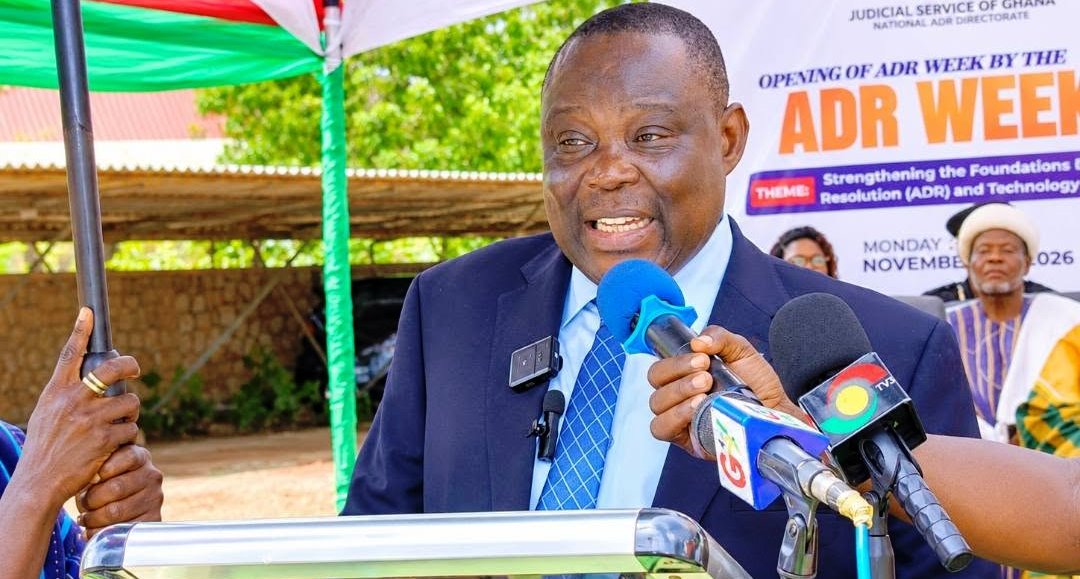
Ghana’s Court Connected Alternative Dispute Resolution (ADR) programme has reduced the caseload of conventional courts by 41,431 cases since its introduction in 2005, Acting Chief Justice Justice Gabriel Scott Pwamang has disclosed.


He said the programme had become an important tool for easing pressure on the courts and improving access to faster, cheaper and more accessible justice.
Justice Pwamang made the disclosure on Monday, November 16, 2026, at the launch of the Judicial Service’s 2026/2027 ADR Week at the Tamale High Court in the Northern Region.
He revealed that 138 courts nationwide had been connected to the programme, supported by 336 trained mediators. In 2025 alone, 6,836 cases were referred to ADR, with 2,722 successfully settled.
The Acting Chief Justice said the figures demonstrated the programme’s contribution to reducing judicial workload and freeing up court time for cases requiring full trials.
He urged lawyers, litigants and the general public to embrace ADR, particularly mediation, as an effective alternative to prolonged litigation.
Justice Pwamang explained that the Judiciary introduced Court Connected ADR in 2005 after recognising that rising case filings were overwhelming available courts, judges and magistrates, resulting in significant backlogs.
He said mediation offered disputing parties an opportunity to resolve their differences through a neutral third party without the financial burden, delays and strained relationships that could accompany conventional litigation.
Beyond reducing court backlogs, the Acting Chief Justice wants technology to make ADR accessible to people regardless of their location.
Speaking under the theme, “Strengthening the Foundations of Justice through Alternative Dispute Resolution (ADR) and Technology,” he called for the adoption of virtual mediation to eliminate unnecessary travel and reduce the cost of accessing justice.
He illustrated the potential of the technology with a farmer in Yendi involved in a dispute with a foodstuff trader in Tamale, arguing that both parties should be able to participate in mediation remotely rather than travel to meet physically.
He said such arrangements would particularly benefit people in rural and underserved communities who face geographical and financial barriers to accessing judicial services.
Justice Pwamang acknowledged, however, that the ADR programme was not yet available in all courts across the country. He disclosed that the Judicial Service had applied to the government for resources to extend its coverage nationwide while exploring technology-driven solutions to support virtual mediation.
He also appealed to development partners, businesses and philanthropists to support the expansion and technological transformation of the programme.
The Acting Chief Justice noted that alternative dispute resolution was not alien to Ghanaian society, recalling that traditional communities relied on dialogue, negotiation and customary mechanisms to settle disputes long before the formal court system was introduced in the Gold Coast Colony in 1876.

He said the annual ADR Week was intended to deepen public awareness and encourage people with pending court cases to explore opportunities for amicable settlement.
Welcoming the Acting Chief Justice and other dignitaries on behalf of the Northern Regional Minister, the Director of Administration of the Northern Regional Coordinating Council, Baba Ahmed Abdul Rahaman, described ADR as particularly relevant to communities in Northern Ghana, where traditional conflict resolution and consensus-building have historically helped maintain peaceful coexistence.
He said prolonged and expensive court proceedings could make justice difficult to access for some citizens and called for stronger collaboration between the Judiciary, traditional authorities, religious leaders and other stakeholders.
He further stressed that accessible and timely justice was essential to peace, social cohesion and national development.
Justice Pwamang subsequently declared the 2026/2027 ADR Week officially launched, reaffirming the Judiciary’s commitment to strengthening ADR as a key pillar of justice delivery in Ghana.
Source: www.kumasimail.com