

































The ECOWAS Court has dismissed all 7 allegations by Gertrude Sackey Torkornoo against Ghana over her suspension and removal from office as Chief Justice.


The Court has effectively upheld the processes activated by Ghana to remove her from office as they were “not unfairly and arbitrarily” done.
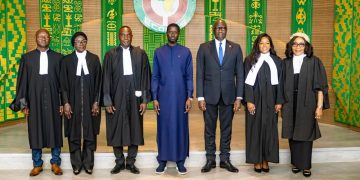
The three-member Court panel, while delivering the judgment on Wednesday, June 24, 2026, said the Committee set up by the President to investigate the petitions was lawful and she was afforded the opportunity to be heard.
The Court also said the prima facie determination by the President in consultation with the Council of State, which was a preliminary measure before she was written to, was a preliminary step and not an actual hearing.
On her demand for $10 million for damage to reputation, the Court also said there is no reparation decision for the Court to make for her.
“In light of the Court’s conclusions that Ghana has not violated any of the Applicant’s rights under the African Charter as alleged, the Court makes no decision on reparations,” the Court said on Torkornoo’s claim for US$10 million in damages.
The ECOWAS Court, while ruling in favour of Ghana, said it found that there were no violations of rights; and so she was not entitled to her claim for 10 million dollars.
Deputy Attorney-General Dr Justice Srem-Sai represented the Republic of Ghana while the former Chief Justice was represented by well-known Senior Advocate of Nigeria Femi Falana.
Summary of issues
- Whether the prima facie determination violated her right to fair hearing under Article 7 of the ECOWAS Charter
Holding: The Court held that the right to be heard crystallizes when a petition is presented to the 5-member committee. The prima facie is a filtering mechanism and not the actual hearing. The Applicant admits she was given petitions and was heard in full by the Committee. The Respondent fulfilled its obligation.
- Whether, contrary to Article 7 of the Charter, the Committee was biased and improperly constituted on the basis that Justices Pwamang and Asiedu had participated in adjudicating similar cases by the same petitioners and also that the Committee didn’t take the judicial oath before beginning its work
Holding: The Court held that the Applicant did not demonstrate that the issues before the ECOWAS Court were similar or substantially the same as those previously before those two Justices. It would be far-fetched to impugn bias merely because they have participated in other matters by the petitioners in their official duties as judges. Also, matters of composition, competence, rules of procedure for judicial and quasi-judicial bodies, including legal consequences of judicial oaths, belong to the courts of Ghana and not the ECOWAS Court.
- Whether the findings of the Committee are supported by evidence or not and therefore rendering the decision of the Committee invalid.
Holding: The Court says it declines to review the evidentiary findings of the Committee as the same is not before it.
- Whether the Applicant’s removal as CJ was unlawful as violating her right to work under Article 15 of the Charter
Holding: The Court held that the test is whether the suspension and removal were arbitrary, punitive, and imposed without lawful procedure. The suspension and dismissal were made pursuant to a clear procedure under Article 146 of the 1992 Constitution. The Court is persuaded by the Respondent’s submission which gives the Ghanaian constitutional position on this issue.
- Whether the Applicant was subjected to indignity under Article 5 of the Charter during the proceedings with allegations that her husband was excluded from the hearings, she and all participants were searched before entering the venue, the venue was specifically selected to traumatize her because it is linked to the murder of her uncle, and petitions were leaked to the media
Holding: The Court held that these measures were reasonable and proportionate in view of the sensitivity of the proceedings. On the choice of venue, no evidence was submitted by the applicant that her uncle was murdered there and that her mere discomfort with the choice of venue is not enough legal ground to constitute a violation of her right to dignity. With the allegation on media leaks, the Court reasoned that proceedings involving the highest judicial officer will undoubtedly attract high public scrutiny and attention.
- Whether the Respondent violated the principle of lis pendens by proceeding to suspend and remove her despite her filing an application at the ECOWAS Court seeking provisional measures
Holding: The Court reasoned that the pendency of an application for provisional measures does not preclude a Respondent state from going ahead with regular proceedings in the absence of a binding order. Restraint is only desirable and not a legal obligation.
- Whether or not the Applicant’s right to information under Article 9 of the Charter was violated by the Respondent’s failure to give her a report on the prima facie determination and the full report of the Committee’s work
Holding: The Court held that the right to information is guaranteed under the Charter but is subject to necessary qualifications. The Respondent state exercised valid and lawful discretion within those qualifications.
End