

































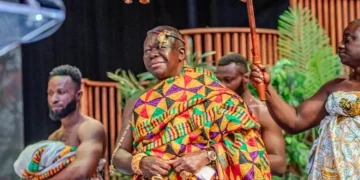







The President of the National House of Chiefs, Ogyeahoho Yaw Gyebi II, has underscored the enduring role of the chieftaincy institution in Ghana’s justice delivery system, saying traditional authorities continue to play a significant part in resolving disputes despite the expansion of the country’s formal court system.


Speaking at the Supreme Court @150 Anniversary Lecture Series held at the Manhyia Palace in Kumasi, Ogyeahoho Yaw Gyebi II said the institution of chieftaincy has evolved from being the sole custodian of justice in pre-colonial Ghana to becoming a constitutionally recognised partner in the administration of justice.
The lecture formed part of activities marking the 150th anniversary of the Supreme Court of Ghana, which is being celebrated throughout July under the theme, “Honouring the Past, Celebrating the Present, and Defining the Future.”
According to the President of the National House of Chiefs, the anniversary provides an opportunity to reflect on the judiciary’s achievements, challenges and evolution while strengthening public confidence in the justice system.
He noted that the celebration also seeks to enhance the corporate identity and visibility of the Supreme Court and deepen its engagement with stakeholders.
Ogyeahoho Yaw Gyebi II described the Supreme Court as the apex court of Ghana’s judiciary, mandated to interpret the Constitution, determine constitutional disputes and serve as the country’s final court of appeal. He added that the court also supervises lower courts and adjudicatory bodies to ensure the effective administration of justice.
Touching on the role of traditional authorities, he said chiefs were the principal custodians of justice in pre-colonial Ghana and continue to exercise recognised judicial functions under the 1992 Constitution.
He explained that the institution of chieftaincy operates alongside the country’s democratic governance system, with traditional councils and the Regional and National Houses of Chiefs handling customary matters and resolving disputes through arbitration.
“The institution of chieftaincy continues to contribute immensely to justice delivery by arbitrating disputes within communities, helping to resolve conflicts quickly and reducing the cost of litigation,” he said.
The anniversary lecture, held under the theme “The Supreme Court and the Institution of Chieftaincy: The Past, Present and the Future,” examined the historical relationship between Ghana’s formal judiciary and the traditional justice system, as well as opportunities for strengthening collaboration between the two institutions.
The Supreme Court @150 celebration features a series of activities aimed at reflecting on the development of Ghana’s judiciary while promoting reforms, technological innovation and greater efficiency in the delivery of justice.
Editorial note: The original transcript appears to contain transcription errors (for example, “Institution of Judgment” should be “Institution of Chieftaincy”, “1902 Constitution” should be 1992 Constitution, and “UNFAW” is likely a mistranscription). The story above has been edited to reflect the intended meaning while maintaining journalistic accuracy.