




































The government has unveiled a comprehensive package of reforms aimed at attracting private investment into Ghana’s rice value chain as part of efforts to achieve rice self-sufficiency and reduce the country’s dependence on imports.


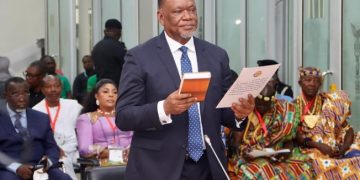
Speaking at the ECOWAS Rice Investment Roundtable in Accra, the Minister for Food and Agriculture, Eric Opoku, announced a series of market-oriented policies designed to create a more predictable and investor-friendly environment for producers, processors, aggregators, and financiers operating within the rice sector.
According to the Minister, key interventions already underway include the satellite mapping of 100,000 hectares of rice farmland and the introduction of a producer-importer quota policy intended to strengthen domestic production and improve market opportunities for local rice farmers.
“The critical challenge before us is not simply introducing new interventions, but building the policy architecture that makes investment viable and sustainable,” Mr. Opoku stated.
He explained that the producer-importer quota policy is not intended to restrict imports but rather to strengthen market linkages and encourage greater investment in local rice production. To further enhance investor confidence, the government is developing a predictable producer pricing framework that will provide greater certainty on input costs, expected margins, and long-term returns.
As part of broader efforts to improve access to finance, the Ministry is shifting from broad-based subsidy programmes to targeted credit arrangements supported by structured off-take agreements. Under the initiative, at least 25 percent of rice farmers are expected to operate under off-take agreements by 2028, creating more reliable market systems while improving financing opportunities for farmers and agribusinesses.
Mr. Opoku also highlighted inefficiencies in Ghana’s rice processing industry, noting that low milling conversion rates of between 50 and 55 percent result in annual losses estimated at between US$15 million and US$19 million.
To address the challenge, the government plans to connect rice production clusters with licensed millers through contract-based supply arrangements while encouraging investment in modern processing infrastructure.
The Minister disclosed that discussions are ongoing with development finance institutions to establish a Rice Processing Modernization Facility that will combine grant funding and concessional financing to support the acquisition of modern milling equipment. Additional measures under consideration include time-bound capital grants and equipment leasing programmes to facilitate the replacement of outdated machinery across the sector.
He further stressed the importance of rural infrastructure in attracting agricultural investment, indicating that production gains cannot be fully realized without efficient transport networks. As a result, the government is prioritising the rehabilitation of feeder roads linking production centres to markets under the Feed Ghana Programme to reduce post-harvest losses, improve market access, and increase farmer incomes.
The reforms form part of Ghana’s broader strategy to strengthen food security, expand local rice production, create employment opportunities, and position agriculture as a key driver of economic growth.
The ECOWAS Rice Investment Roundtable seeks to mobilise public, private, and blended financing to support national and regional rice investment plans and advance West Africa’s ambition of achieving rice self-sufficiency by 2035.
Source: www.kumasimail.com