



























The Upper West Parliamentary Caucus has demanded faster construction and strict adherence to quality standards from contractors executing major road projects in the region, after its first-day inspection revealed uneven progress across key sections of the government’s Big Push road programme.


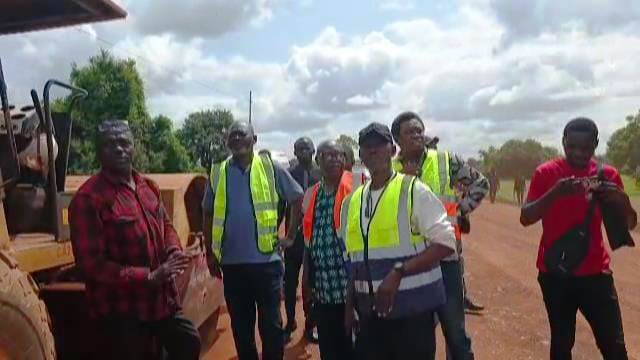
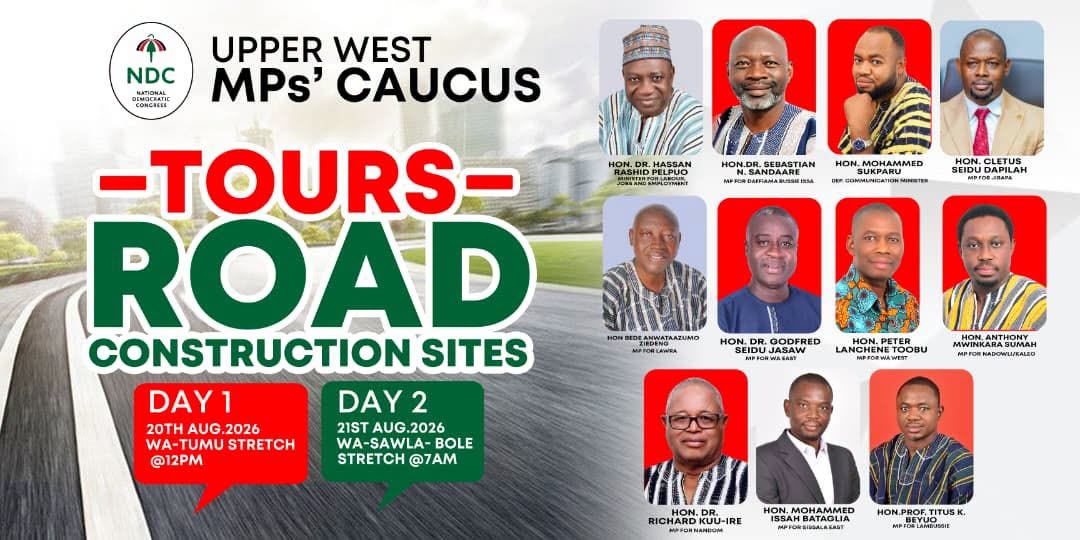
The caucus made the call after inspecting portions of the Wa–Tumu and Tumu–Han–Lawra roads on Thursday as part of a two-day monitoring exercise triggered by growing public concerns over the pace of work on several Big Push projects.
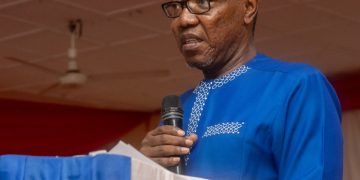
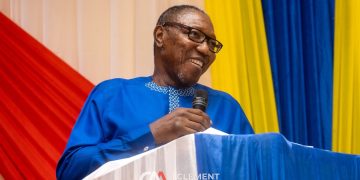
Led by its leader and Daffiama-Busie-Issa MP, Dr Sebastian Sandaare, the delegation included Wa West MP Peter Lanchene Toobu, Nadowli-Kaleo MP Anthony Mwinkaara Sumah and Lawra MP Bede Anwataazumo Ziedeng.
Dr Sandaare said the exercise was intended to give the MPs a firsthand assessment of progress and ensure that the projects were delivered within schedule and to the required standards.
“Our mission is to come around, tour the roads, and see the progress of work. We want our roads to be done in good time, also of quality, because we know how we struggle and how our roads are bad,” he said.
He stressed that the region needed durable roads capable of withstanding heavy traffic and supporting economic activity.
Some contractors making progress, others urged to speed up
The inspection found varying levels of progress among contractors working on the corridors.
Representing P&W Ghanem, Caesar Wadia said work was progressing on two lots, with the Wa–Han section covering about 22 kilometres already receiving primer sealing and the first seal.
He said the second seal was expected to be completed within three days.
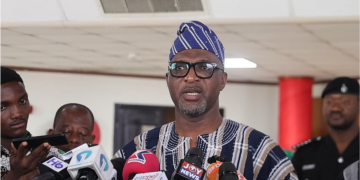
But Wa West MP Peter Lanchene Toobu said while some contractors were making appreciable progress, others were moving too slowly and needed to significantly increase the pace of construction.
He called on District Chief Executives in areas affected by the projects to strengthen monitoring, working with their municipal and district engineers to identify and resolve problems before they become major obstacles.
“If we think that it is the government and nobody cares, we come all the way from parliament to support the effective monitoring of these roads,” Mr Toobu said.
He urged the DCEs to monitor the projects weekly or, at minimum, monthly to ensure contractors remain on schedule.
Mr Toobu also expressed the expectation that the roads would be ready for commissioning by President John Dramani Mahama before the end of his current term in 2028.
Worst section of Wa–Tumu road identified
The District Chief Executive for Wa West, Richard Wollo, identified the section between Wa and Tumu as particularly critical to the region’s economic life, linking Upper West to the Upper East and Northern Regions.
He said the route was essential for the movement of agricultural produce and other goods, making its timely completion important to local economic activity.
While acknowledging progress by contractors including Ghanem and Aschal, Mr Wollo singled out the middle section between Wa and Tumu for urgent attention, saying it currently contains some of the worst portions of the road.
“That stretch for me is where we have the worst part of the road. All the potholes, the worst ones happen to appear on this stretch,” he said.
He therefore urged Greenhouse International Development Ghana Limited and Maripoma Enterprise Limited, which are working on portions of the corridor, to accelerate construction.
Mr Wollo also appealed to the contractors to raise the road level in vulnerable areas to address persistent flooding.
Big push under scrutiny
The inspection comes at a critical stage of the Big Push programme, President Mahama’s flagship infrastructure initiative designed to address Ghana’s deteriorating road network, improve key economic corridors and reduce the cost of transporting people and goods.
The Roads and Highways Ministry says the programme includes major road projects across all 16 regions. Parliament approved nearly GH¢50 billion for the multi-year road and bridge projects, while the government says work had commenced on 87 projects by the end of June 2026.
In Upper West, major projects under the programme include the Wa–Han Road, Tumu–Han–Lawra Road, Tumu–Hamile Road, Tumu–Sissili–Navrongo Road and Tumu–Chuchuliga–Navrongo Road, among others.
The Ministry’s project records show that the Tumu–Han–Lawra corridor has been divided among several contractors, including Aschal Investment Limited, Maripoma Enterprise Limited, Greenhouse International Development Ghana Limited and P&W Ghanem Limited. Maripoma, for instance, is responsible for the 10–30km section under a contract valued at about GH¢90.64 million, with work officially commencing in December 2025.
The first-day inspection therefore provides an important reality check on the government’s ambitious road programme.
While some sections are recording visible construction activity, the caucus’ assessment suggests that the pace is not uniform, with some contractors requiring stronger pressure to meet expectations.
For residents who have repeatedly complained about deteriorating roads, the MPs’ intervention will ultimately be judged not by the inspection itself but by whether it translates into faster construction, stronger supervision and roads that are completed on time and built to last.
The caucus is expected to continue its inspection on Friday, with attention turning to additional road projects across the region.
Source: www.kumasimail.com