








































Ghana has taken a major step towards making social protection a more coordinated and accountable national system with the launch of three new legal instruments governing social assistance and gender equity.


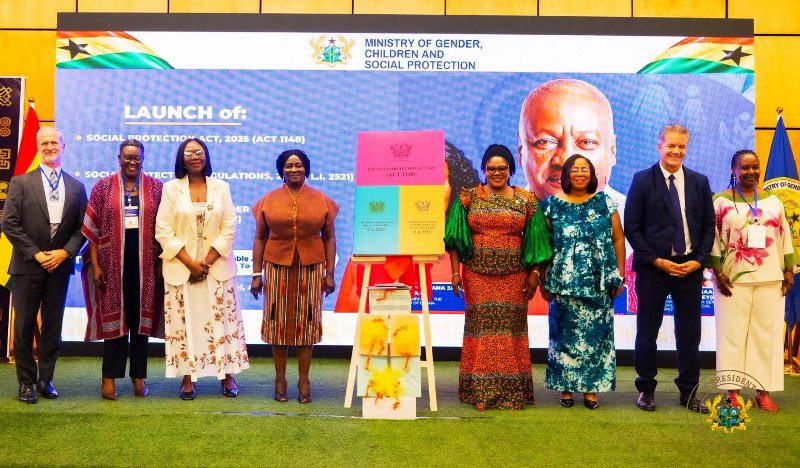
Vice President Professor Jane Naana Opoku-Agyemang on Wednesday launched the Social Protection Act, 2025 (Act 1148), the Social Protection Regulations, 2026 (L.I. 2521) and the Affirmative Action (Gender Equity) Regulations, 2026 (L.I. 2522) in Accra.
The development gives Ghana, for the first time, a strengthened legal and regulatory framework for coordinating social protection interventions, while providing an implementation framework for the country’s affirmative action legislation.
The new framework is expected to bring greater coordination, accountability and targeting to programmes designed to support people experiencing poverty, vulnerability and social or economic risks.
But Vice President Opoku-Agyemang made it clear that the real test begins after the launch.
“Their success will be measured not by their existence, but by the difference they make in people’s lives,” she said.
The Vice President said the laws must ensure that vulnerable households can access support, qualified women receive fair opportunities to participate and progress, and public resources reach the people for whom they are intended.
The framework covers existing interventions including the Livelihood Empowerment Against Poverty (LEAP), Ghana School Feeding Programme and National Health Insurance Scheme, while strengthening provisions for social assistance, emergency relief, productive inclusion and financial inclusion.
The launch comes as the government moves to overhaul the delivery and targeting of social protection programmes.
Gender, Children and Social Protection Minister Dr Agnes Naa Momo Lartey recently disclosed that government was expanding LEAP coverage from 350,000 to 450,000 households under the proposed BIG LEAP initiative.
She said a comprehensive reassessment of beneficiaries had also been undertaken using the National Household Registry, with the exercise identifying households eligible to remain on or enter the programme.
The Minister said the National Household Registry was being used as the common database for identifying eligible beneficiaries and supporting evidence-based planning and decision-making.
The registry has so far profiled millions of Ghanaians, providing government with a broader database for targeting social protection interventions.
Under the new Social Protection Act, the government also seeks to establish clearer institutional responsibilities and improve the coordination and delivery of interventions.
The Social Protection Regulations provide the detailed framework for implementing Act 1148, while the Affirmative Action Regulations provide the implementation framework for the Affirmative Action (Gender Equity) Act, 2024 (Act 1121).
For women, the launch comes as the Gender Ministry moves from the passage of the Affirmative Action law towards enforcement.
Dr Lartey disclosed last month that the implementation structures required under the Affirmative Action Act, including the Gender Equity Committee and Secretariat, had been established and were already working.
The Vice President said the Affirmative Action Regulations represented another step towards turning government’s commitment to gender equity into practical opportunity for Ghanaian women.

She said the country must now move beyond legislation and ensure that the new framework produces measurable changes in the lives of citizens.
“Our task now is to move from legislation to impact, and to ensure that no Ghanaian is unnecessarily left at the margins of our development,” she said.
Professor Opoku-Agyemang commended Dr Lartey and her team, Parliament, the Attorney-General and Minister for Justice, development partners and other stakeholders for their contribution to the process.
She also singled out Dr Esther Ofei-Aboagye for special recognition for her contribution to the development of the framework.
The launch was held under the theme, “Building an Inclusive, Equitable and Resilient Ghana: From Legislation to Impact.”
Source: www.kumasimail.com