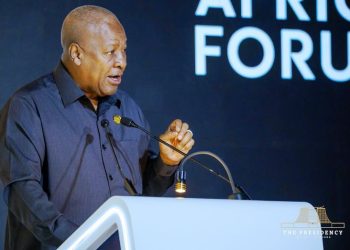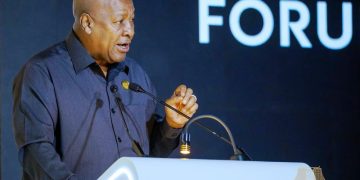



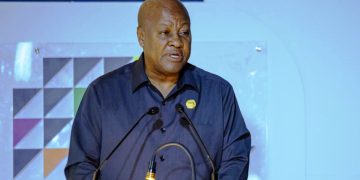





























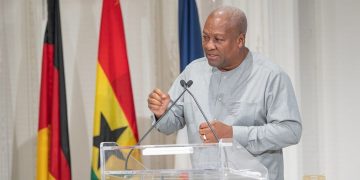



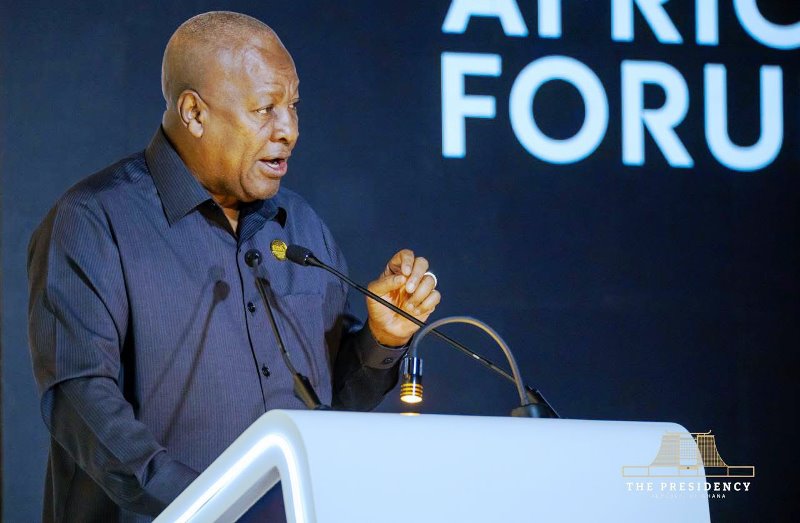
President John Dramani Mahama has turned attention to one of the less-discussed dimensions of Ghana’s housing crisis, thousands of partially completed houses that remain unoccupied because their owners cannot raise the money needed to finish them.


The President has proposed that the National Housing Fund (NHF), in partnership with financial institutions, develop a financing product that would allow owners of unfinished houses to borrow to complete their properties and repay the loans after moving into them.
He made the proposal on Wednesday, October 7, 2026, when he opened the maiden National Conference on Housing Finance in Accra.
President Mahama said the widespread sight of unfinished buildings across the country pointed to a financing problem that could not be solved simply by constructing more new houses.
“I travel all over the country, and anytime we are coming to land, and you see the number of unfinished houses all over. It is mind-boggling,” he said.
The proposed financing arrangement, he said, could unlock the substantial capital already invested in incomplete houses while helping owners who continue to pay rent despite having properties under construction.
The proposal represents a shift in emphasis from treating Ghana’s housing challenge solely as a deficit in the number of housing units to also addressing the financing bottlenecks that prevent existing housing investments from becoming habitable homes.
President Mahama said Ghana’s housing problem was not only about the estimated 1.8 million-unit deficit, but also about a housing finance system that did not adequately reflect the income realities of ordinary households.
He therefore urged the housing sector to develop a range of financing options rather than rely heavily on conventional mortgages.
He said people working in the informal economy, including traders, artisans, farmers and transport operators, should also be brought into the formal housing finance system.
Their repayment capacity, he suggested, could be assessed using alternative indicators such as savings records and verifiable business cash flows rather than relying exclusively on conventional salary-based assessments.
The President also challenged financial institutions to make measurable commitments following the conference.
He called for at least three financial institutions to introduce new or revise existing affordable housing loan products within six months, with a specific focus on households currently excluded from formal housing finance.
He further urged the National Housing Fund, lenders and developers to establish pilot financing partnerships offering realistic housing prices, clearly identified beneficiaries and credible delivery arrangements.
The government is expected to provide significant financial backing for this broader approach.
President Mahama directed the Minister of Finance, Dr Cassiel Ato Forson, to allocate GH¢1 billion in the 2027 Budget as the government’s contribution to a proposed GH¢3 billion revolving National Housing Fund.
The money is expected to finance housing projects on a revolving basis, allowing recovered funds to be redeployed to support additional beneficiaries.
But the President’s proposals extend beyond homeownership.
He announced the NHF’s planned “Easy Rent” programme, under which the Fund would pay rent advances for eligible workers, who would subsequently repay the amount through monthly instalments.
The initiative is intended to ease the financial pressure created by large upfront rent payments, particularly for workers and young households unable to mobilise substantial sums at once.
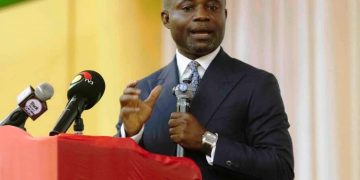
Deputy Minister for Works, Housing and Water Resources, Gizella Tetteh-Agbotui, who represented sector Minister Ahmed Ibrahim at the conference, reinforced the argument that Ghana’s housing crisis is fundamentally also a financing crisis.
She called for longer-term mortgage facilities for formal-sector workers, housing microfinance products for informal sector workers and staged construction financing for households that build incrementally.
She also advocated rent-to-own and shared-equity models to create alternative routes to homeownership, particularly for young people and first-time buyers.

According to the Deputy Minister, developers themselves face financing and cost pressures that ultimately feed into the prices of homes.
She identified high land and infrastructure costs, expensive building materials, limited access to long-term construction finance and difficulties associated with land administration as some of the factors contributing to the high cost of housing.
Her position builds on an earlier call for the National Housing Fund to move beyond policy intentions and translate government’s housing agenda into practical financing interventions.
The NHF has already begun widening its approach through initiatives including district-based housing projects, mortgage financing and rent-to-own arrangements.
The Fund’s National Mortgage Scheme resumed lending in September 2026 at an interest rate of 8.4 per cent, down from 13.5 per cent, while developer financing under the scheme stands at 10.4 per cent.
The government and NHF are also pursuing a District Housing Programme being piloted in eight districts, with the aim of extending decent and affordable housing beyond Ghana’s major urban centres.
Source: www.kumasimail.com