
























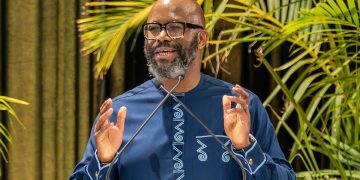






A National Vice Chairman aspirant of the National Democratic Congress (NDC), Samuel Addo Otoo, has proposed a comprehensive welfare and economic empowerment programme for party members, including group health, life and personal accident insurance schemes for grassroots activists and executives.


The proposal, which forms part of his vision for the party ahead of its internal elections, seeks to establish a social protection system that will support members beyond election campaigns and provide financial security for those who commit their resources and time to the party.
Mr Otoo said the NDC must move away from a system in which grassroots activists are mobilised to secure electoral victories but are often left to deal with personal challenges without institutional support after elections.
“A party should never just ask for your sacrifice during elections; it must protect your life, honour your hard work, and support your family every single day,” he stated.
He observed that branch executives, constituency officers, regional executives and grassroots activists made enormous sacrifices to secure electoral victories but were frequently neglected when they encountered medical emergencies, economic difficulties or legal challenges.
“When a comrade falls sick, they are often left to handle the medical bills alone. When an executive steps down or loses an election, they are forgotten. When our young activists are harassed for defending the party, they fight legal battles without help,” he said.
Under his proposed welfare programme, the party would introduce comprehensive group health, life and personal accident insurance schemes to provide a safety net for executives, branch officers and their families.
He also proposed a dedicated Elderly and Veteran Welfare Endowment Fund to support founding members, cadres and ageing party veterans with medical assistance and financial care.
Beyond welfare, the National Vice Chairman hopeful wants the NDC to establish cooperative businesses in every constituency to generate employment, improve members’ livelihoods and strengthen the party’s financial independence.
The proposed enterprises would include credit unions, grocery outlets, agrochemical supply shops, sorting and distribution hubs, and housing cooperatives.
He further proposed the establishment of party farms and cooperative restaurants across the country to provide members with access to quality food at subsidised prices.
According to him, these initiatives would help transform the party into an economically empowered institution rather than one that depends largely on the goodwill and financial contributions of individual supporters.
“We will establish locally owned cooperative businesses across every constituency. Owned and operated by our members, these enterprises will directly create jobs and elevate living standards,” he stated.
To provide sustainable financing for the proposed initiatives, Mr Otoo outlined plans to establish an independent Commercial Investment Trust, PEC-Trust Ltd, alongside a modernised revenue mobilisation system and digital dues collection platform.
He argued that the NDC must reduce its dependence on individual campaign financiers to sustain its daily operations and develop independent revenue streams to support its organisational activities.
The aspirant also proposed revolving micro-credit and business development funds to provide seed capital, low-interest loans and business mentorship for young people, women organisers and local entrepreneurs within the party.
On institutional development, he wants the party to construct and own permanent offices in every constituency and regional capital, moving away from rented premises and temporary operational spaces.
He further proposed granting former constituency, regional and national executives ex-officio delegate status and permanent positions on advisory councils to preserve institutional memory and retain their experience within the party.
Mr Otoo also pledged to establish regional law offices and a Pro-Bono Legal Defence Fund to assist party members facing political victimisation, legal harassment and violations of their civil rights.
To address internal disagreements, particularly following competitive party elections, he proposed formal Alternative Dispute Resolution (ADR) panels at the regional and national levels to resolve grievances without unnecessary resort to the courts.
Other components of his vision include direct partnerships between diaspora branches and constituencies to facilitate investment, technology transfer, skills development and educational exchanges, as well as constituency-level vocational, technical and digital skills training programmes for young members.

Explaining the philosophy behind his proposals, Mr Otoo said the NDC must transition from what he described as election democracy to transformational and developmental democracy, where the party’s commitment to improving lives begins with its own members.
“Democracy cannot end at the ballot box,” he said, arguing that social democracy must go beyond political transitions to deliver tangible economic growth and improve the welfare of the people who sustain the democratic process.
He said his professional experience as a lawyer, banker, economist, co-operator and businessman had informed the development of what he described as a practical blueprint for building a financially independent and structurally stable party.
“My vision is to advise and assist the National Chairman to build a resilient, self-reliant, and compassionate National Democratic Congress: a party where every member’s contribution is honoured, every executive is empowered, and no activist is left behind in hardship or forgotten in victory,” he stated.
Mr Otoo is seeking the position of National Vice Chairman on a platform centred on grassroots welfare, economic empowerment, institutional development and financial independence of the NDC.
Source: www.kumasimail.com