

































The government is prioritising the upgrade of rural 2G and 3G mobile networks to 4G and 5G-capable infrastructure as part of efforts to close Ghana’s digital divide.


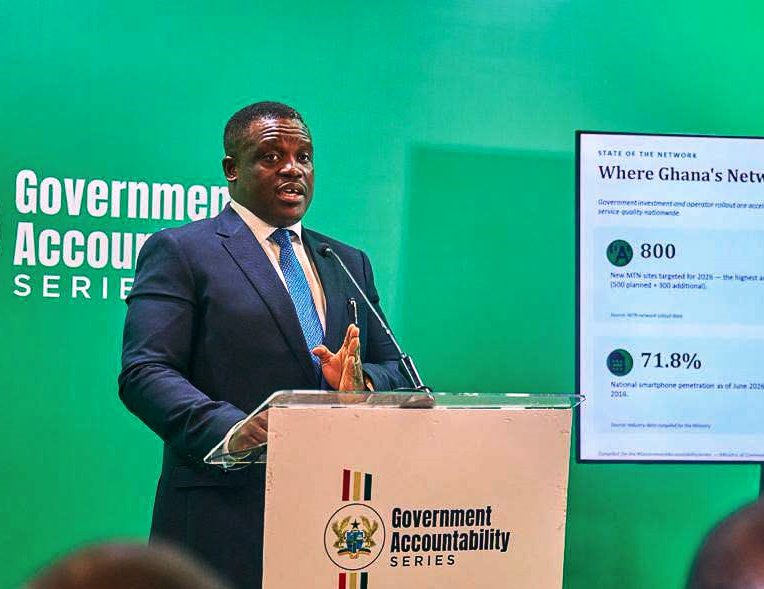
The Minister of Communication, Digital Technology and Innovations, Samuel Nartey George, disclosed this at the Government Accountability Series in Accra, saying the upgrade would be supported by fibre and microwave infrastructure to improve broadband connectivity in underserved and unserved communities.
He said the initiative would be implemented by the Ministry in collaboration with the Ghana Investment Fund for Electronic Communications (GIFEC), the National Communications Authority (NCA) and Mobile Network Operators.
According to the Minister, expanding reliable high-speed connectivity to rural communities remains central to the government’s digital transformation agenda.
He commended GIFEC for its contribution to digital inclusion, connectivity and digital skills development, particularly through the Rural Telephony Project (RTP), which is extending mobile connectivity to communities that have historically remained underserved.
Mr George also highlighted GIFEC’s support for government’s digital skills programmes, including the Girls in ICT Programme and the One Million Coders Programme (OMCP).
He said GIFEC’s ICT centres, regional offices, infrastructure and equipment were providing critical support for the implementation of the programmes.

Earlier in the day, the Ministry, in collaboration with GIFEC, officially launched the National Girls in ICT Programme at the Kofi Annan Training Centre in Accra.
The Minister congratulated 100 girls who emerged outstanding participants in the 2025/2026 programme, with 50 selected from the Volta Region and another 50 from the Upper East Region.
The Minister’s remarks underline GIFEC’s growing role in the government’s strategy to expand digital access while equipping young people with skills needed to participate in the digital economy.
The government’s rural network upgrade is expected to complement ongoing connectivity interventions by improving access to faster and more reliable internet services beyond Ghana’s major urban centres.
Source: www.kumasimail.com