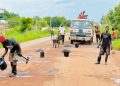
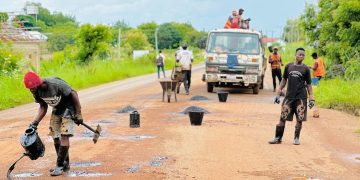

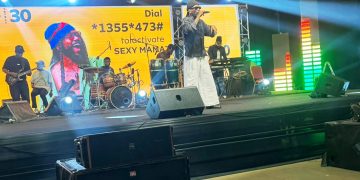





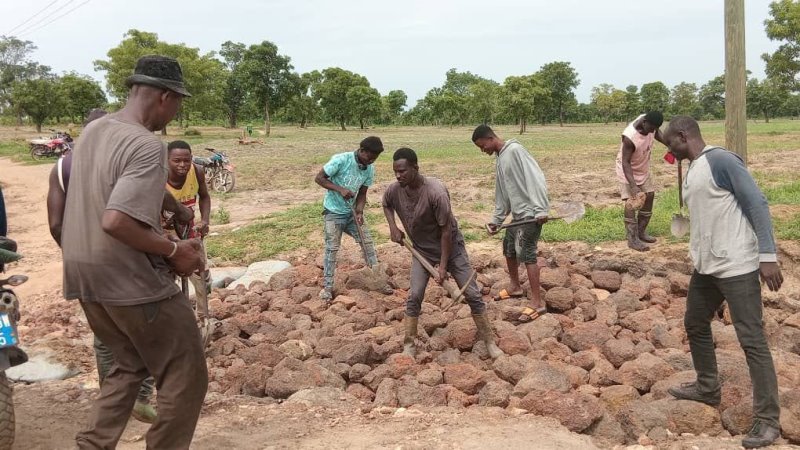
Ghanaian Afrobeat artiste Noella Wiyaala has reignited attention on the deteriorating state of roads in the Wa East District, questioning the apparent absence of effective leadership to address what she describes as one of the worst roads in Ghana.


In a blunt social media post recently, the internationally recognised musician singled out roads in Funsi, the district capital, and questioned whether the people of Wa East have adequate political representation.
“FUNSI ROAD IS ONE OF THE WORST ROADS IN THE HISTORY OF GHANA. Do we have a member of parliament? Or are we yet to vote for one?”
Wiyaala’s outburst comes at a time when the Upper West Parliamentary Caucus has undertaken a two-day inspection of major roads under the government’s Big Push infrastructureprogramme, amid growing public frustration over the pace of road development across the region.
But Funsi’s predicament raises a bigger question: why does Wa East continue to lag behind despite having a Member of Parliament, a District Chief Executive and a district administration responsible for driving development?
More than a bad road
For residents of Wa East, the problem is not simply about potholes or a difficult journey into the district capital.
The poor road network has become a development constraint, affecting virtually every major sector of the local economy and public service delivery.
For healthcare, bad roads can mean longer and more difficult journeys for patients seeking emergency treatment, while health workers and essential supplies also have to navigate difficult routes to reach communities.
For agriculture, the consequences are equally serious. Wa East is predominantly agrarian, but poor roads make it difficult and expensive for farmers to transport farm inputs to production areas and move harvested produce to Funsi, Wa and other markets.
The result is a familiar cycle: farmers produce, but struggle to move their produce efficiently; transport costs rise; post-harvest losses increase; and the economic value of agricultural production is weakened.
Transportation itself has become a daily burden for residents of Wa East, particularly during the rainy season when already-degraded roads can become difficult or, in some locations, virtually impassable.
And that has implications far beyond mobility.
Businesses are discouraged from operating in communities where movement is unpredictable. Public servants can find rural postings less attractive. Students and teachers face difficult journeys. Contractors and development partners encounter higher costs when implementing projects.
In other words, a road problem becomes a development problem.
Where is the Big Push for Funsi?
That is what makes Wiyaala’s intervention particularly timely.
The government’s Big Push programme was presented as an ambitious response to Ghana’s infrastructure deficit, with major road projects being rolled out across the country.
The Upper West Parliamentary Caucus is now physically inspecting selected projects in the region to determine whether contractors are working at the required pace and whether the roads will be delivered on schedule.
But residents of Wa East have reason to ask whether Funsi and the wider district are receiving the same level of attention.
The caucus’ inspection has already revealed uneven progress on some major roads, with MPs calling on contractors to accelerate construction and local authorities to strengthen monitoring.
Yet the development deficit confronting Wa East cannot be solved by one road project alone.

It requires sustained advocacy, effective supervision, infrastructure investment and political leadership capable of pushing the district’s priorities to the centre of government’s development agenda.
The MP and DCE must answer
Wiyaala’s question about whether Wa East has an MP is deliberately provocative, but it captures the frustration of residents who want to see visible results from their political representation.
The district is represented in Parliament by Dr. Godfred Seidu Jasaw, while the District Chief Executive Sayibu Adamu is responsible for coordinating development at the local-government level.
The accountability question for both leaders is therefore straightforward: What concrete interventions have been secured for the Funsi road and other critical roads in Wa East?
What commitments have been made by the Roads and Highways Ministry?
Which roads have been submitted for rehabilitation or reconstruction?
Which have been awarded?
What is the status of those projects?
And where projects have not yet been secured, what is being done to change that?
For the DCE, the questions extend to the district’s development planning and supervision: Which roads have been prioritised in the Assembly’s Medium-Term Development Plan? What has the Assembly done to maintain critical feeder roads? How frequently are engineers inspecting the road network? And what challenges are being escalated to the Regional Coordinating Council and central government?
These are not partisan questions. They are questions of public accountability.
A District waiting for development
Wiyaala may have spoken about one road, but her intervention has exposed a much larger conversation about Wa East.
Funsi and its surrounding communities cannot fully unlock their agricultural potential, improve access to healthcare, attract investment or connect effectively to markets while basic transportation infrastructure remains severely constrained.
The irony is that Wa East has productive farmland and communities with enormous potential, yet poor connectivity continues to limit the ability of residents to convert that potential into sustained economic opportunity.
As the Upper West MPs inspect Big Push roads across the region, Wa East should not be left outside the conversation.
The people of the district deserve to know whether their roads are on government’s infrastructure agenda, when work is expected to begin and who is responsible for ensuring that promises translate into construction.
Noella Wiyaala has asked a provocative question:
“Do we have a member of parliament?”
The answer is, of course, yes.
The more important question now is: What is Wa East’s political and development leadership doing to ensure that the people of Funsi and the wider district no longer have to shout on social media before their roads receive attention?
Source: www.kumasimail.com