




























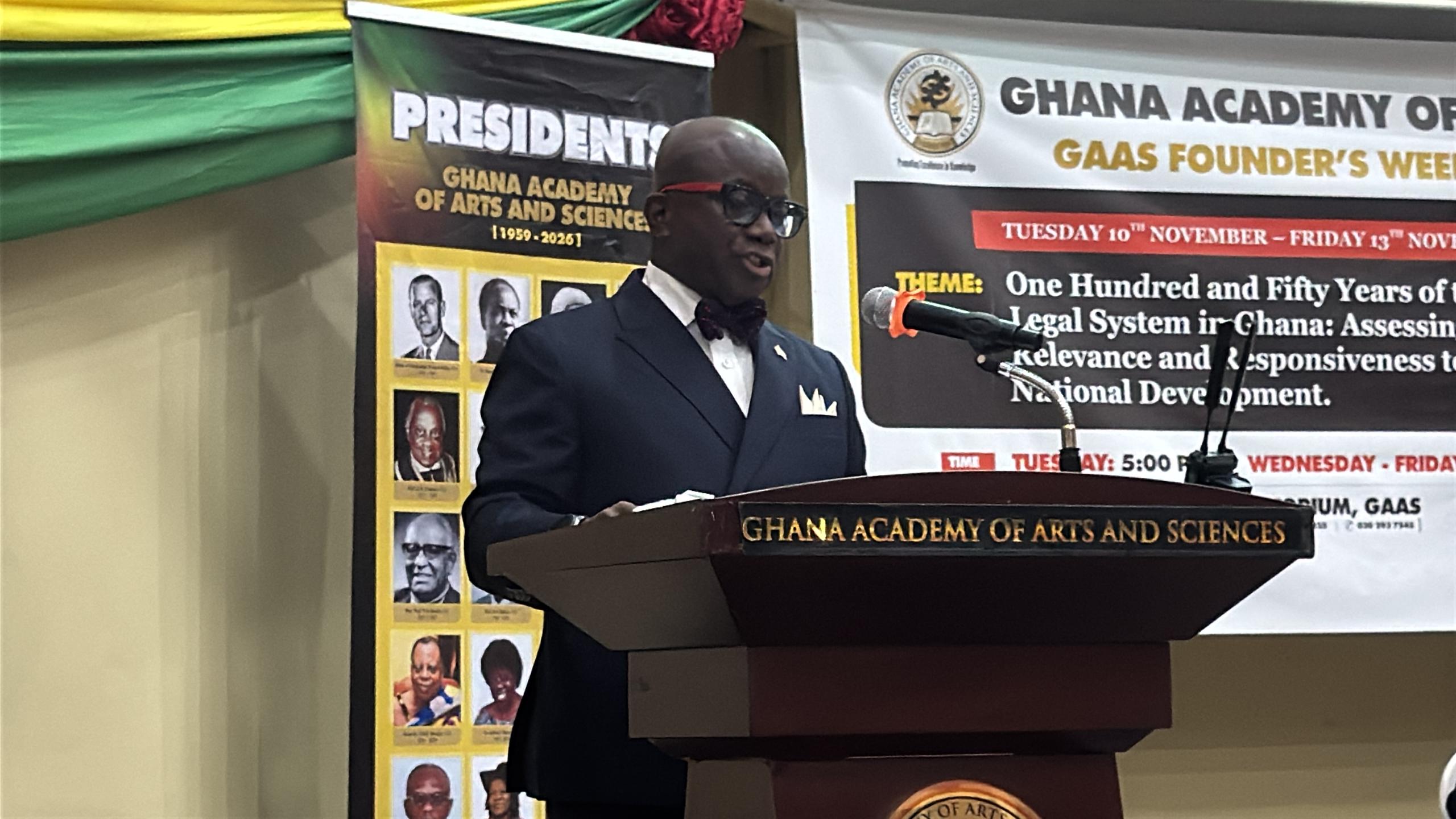
Ghana’s legal system began life as a colonial transplant and has since been made national through the combined work of the law faculties, the Bar and the courts.


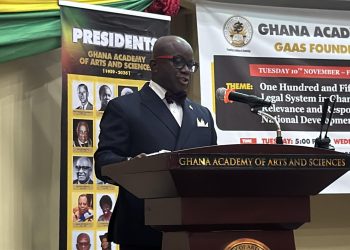
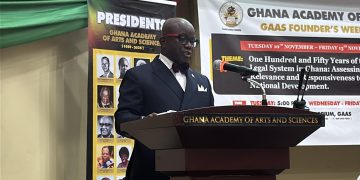
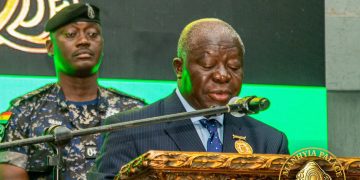
That was the central argument of Justice Kweku Tawiah Ackaah-Boafo of the Supreme Court of Ghana, who delivered his lecture on Day 2 of the 2026 Founder’s Week Lectures of the Ghana Academy of Arts and Sciences in Accra.
The lectures mark 150 years since the Supreme Court Ordinance of 1876, which established a Supreme Court for the Gold Coast Colony and brought in English common law, equity and statutes of general application, admitting the customary law of the people only so far as it was judged compatible with those imported rules. “The legal system we inherited therefore began its life as a transplant,” he said.
A legal system becomes national, he argued, when the people it governs come to own it. In Ghana that ownership has been built by three institutions acting on one another.
The Faculty forms lawyers and asks why the law is what it is. The Bar carries those questions into court and puts the State to the test.
The Bench decides them, and its decisions return to the classroom to be studied and refined. Over time, he said, the lessons of this cycle have been written into the 1992 Constitution, which is “in large part a record of what we learned in our classrooms and courtrooms” during the decades before it.
The Faculty
Justice Ackaah-Boafo began with the Faculty, because every lawyer and judge passes through it.
Ghanaian legal scholarship, he noted, is older than the country’s law schools. John Mensah Sarbah’s Fanti Customary Laws in 1897, followed by the work of J.E. Casely Hayford and J.B. Danquah, placed indigenous law on the record in a form the colonial courts could read, and showed it to be a coherent body of rules with its own logic.
After independence, the Ghana School of Law and the University of Ghana Faculty of Law gave the nation the means to train its own lawyers, and scholars such as S.K.B. Asante, A.K.P. Kludze, W.C. Ekow Daniels and N.A. Ollennu wrote the texts through which Ghanaian law came to be taught.
Scholarship also turned Re Akoto, the 1961 decision upholding preventive detention, into a lasting lesson on what becomes of liberty when judicial review is weak, and an academic, Nana Dr. S.K.B Asante, chaired the Committee of Experts that prepared the 1992 Constitution.
He identified three challenges for the Faculty.
Access to professional legal education has become a matter of national debate, and while acknowledging the reforms already under way, he called for standards to be maintained through a transparent admissions process, investment in teaching and closer cooperation between the General Legal Council, the universities and the Ghana School of Law.
He also pointed to a “citation gap”, since Ghanaian courts rarely cite Ghanaian scholarship, and to the formation of character, drawing on his own years teaching ethics at the Ghana School of Law.
The Bar
Turning to the Bar, he described it as a nation-building profession from its beginnings, recalling the role of lawyers in the Aborigines’ Rights Protection Society’s opposition to colonial land legislation in the 1890s.
The Bar supplies the Bench with its judges, so the integrity of the courts depends on the culture of the profession. It also supplies the courts with their questions.
“Every landmark in our constitutional history began as a lawyer’s decision to file a writ,” he said.
He traced the struggle over personal liberty from Re Akoto through the Salifa cases of 1968, in which a young man freed on habeas corpus was immediately re-arrested, and the growth of judicial authority through Sallah v Attorney-General in 1970 and Tuffuor v Attorney-General in 1980.
The framers of the 1992 Constitution drew on that history, setting out detailed protections for liberty in Article 14, including the 48-hour rule, and giving every citizen direct access to the Supreme Court under Article 2.
Lawyers have made full use of that access, securing the right of prisoners to vote, a cleaner voters’ register and the recovery of public money paid under contracts never approved by Parliament.
He gave particular attention to the bail cases brought by lawyer Martin Kpebu, which ended the mandatory refusal of bail for serious offences in 2016 and established in 2019 that the 48-hour limit runs through weekends and public holidays.
“Across that span,” he said, “the citizen’s right to be brought promptly before a judge grew from a door the State could close at will into a guarantee that obliges our courts to open on a Sunday.”
He also cited the presidential election petitions of 2013 and 2021 as examples of the Bar and Bench resolving the most political of disputes according to law.
He cautioned that open standing under Article 2 can be used for partisan ends, that legal services remain concentrated in a few cities and beyond the reach of many citizens, and that commercial pressures threaten the public-interest tradition on which so much constitutional progress has depended.
The Bench
Justice Ackaah-Boafo, who sits on the Bench himself, recalled its darkest moments, among them the revocation of Chief Justice Sir Arku Korsah’s appointment in 1963 after a treason acquittal, the 1964 amendment that let the President dismiss judges at will, and the murder of three High Court judges in 1982.
These events, he said, explain why the 1992 Constitution guards judicial independence so carefully. Alongside these trials, the courts carried on the quieter work of developing customary law and adapting the common law to Ghanaian conditions.
After the 2019 bail ruling, designated courts began sitting on weekends and public holidays, which he described as the judiciary re-organising its own working week around the liberty of the citizen.
More than three decades after Article 22(2) directed Parliament to legislate on the property rights of spouses, he noted, no such law has been passed.
The Supreme Court has acted in the meantime, holding in Mensah v Mensah, Arthur v Arthur, Quartson v Quartson, Boafo v. Boafo and lately Owusu Sarpong v. Owusu Sarpong that property acquired during marriage is presumed to be jointly acquired, a change of particular benefit to women.
Judge-made rules, he acknowledged, cannot give the certainty of a statute, but “until Parliament acts, it is the judiciary that has kept the constitutional promise of Article 22 within reach of the spouses it was meant to protect.”
He named delay, the implementation of decisions and public confidence as the Bench’s chief challenges, adding that technology can help with the first two, while “public confidence can only be earned through conduct.”
Conclusion
Justice Ackaah-Boafo closed by returning to the history of personal liberty as proof that the three institutions work as one system, since scholarship, advocacy and adjudication were each needed to move from the unprotected detainee of 1961 to courts that now sit on Sundays.
He asked the Faculty for research the courts can use and wider access to professional training, the Bar for renewed commitment to public-interest litigation and to legal services beyond the major cities, and the Bench, including himself, for timely justice, faithful implementation and conduct that keeps the confidence of the public.
“Ghanaians have made the legal system received in 1876 their own,” he concluded, “and the work of moulding it continues in every lecture given, every writ filed and every judgment written.”