
































The New Patriotic Party (NPP) has rejected a number of key proposals contained in the Constitution Review Committee’s (CRC) report and the government’s response, arguing that any changes to Ghana’s 1992 Constitution must be based on broad national consensus rather than partisan considerations.


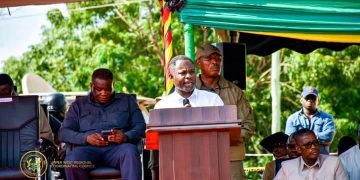
The party’s position was presented by the Member of Parliament for Gushegu, Sulemana Tampuli Alhassan, on behalf of the NPP’s ad hoc constitutional review committee, as the party outlined its proposed alternatives to several recommendations.
The NPP’s position follows the government’s July 30, 2026 response to the CRC report. The government accepted, among other proposals, a five-year presidential term, a November presidential election and a ceiling of 60 ministers and deputy ministers.
Call for broad consensus
The NPP said the Constitution belongs to the people of Ghana and should not be altered through a process controlled by one political party.
The party called for the participation of the two major political traditions, civil society organisations, traditional authorities, organised labour, including the Trades Union Congress, and marginalised groups in determining the future constitutional framework.
It also opposed what it described as attempts to impose partisan timelines on the review process, including a rushed drafting exercise or referendum timetable.
Instead, the NPP proposed the establishment of a Constituent Assembly to provide a broader platform for national consideration and ownership of constitutional amendments.
Four-year presidential term to remain
A major point of disagreement concerns the proposed extension of the presidential term from four to five years.
The NPP said it does not support the extension and wants the current four-year presidential mandate retained.
According to the party, the four-year cycle provides voters with a regular opportunity to assess the performance of an administration and decide whether to renew its mandate.
The CRC proposed extending the presidential term to five years, a position subsequently accepted by the government.
The NPP, however, supports moving presidential elections from December to the first week of November, specifically on a Tuesday. The party said the change would provide a longer transition period and accommodate considerations relating to Ghana’s multi-faith population.
The party also rejected additional constitutional restrictions on an outgoing president during the transition period, including proposed restrictions concerning leases, appointments and contracts.
It argued that an elected president retains a valid mandate until the expiration of the constitutional term and that existing legal and institutional safeguards are sufficient to deal with potential abuses.
Separation of executive and legislature
On the relationship between Parliament and the Executive, the NPP accepted the CRC recommendation that ministers should no longer simultaneously serve as Members of Parliament.
The party said separating the two roles would strengthen parliamentary oversight of the Executive.
It also backed the government’s proposal for a constitutional ceiling of 60 ministers and deputy ministers, describing the limit as a measure to promote fiscal discipline and prevent excessive expansion of government.
The government has proposed a 60-member ceiling, compared with the CRC’s recommendation for a lower limit.
Presidential age and election of DCEs
The NPP supports lowering the minimum age for presidential candidates from the current 40 years to 30.
The party’s position goes beyond the government’s proposal of 35 years, which was adopted as a modification of the CRC’s recommendation for a 30-year threshold.
The NPP argued that age should not be the principal determinant of eligibility for the presidency and said greater opportunities should be created for young people to participate in national leadership.
On local governance, the party supports the election of District Chief Executives (DCEs), but disagrees with both a phased implementation and a proposal that would limit candidates to a shortlist nominated by the President.
The NPP wants political parties to be legally permitted to sponsor candidates for DCE elections, in a system similar to parliamentary elections.
The question of who should be permitted to contest DCE elections has already emerged as one of the contentious areas of the constitutional review.
Article 71 and public-sector pay
The NPP also rejected the proposal to establish a separate independent Public Emoluments Commission to determine the remuneration of Article 71 office holders.
Instead, the party proposed expanding the statutory mandate of the Fair Wages and Salaries Commission (FWSC) to include Article 71 office holders.
It argued that creating another institution could result in duplication, additional bureaucracy and increased pressure on public finances.
Democracy Fund
The party supports constitutional recognition of a Democracy Fund to assist political parties with non-electioneering activities.
However, it does not support creating a separate institution to administer the fund. The NPP wants the Electoral Commission to be responsible for administering it.
The government has indicated that campaign financing and the proposed Democracy Fund could be dealt with through legislation as part of its proposed framework for regulating political parties.
Judiciary
On the Judiciary, the NPP rejected proposals to alter the existing tenure arrangements for the Chief Justice, arguing that there was insufficient empirical or institutional justification for changing the current framework.
The government, by contrast, has supported a fixed, single, non-renewable 10-year term for the Chief Justice, subject to the retirement age.
The NPP agreed that the process for removing superior court judges under Article 146 should be made more structured. However, it said the detailed procedures should be established through ordinary legislation or regulations rather than through further constitutional amendments.
The party also supports the CRC’s proposal to place a ceiling of 15 justices on the Supreme Court, comprising the Chief Justice and 14 other justices.
The CRC similarly recommended a maximum of 15 Supreme Court justices as part of measures intended to streamline the court and improve efficiency.
The NPP said expanding the apex court is not the appropriate response to delays in the administration of justice. It instead called for improved case management, administrative reforms and greater use of digital technology to address delays.
A distinct position from government
The NPP’s proposals place the party at odds with the government on several significant aspects of the constitutional review, including the length of the presidential term, the presidential age threshold, the transition powers of an outgoing president, the structure of DCE elections and the tenure of the Chief Justice.
The government has said its position was developed after Cabinet consideration of the CRC’s recommendations, which followed an extensive review process involving stakeholder consultations and public submissions. The CRC submitted a report containing 206 proposed amendments and new constitutional provisions.
The NPP’s position now adds another major political perspective to the debate over how Ghana’s constitutional framework should evolve, with the party insisting that any eventual amendments should emerge from a broad and inclusive national process.
Source:www.kumasimail.com