







































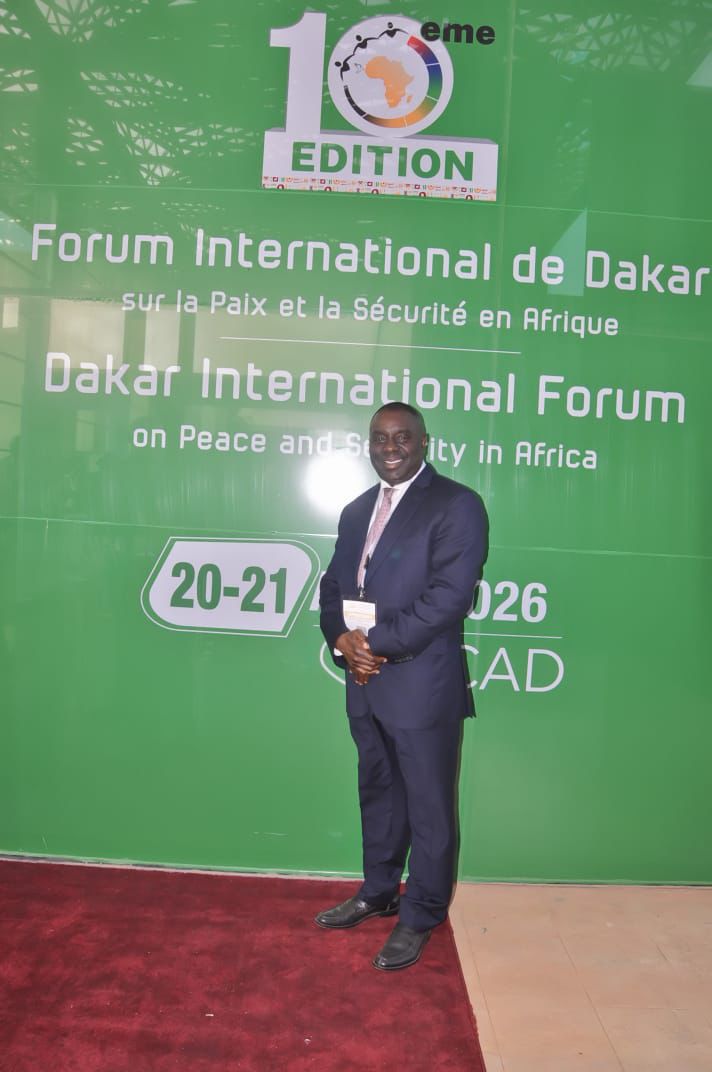
Rasheed Seidu Inusah, Chief Executive Officer of the Centre for Intelligence and Security Analysis (CISA Ghana), has called for stronger regional cooperation and the integration of civil society actors into West Africa’s security architecture to address growing threats of terrorism and instability.


Speaking at the 10th Dakar International Forum on Peace and Security in Africa, Ambassador Inusah emphasized that evolving security challenges in the region require more than state-led military interventions.
“Civil society and non-state actors are neither substitutes for state authority nor marginal participants in security governance,” he said. “They represent a strategic layer within a broader, integrated security framework.”
The forum, which brings together policymakers, security experts, and civil society leaders, focused on advancing African-led solutions to peace and security challenges across the continent.
Ambassador Inusah warned of the continued southward spread of extremist activity from the Sahel into coastal West African countries, including Benin, Togo, Ghana, and Côte d’Ivoire. He noted that groups linked to Jama’at Nusrat al-Islam wal-Muslimin (JNIM) and the Islamic State Sahel Province (ISSP) are exploiting porous borders and governance gaps to expand their influence.
He described the situation as an “interconnected arc of instability,” highlighting hotspots such as the Liptako-Gourma region and the Lake Chad Basin as key sources of spillover risk.
The CISA CEO also pointed to shifting geopolitical dynamics, including developments within the Economic Community of West African States (ECOWAS) and the emergence of the Alliance of Sahel States, as factors complicating regional security cooperation.
Against this backdrop, he underscored the importance of civil society actors—including traditional leaders, religious groups, youth networks, and community organisations—in strengthening early warning systems, mediating conflicts, and countering radicalisation.
“In many communities, particularly in border regions, these actors are the most trusted institutions and serve as frontline agents in preventive security,” he said.
Ambassador Inusah further highlighted the need to view civil society as part of a broader ecosystem that includes the private sector, humanitarian organisations, and research institutions, especially in areas where state presence is limited.
He cautioned, however, that the growing role of non-state actors must be supported by strong governance frameworks to ensure accountability, protect human rights, and maintain state authority.
The CISA CEO also referenced regional initiatives such as the Accra Initiative as examples of collaborative approaches that combine security operations with community engagement.
He called for the institutionalisation of civil society participation in early warning systems, increased investment in vulnerable border communities, and stronger collaboration between governments, regional bodies, and non-state actors.
Ambassador Inusah concluded that sustainable peace in West Africa will depend on inclusive strategies that balance military capability with community trust.
“An effective response to contemporary security challenges must combine capable state institutions, strong regional cooperation, and approaches that reinforce trust between governments and the communities they serve,” he said.
Source :www.kumasimail.com