





































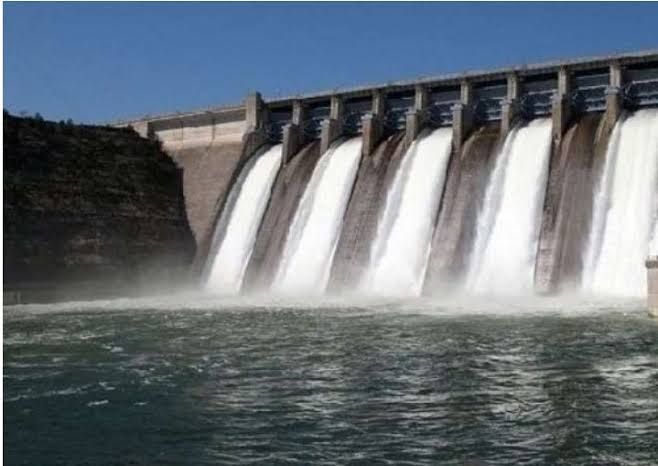
President John Dramani Mahama is considering a major rethink of Ghana’s response to the annual flooding caused by the spillage of Burkina Faso’s Bagre Dam, with a proposal to construct small dugouts to capture excess water for dry-season farming.


The emerging policy thinking, disclosed by the Upper East Regional Minister, Donatus Akamugri Atanga, could mark a significant departure from Ghana’s traditional approach of preparing communities for floods, evacuating residents and providing relief after the destruction.
Instead of treating the annual release of water from the Bagre Dam solely as a disaster to be endured, the government is exploring ways of capturing the water, storing it away from vulnerable riverbanks and converting it into an agricultural resource.
The proposal is particularly significant because the Bagre spillage has become an annual threat to communities along Ghana’s White Volta system.
Since the Bagre Dam was commissioned in Burkina Faso in 1992, controlled releases of excess water have repeatedly pushed the White Volta beyond its banks, with devastating consequences for communities downstream. The problem has been worsened when dam releases coincide with heavy rainfall in northern Ghana, leaving the river system with little capacity to absorb additional water.
The Water Resources Commission (WRC) says the White Volta Basin covers about 20 per cent of Ghana’s total land area. In 2026, the Commission again warned communities in the Upper East, North East, Northern and Savannah regions ahead of the Bagre spillage.
The latest controlled spillage began on August 28, 2026, after the reservoir in Burkina Faso reached critical levels. The WRC reported that the dam stood at 234.64 metres and was 95.19 per cent full on August 27, with only 0.36 metres of capacity margin.
For communities downstream, the consequences can be devastating.
Historical records illustrate the scale of the problem. In 2007, more than 307,000 people were reportedly affected by flooding, about 12,000 hectares of farmland were destroyed and the Upper East Region alone lost an estimated 144,000 metric tonnes of food crops. In 2018, 17 people died, 76,000 hectares of farmland were destroyed and Ghana lost more than 127,000 metric tonnes of maize. In 2020, 10 people died, 100 communities were submerged and more than 76,000 farmlands were reportedly destroyed.
Research has also shown how the problem becomes particularly severe when rainfall occurs simultaneously in Burkina Faso and northern Ghana. With the river system already saturated, additional water released from Bagre has nowhere to go except into surrounding communities and farmlands.
It is against this background that Mr Akamugri’s disclosure of President Mahama’s thinking assumes wider significance.
Speaking during a visit to Sapelega in the Bawku West District on Thursday, the Minister said the President was considering the construction of small dugouts away from riverbanks to collect water released during the annual spillage.
The stored water, he explained, could then be used for dry-season farming.
The idea, therefore, is not merely to build more flood-control infrastructure. It is to change the economics of the Bagre spillage.
Water that currently arrives downstream as a destructive surge could, where technically feasible, be diverted into strategically located storage facilities and subsequently used to irrigate farms during the dry season.
“That means when the spillage is done, then the waters can be collected over there. And when it comes to dry season, those hold-up areas, the water will still be there for us to do the dry-season farming,” Mr Akamugri said.
He said the President was “thinking outside the box” to find a lasting solution to a problem that has become an annual ritual for communities along the White Volta.
From disaster management to water management
The significance of the proposal lies in its potential to change the policy question confronting Ghana.
For decades, much of the response to Bagre spillage has centred on warnings, evacuation, emergency shelters, relief supplies and post-flood reconstruction.
Those interventions remain necessary because the spillage is ultimately controlled by Burkina Faso and is undertaken to protect the integrity of the Bagre Dam.
But they do not eliminate the underlying vulnerability.
The WRC has consistently explained that the controlled release from Bagre combines with rainfall and hydrological conditions in Ghana to increase flood risks downstream.
A network of strategically located dugouts, reservoirs and other water-retention structures could introduce another layer to the response: capture, storage and productive reuse.
If properly designed, such infrastructure could potentially serve several purposes simultaneously — reducing peak flood flows in vulnerable locations, providing water for dry-season irrigation, supporting livestock production, improving food security and creating new income opportunities for farming communities.
It could also help Ghana turn one of its most predictable seasonal disasters into a more predictable agricultural opportunity.
But the idea will require more than dugouts
The proposal should not, however, be interpreted as suggesting that small dugouts alone can eliminate Bagre-related flooding.
The scale of the White Volta system and the volume of water involved mean that the intervention would require serious hydrological studies, land-use planning and substantial investment.
The location, capacity and design of each retention facility would be critical. Building storage facilities in the wrong locations could simply transfer the flooding problem elsewhere.
There would also be questions around who controls the stored water, who owns the irrigation facilities, how farmers gain access to the water and how the infrastructure is maintained.
A broader programme could therefore involve a hierarchy of interventions — from community dugouts and retention ponds to larger reservoirs, irrigation schemes, flood-control channels, strengthened river buffers and improved flood forecasting.
It could also complement existing efforts to strengthen climate resilience in the Volta Basin. Research and adaptation programmes have increasingly advocated nature-based and community-centred approaches to managing the risks associated with the annual releases.
The Burkina Faso factor
There is also a larger regional dimension.
Ghana cannot completely control the timing and volume of water released from a dam located in Burkina Faso. The annual nature of the problem therefore makes cooperation between the two countries indispensable.

Better real-time information sharing, coordinated reservoir management, improved forecasts and longer lead times for communities could help Ghana prepare more effectively.
But even with improved coordination, Burkina Faso will still have to release water when reservoir levels threaten the safety of the Bagre Dam.
That makes Ghana’s ability to receive, regulate, store and use the water crucial.
President Mahama’s emerging proposal could therefore be the beginning of a more fundamental rethink: rather than asking every year how Ghana can survive the Bagre spillage, the country could begin asking how it can manage the water before it becomes destructive.
If backed by the necessary hydrological studies, financing and long-term implementation, that shift in thinking could turn the annual Bagre spillage from an event associated almost exclusively with flooded homes, destroyed farms and displaced communities into part of a wider northern Ghana water-security and irrigation strategy.
For thousands of farmers who watch their crops disappear under floodwaters almost every August and September, that could be a far more meaningful definition of a lasting solution.
Source: www.kumasimail.com