

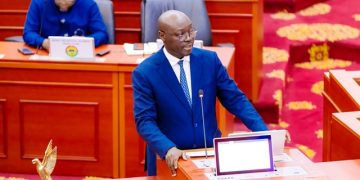
































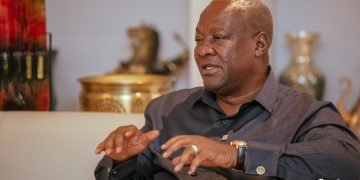
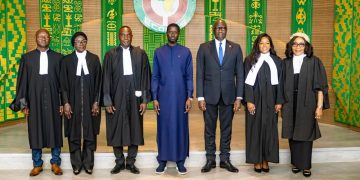



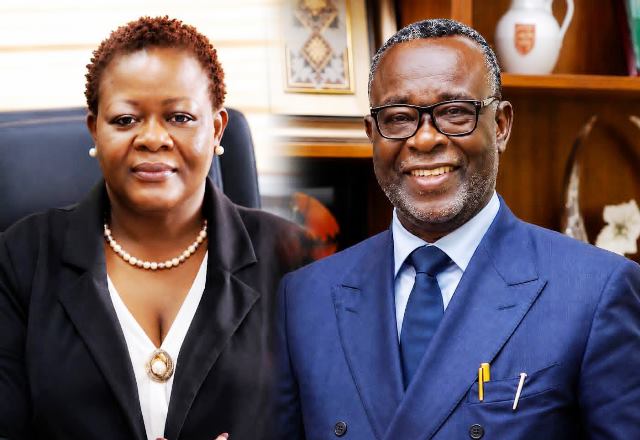
Deputy Chief Executive Officer of the National Health Insurance Authority (NHIA), Anatu Anne Seidu Bogobiri Esq., has defended Chief Justice Paul Baffoe-Bonnie over his recent call for Ghanaians to support President John Dramani Mahama’s agenda. She argued that the statement should not be interpreted through a partisan political lens.


According to her, the Chief Justice’s call for the success of President Mahama’s agenda was fundamentally a call for nation-building and should be viewed in the broader interest of Ghana rather than as an endorsement of the governing National Democratic Congress (NDC).
The Chief Justice, she noted, said: “Pres. Mahama’s agenda is one that will benefit Ghana. We should do everything to ensure that he succeeds.”
Reacting to criticism of the statement on her social media handles, Ms. Bogobiri said there was “absolutely nothing wrong” with the Chief Justice encouraging Ghanaians to support policies and initiatives that he believes could benefit the country.
She argued that President Mahama’s position as Head of State means that his success ultimately has implications for the entire country, irrespective of political affiliation.
“John Dramani Mahama is not just National Democratic Congress (NDC) President; he is President of the Republic of Ghana. His failure is Ghana’s failure. His success is Ghana’s success,” she stated.
She explained that if the government succeeds in implementing its agenda to reset the economy, fight corruption, create jobs and improve the living conditions of Ghanaians, the benefits would extend to citizens across the political divide, including supporters of the opposition New Patriotic Party (NPP).
Ms. Bogobiri questioned why anyone committed to Ghana’s development would wish for the failure of a sitting President.
She further maintained that the Chief Justice did not ask Ghanaians to vote for the NDC or campaign for President Mahama to win the 2028 general election.
“He did not say ‘NDC must win 2028.’ He did not say ‘vote for NDC.’ He spoke about Ghana,” she stressed.
According to her, the Constitution guarantees citizens, including members of the judiciary, the right to hold and express opinions on matters of national interest, provided such expressions do not compromise their constitutional responsibilities.
She therefore rejected attempts to portray the Chief Justice’s comments as partisan political advocacy, describing the remarks instead as an expression of support for national development.
Ms. Bogobiri also argued that judicial independence and impartiality should not be confused with silence on matters of national development.
She noted that the judicial oath requires judges to perform their constitutional duties impartially and without fear or favour, particularly in the adjudication of cases, but does not necessarily prevent them from contributing to national discourse outside the courtroom.

“The Chief Justice was speaking at a nation-building forum, not from the bench,” she said, adding that his comments were intended to encourage citizens to contribute to the success of a national development agenda.
She described such intervention as responsible leadership rather than political campaigning.
The NHIA Deputy CEO also accused critics of the Chief Justice of applying double standards, arguing that some individuals who are now condemning his comments were previously silent when similar statements were made in support of government initiatives under previous administrations.
“The hypocrisy must stop,” she said.
Ms. Bogobiri called for consistency in the public discourse surrounding the judiciary and political leadership, insisting that national development should not become a partisan issue.
She maintained that President Mahama’s “reset agenda” is intended to benefit Ghana and that citizens should be willing to support initiatives that advance the national interest, regardless of their political affiliation.
“The Chief Justice, as an eminent statesman, has every right to call on all of us to support it to succeed,” she added.
She urged Ghanaians to place the national interest above partisan considerations and to judge public statements within their proper context rather than deliberately interpreting calls for national development as political endorsements.
Source: www.kumasimail.com/Edmond Gyebi