



























Excellencies, Honourable Members of the National Assembly, distinguished guests, ladies and gentlemen,


Today, I would like to look at Artificial Intelligence from a slightly different perspective.
Not only as a technology. But as a question of humanity, development, sovereignty and diplomacy.
And, more importantly, I would like to look at AI from an African perspective.
What kind of AI-powered world do we want to build?
This, to me, is the fundamental question.
What kind of AI-powered world do we want to build?
The answer cannot come only from Seoul.
It cannot come only from Silicon Valley, London or any other technology centre.
It must also come from Accra, Nairobi, Lagos, Kigali, Addis Ababa and from communities across the African continent.
Because the AI revolution is not only about algorithms.
It is about people.
It is about data.
It is about infrastructure.
It is about energy, languages, markets, institutions and human experience.
And that is where Africa enters this conversation.
Korea has the technology. Africa has something equally important.
Korea has extraordinary technological capabilities.
Korea has world-class semiconductor industries.
It has telecommunications.
It has advanced manufacturing.
It has digital infrastructure.
It has research institutions.
It has healthcare technology.
And it is rapidly developing one of the world’s most sophisticated AI ecosystems.
Korea also has the ambition to become one of the world’s leading AI powers.
But there is one thing that AI cannot exist without.
And that is data.
The better the data, the more relevant the AI.
And the future of AI will increasingly depend on whether the data used to train and develop these systems adequately represents the world’s people.
This is where Africa has an enormous strategic opportunity.
Africa is home to more than 1.4 billion people.
We have a young population.
Hundreds of cultures and languages.
Rapidly growing cities.
Enormous agricultural systems.
Unique healthcare challenges.
Emerging industries.
And some of the world’s fastest-growing consumer markets.
Africa is not short of data.
Africa is short of the infrastructure and systems needed to transform that data into value.
Much of Africa’s data remains under-digitised, fragmented, poorly connected, or processed outside the continent.
And this brings us to an important concept:
Data sovereignty.
Who owns the data?
Where is it stored?
Who has access to it?
Who processes it?
Who develops AI models from it?
And ultimately, who captures the economic value created from that data?
These are no longer simply technical questions.
They are questions of sovereignty, economic development and national interest.
Africa must not simply become a consumer of AI
This is perhaps the most important message I want to leave with you today.
Africa has experienced many waves of technological transformation where the continent was primarily a market rather than a creator.
We cannot repeat that pattern with Artificial Intelligence.
If tomorrow’s AI systems are trained predominantly on data generated elsewhere, developed elsewhere and governed elsewhere, they may not adequately understand African realities.
What happens when an AI system does not understand our Twi, Frafra, Ga or Ewe?
What happens when agricultural AI is trained primarily on conditions outside Africa?
What happens when healthcare models are developed without sufficient African clinical data?
What happens when African cities are analysed without African urban data?
What happens when African history and culture are poorly represented in the datasets shaping global AI?
These are not merely technical questions.
They are questions about representation, sovereignty and development.
Therefore, Africa must move from:
AI for Africa to AI with Africa.**
And ultimately:
AI built by Africans, with trusted global partners.
Ghana has an opportunity
Ghana has already begun this journey.
In April this year, President John Dramani Mahama launched Ghana’s National Artificial Intelligence Strategy, with the ambition of positioning Ghana as an AI hub in West Africa.
The strategy recognises an important principle:
AI must understand Ghana. That means:
Local data.
Local languages.
Local institutions.
Local talent.
Local challenges.
And local solutions.
Ghana is also investing in AI skills and has announced plans for a US$250 million national AI computing centre, including work around national language models.
These are important foundations.
But I believe we should think beyond building an AI facility for Ghana.
We should think about building an AI ecosystem for Africa.
A Pan-African AI Hub in Ghana
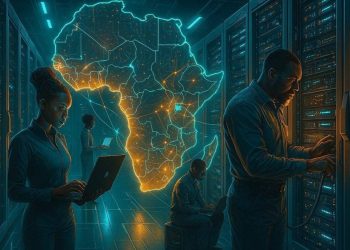
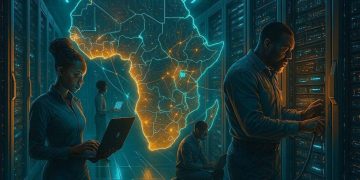
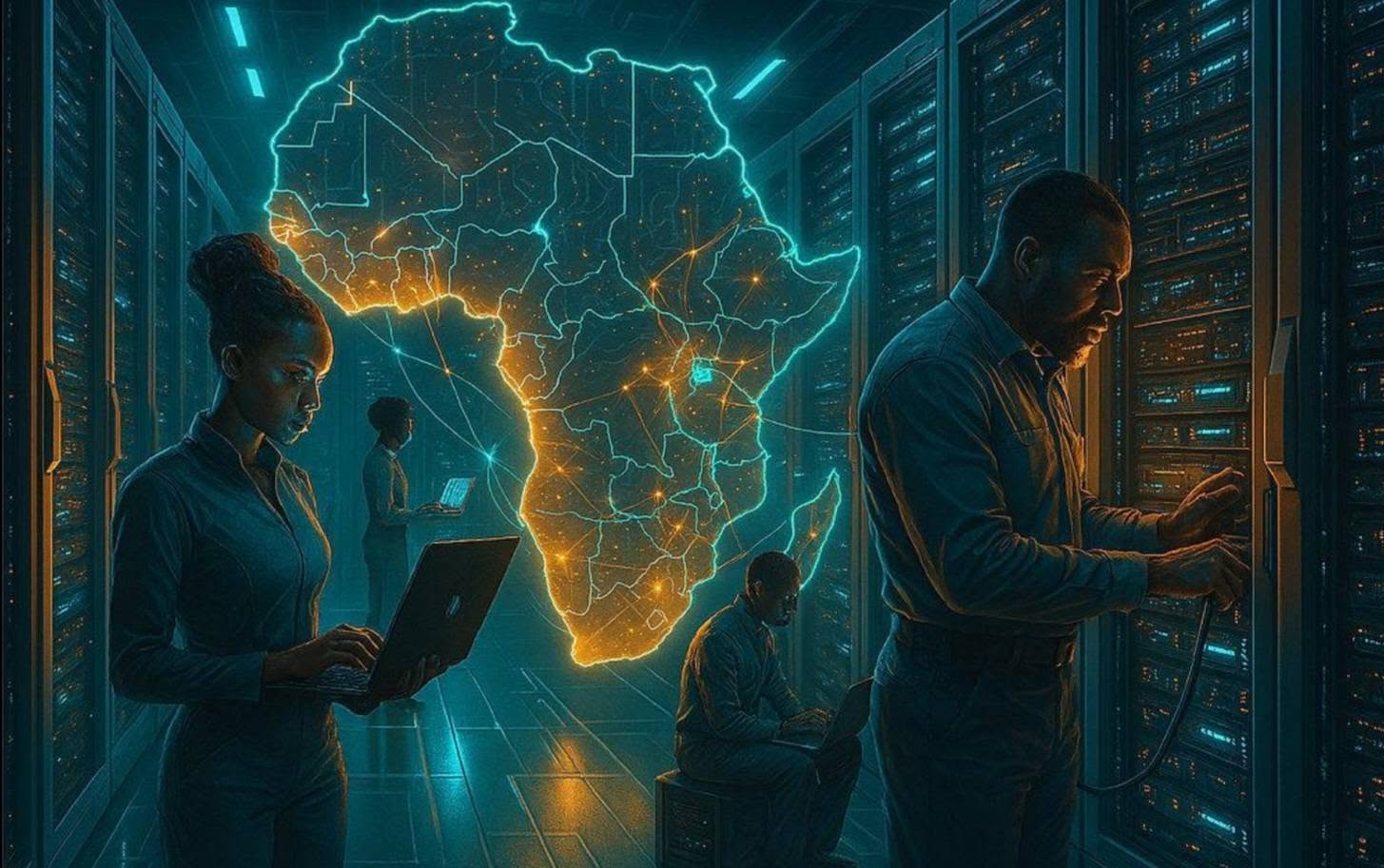
Imagine a major AI and data infrastructure ecosystem in Ghana. Not simply a building filled with servers.
But an ecosystem connecting:
Data centres.
Cloud and computing.
Reliable energy.
Fibre connectivity.
African data.
AI research.
Universities.
Start-ups.
Investment.
And responsible AI governance.
Such a platform could serve Ghana.
But its ambition should be continental.
Researchers from across Africa could access computing capacity.
African universities could develop AI applications.
Start-ups could train and test African solutions.
Healthcare institutions could work with African health datasets.
Agricultural researchers could develop models suited to African crops and climate.
Language researchers could develop African-language AI.
And African companies could commercialise solutions developed:
in Africa, for Africa, and eventually for the world.
That is why a data centre in Ghana should not be viewed simply as another technology infrastructure project.
It could become a symbol of Africa’s participation in the AI age.
Why does a Data Centre matter?
Sometimes we talk about AI as though it exists only on a screen.
It does not.
Behind every AI application is a physical ecosystem.
Servers.
GPUs.
Cooling.
Power.
Fibre.
Cloud infrastructure.
Cybersecurity.
Data storage.
Research facilities.
And, most importantly, people.
Without these foundations, AI remains dependent on infrastructure located somewhere else.
That creates both an economic and strategic vulnerability.
If Africa’s data is generated in Africa but processed somewhere else, much of the economic value created from that data may also accrue somewhere else.
Therefore:
Data sovereignty must become part of Africa’s digital development agenda.
A Ghana-based data and AI infrastructure ecosystem could begin to change that equation.
It could allow Africa not only to consume computing capacity, but increasingly to own and develop computing capacity.
This is where Korea becomes particularly important
Let me be clear.
My proposition is not that Ghana should simply ask Korea to build a data centre.
The opportunity is much bigger.
Korea and Africa can create a new model of technology partnership.
Korea brings:
AI and semiconductor technology.
Data-centre engineering.
Digital infrastructure.
Energy technology.
Manufacturing capability.
Healthcare technology.
Research capacity.
And private-sector investment.
Africa brings something equally important:
People
Talent.
Markets.
Data.
Natural resources.
Diverse environments.
And an enormous young consumer population.
And Ghana can provide an important bridge between these capabilities.
So I would put the proposition very simply:
Korea has the technology.
Africa has the people and the data.
Ghana can help bring them together.
The timing is important
This conversation is no longer theoretical.
At the KOAFEC Ministerial Conference in Seoul last month, AI and digital transformation were placed firmly at the centre of Korea-Africa economic cooperation.
The discussions included AI infrastructure, AI applications across sectors and AI talent development.
Korea is also developing approaches that link AI solutions with data centres and power infrastructure.
This is significant.
Because the policy architecture for precisely the kind of partnership I am discussing today is already beginning to emerge.
So the question is no longer:
“Can Korea and Africa cooperate on AI?”
The question is:
“Where do we apply this cooperation at scale?”
And I believe Ghana could be one of those places.
Ghana and the African Union:
Ghana has several strategic advantages.
We are already positioning ourselves as a digital and economic gateway in West Africa.
We host the AfCFTA Secretariat.
We have a growing technology ecosystem.
We have a young population.
We have adopted a national AI strategy.
And next year, Ghana will assume the Chairmanship of the African Union under President John Dramani Mahama.
This creates a unique opportunity.
Because Ghana’s AI ambition does not have to remain only a national policy.
It can become part of a Pan-African development agenda.
Imagine a Pan-African AI ecosystem where Ghana provides an important physical and institutional anchor, while countries across the continent contribute their own areas of expertise.
Accra.
Nairobi.
Kigali.
Lagos.
Addis Ababa.
And many others.
One country may develop health AI.
Another agriculture.
Another fintech.
Another climate technology.
Another smart-city applications.
But they share infrastructure, research, standards and knowledge.
That is how we turn separate national AI projects into a continental AI ecosystem.
AI Diplomacy:
And this brings me to a concept that I believe we need to begin discussing much more seriously: AI Diplomacy.
AI is no longer simply a technology issue.
It is becoming an issue of:
diplomacy,
economic security,
development,
national competitiveness,
and international cooperation.
Traditional diplomacy has focused on political relations, trade, development cooperation, peace and security.
But the next generation of diplomacy must also ask:
Who controls the technology?
Who owns the data?
Where is the computing infrastructure?
Who develops the AI talent?
Who establishes the standards?
And:
Who benefits from the value created by AI?
These are diplomatic questions.
For Ghana, I believe AI Diplomacy should mean using international partnerships to ensure that Ghana and Africa are not merely recipients of AI technology, but active participants in shaping the global AI ecosystem.
And this is where Korea becomes particularly important.
Korea has demonstrated how technology, education, infrastructure, industrial policy and international partnerships can transform a country’s economic position.
With Ghana assuming the African Union Chairmanship in 2027, AI Diplomacy can become part of Ghana’s broader continental engagement.
We can contribute to conversations on:
data governance,
AI ethics,
computing infrastructure,
talent development,
technology partnerships,
and African participation in global AI governance.
From Digital Diplomacy to AI Diplomacy.
I believe this is the transition we need to begin making.
This is also an economic opportunity:
There is another reason why this matters.
The AI revolution will create enormous new industries.
Data centres require energy.
Energy requires infrastructure.
Infrastructure requires finance.
AI requires researchers.
Researchers require universities.
Start-ups require capital.
And successful AI businesses require markets.
Therefore, an African AI ecosystem could stimulate investment across many sectors simultaneously.
A major AI data centre in Ghana could create demand for:
renewable energy,
power infrastructure,
fibre networks,
cybersecurity,
cloud services,
engineering,
construction,
research,
education,
software development,
and start-up investment.
In other words:
AI infrastructure can become industrial infrastructure.
And that, I believe, is the bigger opportunity for Ghana.
But AI must remain human:
Let us return to the today’s theme Global Ai for Humanity:
The purpose of AI cannot simply be greater computing power.
It must ultimately be better human outcomes.
If AI helps a farmer increase productivity, that is progress.
If AI helps a doctor diagnose disease earlier, that is progress.
If AI helps a child learn in his or her mother tongue, that is progress.
If AI helps government deliver services more efficiently, that is progress.
If AI helps African entrepreneurs compete globally, that is progress.
But if AI deepens inequality, removes human dignity, or allows African data to be extracted without value returning to African societies, then we must ask ourselves:
Are we truly building AI for humanity?
This is why responsible, inclusive and culturally grounded AI must remain at the heart of our approach.
Africa does not have to wait to catch up
For too long, Africa has been described as a continent that will eventually “catch up.”
I do not think that is the right way to think about the AI age.
Africa does not have to catch up by copying yesterday’s technologies.
Africa can leapfrog.
We can develop new models of healthcare.
New models of education.
New models of agriculture.
New models of public administration.
New financial systems.
New businesses.
And new ways of connecting Africa’s young population to global opportunity.
But to do this, we need:
Infrastructure.
Data.
Talent.
Policy.
And trusted partners.
Now, From Seoul to Accra:
Korea is looking toward the future and seeking to establish itself among the world’s leading AI powers.
Africa is also looking toward the future.
Africa does not want to be left behind.
Ghana does not want to be left behind.
But Ghana’s ambition should be greater than simply catching up.
Ghana should help lead.
If Ghana’s National AI Strategy, its planned computing infrastructure, its technology ecosystem and its 2027 African Union Chairmanship can be connected into one strategic vision, Ghana could help provide a platform for Africa’s participation in the AI revolution.
And Korea can be part of that journey.
Not simply as a supplier.
Not simply as a donor.
But as a:
trusted technology partner,
investment partner,
and ultimately,
strategic partner.
A proposition for the future:
So perhaps the proposition is very simple.
Korea has the technology.
Africa has the people, the markets and the data.
Ghana can help bring them together.
Let us build the infrastructure.
Let us protect the data.
Let us train the people.
Let us develop African AI.
Let us create partnerships that generate value on both sides.
And let us make sure that the AI revolution does not happen to Africa.
Let it happen with Africa.
Perhaps one day, when historians look back at the early years of the African AI revolution, they will not ask:
“Why was Africa left behind?”
They will ask:
“How did Africa choose to participate?”
And perhaps they will also ask:
“Where did that journey begin?”
I believe Ghana has an opportunity to make that story part of its future.
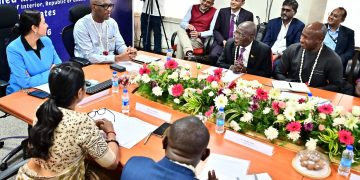
And perhaps the conversation that began here, in this room at the National Assembly of the Republic of Korea, can become part of that journey.
Global AI for Humanity.
Global AI with Africa.
And ultimately:
Global AI from Ghana to the world.
By Kojo Choi, Ghana Ambassador to the Republic of Korea