








































The Bank of Ghana has maintained the Monetary Policy Rate at 14 percent, citing declining inflation, resilient economic growth and improving financial conditions.
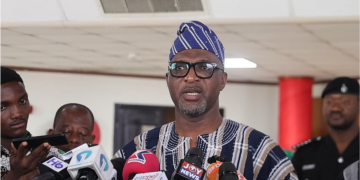
The decision was highlighted by Bank of Ghana Governor, Dr. Johnson Pandit Asiama, during a post-Monetary Policy Committee (MPC) engagement with heads of banks in Accra on Wednesday, August 12, 2026.
Dr. Asiama said the MPC, at its 131st regular meeting in July, assessed the evolving economic environment and concluded that the current policy stance remained appropriate to guide inflation toward the medium-term target while allowing the central bank to monitor global economic risks.
Headline inflation fell to 4.6 percent in July from 5.3 percent in June, supported by slower food inflation and relative stability in the cedi. The figure remains below the lower bound of the Bank of Ghana’s medium-term inflation target of 8 percent, plus or minus 2 percentage points.
The Governor said Ghana’s economy had also continued to show resilience, with real Gross Domestic Product growing by 6.4 percent in the first quarter of 2026, up from 6.2 percent during the same period in 2025.
He attributed the growth largely to strong performance in the services and industry sectors, adding that consumer and business confidence remained positive.
Private sector credit rebounds
Dr. Asiama said easing financial conditions were beginning to translate into stronger credit flows to businesses.
Private sector credit grew by 41.2 percent in June 2026, compared with 8.6 percent a year earlier, while real private sector credit growth stood at 34.1 percent.
He urged banks to take advantage of the improved economic environment to increase financing to productive sectors, particularly small and medium-sized enterprises.
According to the Governor, many SMEs, especially those operating within the agricultural value chain, continue to face difficulties accessing finance because they are considered relatively high-risk borrowers.
He called on banks to develop innovative and flexible credit products that reflect the seasonal nature of agricultural businesses and align loan repayments with borrowers’ cash flows.
Banking sector strengthens
The Governor also highlighted improvements in the banking sector, saying total banking sector assets increased by 30.7 percent in June 2026, largely driven by growth in deposits and shareholders’ funds.
The sector’s Capital Adequacy Ratio rose sharply to 20.4 percent in June, compared with 10.6 percent a year earlier.
At the same time, the Non-Performing Loan ratio declined from 23.1 percent to 16.1 percent over the period, indicating an improvement in asset quality.
Dr. Asiama said the developments reflected efforts by banks to strengthen their balance sheets and improve resilience.
Trade surplus reaches $8.8 billion
Ghana’s external position also strengthened during the first half of 2026, with the trade surplus increasing to US$8.8 billion from US$5.8 billion during the corresponding period of 2025.
The Governor said the improvement was supported by strong earnings from gold and cocoa exports.
The current account surplus also increased to US$5.1 billion from US$4.1 billion, while gross international reserves stood at US$12.9 billion at the end of June, equivalent to 5.0 months of import cover.
He said the cedi had also remained relatively stable on the foreign exchange market.
Bank warns against unlicensed digital lenders
Dr. Asiama disclosed that the Bank of Ghana had intensified efforts to clamp down on unlicensed digital lending activities.
He said the central bank had begun publishing weekly lists of entities identified as providing digital credit services without the required approval.
He urged banks to conduct thorough due diligence on Digital Credit Service Providers before entering into partnerships or business relationships with them.
Banks, he said, should verify the licensing status of such operators with the Bank of Ghana.
The Governor also expressed concern about increasing incidents of dud cheques and urged banks to strengthen monitoring, customer engagement and education to improve compliance.
Call for better use of diaspora remittances
Dr. Asiama further encouraged banks to develop dedicated investment products for Ghanaians living abroad, saying the banking industry had yet to fully tap into the potential of diaspora remittances.
He said remittances were still largely being channelled through basic money transfer services instead of structured savings, bonds and other investment products.
According to him, developing bank-led investment products, mobile money solutions and digital remittance platforms could help channel a greater proportion of diaspora funds into productive investment.
He said the Bank of Ghana would continue working with stakeholders to develop a national remittance strategy aimed at enhancing remittance flows and promoting savings, investment and broader economic development.
Dr. Asiama said the improved economic conditions provided an opportunity for banks to play a greater role in supporting businesses, households and sustainable economic growth.
He assured the banking industry that the Bank of Ghana would continue to provide the regulatory and policy environment needed to build a sound, resilient and growth-oriented financial sector.