









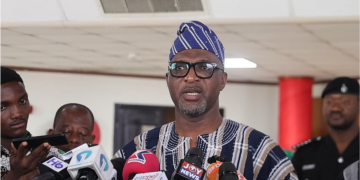
























Ghanaian journalist, communications professional and cancer-control advocate Benjamin Akyena Brantuo, whose book Dying Many Times: The Struggles of a Cancer Patient chronicles his family’s devastating encounter with cancer, is demanding a fundamental overhaul of the country’s response to the disease.


Mr. Brantuo, speaking on Joy Prime on Thursday, said Ghana could no longer afford to approach cancer as a collection of individual cases, arguing that the disease must be treated as a national public-health priority backed by dedicated financing, coordination and accountability.
His call for a National Cancer Authority and a dedicated National Cancer Fund comes from a deeply personal experience documented in his 2021 book, which recounts his struggle to care for his late wife, Patience Akyena Brantuo, who died from cancer in April 2020. The book examines not only the patient’s suffering but also the financial, emotional and systemic pressures cancer places on families.
Brantuo has previously said he wrote the book to complement medical literature with the perspective of a cancer victim and family, while pressing policymakers to make cancer management more affordable, efficient and accessible.
He is now seeking to turn those concerns into a broader national policy conversation.
“Ghana needs to move from treating cancer as individual cases to managing cancer as a national priority.”
At the centre of his proposal is the creation of a National Cancer Authority with responsibility for coordinating, regulating, monitoring and evaluating cancer prevention, screening, diagnosis, treatment, palliative care and survivorship.
According to him, the Authority should bring together government agencies, healthcare professionals, researchers, civil society, patients and development partners under a single national framework.
“We need one national authority, a dedicated cancer fund, a national strategy, standardised protocols and a measurable four-year action plan,” he said.
Call for dedicated cancer fund
Brantuo also wants government to establish a National Cancer Fund to provide sustainable financing for the fight against the disease.
The proposed fund, he said, should finance cancer prevention and public education, screening and early detection, diagnosis and treatment, essential medicines, equipment and infrastructure, research, cancer data and surveillance, palliative care and support for patients and their families.
He proposed that existing cancer-related funding arrangements could be reviewed and consolidated under the Fund, subject to the necessary policy and legislative processes.
But he stressed that the Fund must not become another opaque financing mechanism.
It should operate under strict governance, transparent reporting and accountability, with the proposed National Cancer Authority providing oversight, he said.
National strategy, standardised care
Beyond funding, Brantuo is proposing a long-term National Cancer Strategy covering the entire cancer-care chain — from prevention and early detection to diagnosis, treatment, palliative care, survivorship, research and surveillance.

He is also calling for national standard operating procedures to establish clear pathways for cancer referral, diagnosis, treatment, follow-up and palliative care.
Such protocols, he argued, would reduce variations in the quality and timeliness of cancer care and help patients navigate what can often be a complicated health system.
He further wants the national strategy translated into a four-year, measurable cancer action plan, with clearly defined priorities, budgets, responsible institutions, timelines and performance indicators.
The plan should be reviewed at the end of each four-year cycle to reflect performance, emerging cancer trends and changing national needs, he said.
From personal tragedy to national reform
For Brantuo, the proposals are not merely an abstract policy prescription.
Dying Many Times emerged from one of the darkest periods of his life, when he was simultaneously caring for his young son, dealing with the death of his wife and documenting the family’s experience with cancer.
The book has been described as an unusually personal account of cancer’s impact on patients and their families and as a critique of the difficulties confronting cancer care in Ghana.
Brantuo is now using that experience to press for systemic change.
“We need to move from treating cancer as individual cases to managing cancer as a national priority,” he reiterated.
His central argument is that Ghana’s response to cancer must move beyond isolated interventions towards a coordinated, adequately funded and measurable national system capable of preventing cancer, detecting it earlier, treating patients effectively and supporting families through the disease.
Dying Many Times: The Struggles of a Cancer Patient was published in 2021.
Source: www.kumasimail.com