



























The Institute of Economic Affairs (IEA) has challenged claims that the Ghana Gold Board (GoldBod) incurred a GH¢1.7 billion loss under the Bank of Ghana’s Domestic Gold Purchase Programme, saying the figure largely reflects accounting and foreign-exchange valuation differences rather than an actual financial loss.


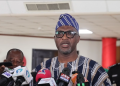
Professor Alexander Bilson Darku, Director of Research at the IEA, said the reported amount included service and assaying fees paid by the Bank of Ghana (BoG) to GoldBod, as well as exchange-rate valuation differences arising from gold purchases and exports.
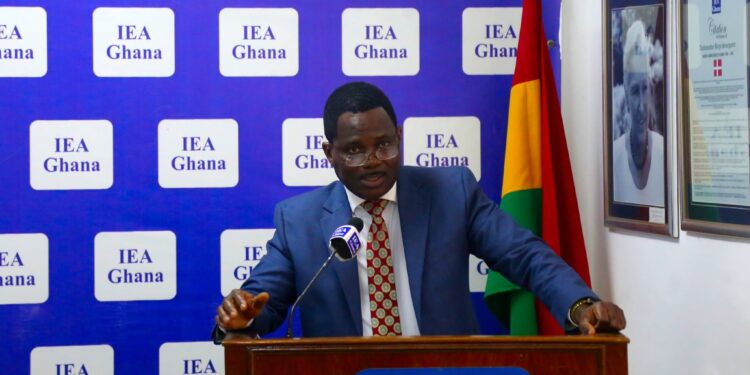
Speaking at the IEA’s assessment of the 2026 mid-year budget review on Wednesday, Prof. Darku questioned the classification of the fees as losses, noting that they represented revenue earned by GoldBod for services provided to the central bank.
“I don’t understand why somebody would call revenue a loss,” he said.
According to Prof. Darku, about 90 per cent of the GH¢1.7 billion figure was linked primarily to foreign-exchange valuation.
He explained that GoldBod purchased gold on behalf of the BoG, while the proceeds were later converted from US dollars into cedis using the central bank’s applicable reference exchange rate. Changes between the exchange rate at the time of purchase and the rate used to value the proceeds could therefore create an accounting loss on the BoG’s books.
He stressed that such a valuation difference did not necessarily mean that the country had lost an equivalent amount of wealth.
“It is merely a book accounting issue, and not a significant loss to the nation,” Prof. Darku said.
Government-wide impact
The IEA researcher said the relationship between GoldBod and the BoG should also be assessed from the perspective of the government as a whole.
He explained that a cost recorded by one state institution could correspond to revenue received by another, meaning that looking at the two institutions separately could give a misleading impression of the overall fiscal impact.
“To the Government, its monetary authority, which is the Central Bank, has made that loss. To the Government, its Gold Board has made that gain,” he said.
Prof. Darku, however, said the clarification should not be interpreted as a reason to exempt GoldBod from financial scrutiny.
He noted that the institution’s financing arrangements were changing, with GoldBod increasingly expected to source funds from the private sector to finance its gold purchases rather than depend primarily on BoG financing.
He said the new model could help deepen Ghana’s capital markets if it was supported by transparency, prudent financial management and effective oversight.
Gold exports and economic stability
The IEA also acknowledged GoldBod’s role in boosting gold exports, generating foreign-exchange inflows and supporting reserve accumulation.
Prof. Darku said these developments had contributed to the appreciation and relative stability of the cedi, with potential benefits for import costs, inflation, interest rates and Ghana’s debt-to-GDP position.
However, he warned against making gold the sole pillar of the country’s foreign-exchange and reserve strategy.
He called for stronger export promotion, import substitution, better regulation of the foreign-exchange market and greater Ghanaian participation in the ownership of productive assets.
The IEA also urged the government to use the gains from recent macroeconomic stabilisation to pursue longer-term economic transformation.
“The IEA thinks that the Government has done well to achieve some reasonable macroeconomic stability, and most of the macro-indicators have moved in the right direction within a relatively short period of time,” Prof. Darku said.
“The question is whether we have the courage to consolidate those gains into lasting economic transformation that includes the lives of every Ghanaian.”
He called for increased investment in agriculture, employment-led growth, greater local processing of natural resources and reforms to Ghana’s natural-resource regime.
Prof. Darku further proposed that GoldBod evolve beyond its role as a gold trader into a strategic asset manager capable of contributing more broadly to Ghana’s economic development.
He also urged stronger enforcement powers for the Fiscal Council and measures to ensure that reductions in the monetary policy rate translate into lower lending costs for businesses and the private sector.
Source: www.kumasimail.com