































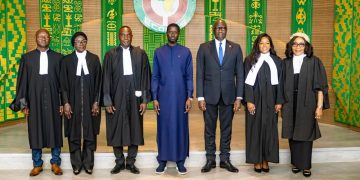



The Court of Appeal has unanimously restored the licence of GN Savings and Loans Company Limited. That was after a three-member panel of the second-highest court quashed the decision of the High Court, which upheld the revocation of the licence on the grounds that the decision was unfair and unreasonable.


By the judgment, both the decision to revoke the licence and the High Court decision to uphold same have been quashed.
The court, subsequently, ordered the Receiver, Eric Nana Nipah, a Director at PricewaterhouseCoopers (PwC), to also hand over the possession, management, and control of the assets and other activities to the shareholders of the company.
Background
On January 4, 2019, GN Bank Limited was reclassified as a savings and loans company and consequently renamed GN Savings and Loans Company Limited. Seven months later, on August 16, 2019, the BoG, then under the leadership of Dr Ernest Addison, revoked the operating licence of GN Savings and Loans Company Limited and appointed Eric Nana Nipah as Receiver as part of the banking sector clean-up exercise.
The same month, Groupe Nduom, owners of GN Savings and Loans Company Ltd, led by Dr Papa Kwesi Nduom, challenged the revocation of the lience in the Accra High Court.
The application against the Bank of Ghana (BoG), the Attorney-General, and the Receiver of the savings and loans companies prayed the High Court to reverse the decision by BoG to revoke the licence of GN Savings and Loans, saying the action was a violation of his fundamental human rights.
The court, presided over by Justice Gifty Addo Adjei, delivering judgment on the case, said the central bank was, therefore, right when it revoked the licence of the third respondent because it had become apparent that it was unable to meet its debt obligations due to poor governance structures.
Initially, lawyers for the BoG raised a legal objection to the application on the basis that the jurisdiction of the High Court had been wrongly invoked.
Dr Justice Srem Sai, Counsel for Dr Nduom at the time, said the action taken by the BoG and its agents, which included the Receiver of the savings and loans company, was a clear violation of his human rights.
The lawyers for the central bank and the Attorney-General said the jurisdiction of the court had been wrongly invoked because matters of banking revocation were expected to go for arbitration at the Arbitration Centre.
However, Justice Srem Sai, the lawyer for GN Savings and Loans at the time, opposed this argument.
The court said the applicant had not been able to satisfy the court that at the time of the revocation of its licence, it was solvent and able to meet its debt obligations.
Justice Addo Adjei said the claim by the applicants of unreasonableness, coupled with malice and violation of existing laws in the process of the revocation, was unfounded.
On the violation of the rights of the administrative justice, the court was of the view that the central bank intervened in the applicants’ operations by way of revocation of the licence according to the provisions of Article 130 of the 1992 Constitution.
“No illegality was occasioned by the conduct of the central bank in revoking the licence in the face of insolvency,” she added. The judge also said BoG had not breached the fundamental principles imbibed in its status.
The court said the central bank took the most reasonable and fair decision in the face of the liquidity challenge in accordance with its mandate.
On the issue of discrimination, the court concluded that the applicants were not discriminated against since other entities suffered a similar fate as that of the applicants, hence declaring their pleadings unfounded and without merit.
It said the applicants could take up the matter of debt owed to them by the government through the Ministry of Finance, even though they maintained that several actions to demand their money from the government had failed, and so it was unreasonable for the BoG to have revoked their licence, considering their circumstances.
It was this decision that Dr Nduom, led by his counsel Cletus Alengah, challenged at the Court of Appeal.
Source: www.kumasimail.com