


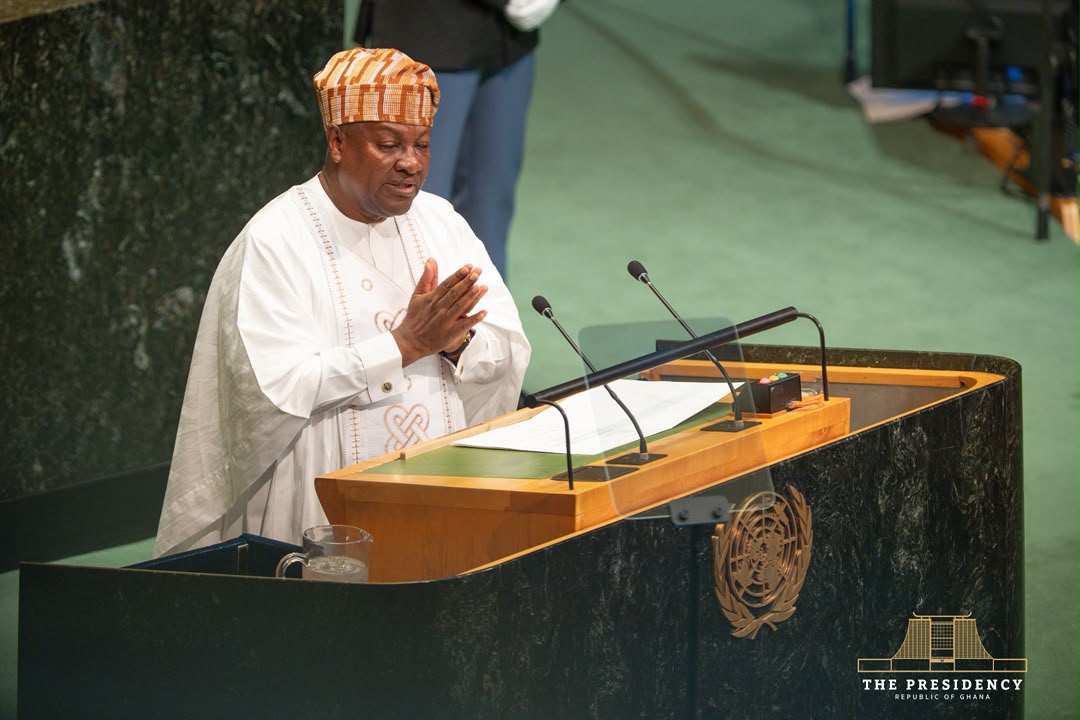
President John Dramani Mahama has used Ghana’s address to the 81st United Nations General Assembly to demand a more equitable international system, calling for reparatory justice for Africans, permanent African representation on the UN Security Council and a fundamental overhaul of global financing arrangements.


Delivering Ghana’s national statement in New York on Thursday, September 24, 2026, President Mahama argued that the international system was facing a crisis of trust and legitimacy and said Africa could no longer remain on the margins of decisions affecting global security, finance and development.
The 81st General Assembly is being held under the theme “Restoring Trust, Managing Transformation: A United Nations That Delivers for All.” The general debate runs from September 22 to 26 and September 28.
Mahama began by congratulating General Assembly President Khalilur Rahman of Bangladesh and commending outgoing UN Secretary-General António Guterres for his decade of service.
Drawing on Ghana’s national anthem and its call to defend freedom, justice and fearless honesty, the President framed his address around what he described as the need for countries to confront historical injustices and present-day inequalities with greater courage.
Reparations and the legacy of slavery
A major part of the address focused on Ghana’s campaign for international recognition and reparatory justice over the transatlantic slave trade and racialised chattel enslavement of Africans.
Mahama recalled that Ghana had sponsored a resolution adopted by the UN General Assembly on March 25, 2026, declaring the trafficking of enslaved Africans and racialised chattel enslavement of Africans the “gravest crime against humanity.”
The UN records show that Resolution A/RES/80/250 was adopted with 123 countries voting in favour, three against and 52 abstentions.
Mahama said the objective was not to reopen historical wounds for political division but to pursue what he described as healing through truth, acknowledgement and repair.
He argued that the consequences of slavery remained visible in contemporary economic and social structures, including racism, economic marginalisation and unequal access to global finance.
The President said meaningful reparatory justice should go beyond symbolic acknowledgement and include changes to what he described as unfair global trade rules, exploitative resource extraction, discriminatory credit ratings and unsustainable debt arrangements.
He welcomed what he described as positive moves by the Netherlands, Germany and France toward discussions on reparatory justice and restitution.
Mahama demands permanent African seat on Security Council
The President also renewed Ghana’s call for comprehensive reform of the UN Security Council.
He noted that Africa has a population of about 1.5 billion people and constitutes the largest regional voting bloc in the General Assembly, yet has no permanent seat on the Security Council.
Mahama called for African countries to be given permanent representation, including the rights and responsibilities attached to permanent membership and veto powers.
He argued that the current structure reflects the geopolitical realities of the period immediately after the Second World War and no longer adequately represents the contemporary international system.
“Security Council reform is not a favour to Africa,” he said, describing it as necessary for the legitimacy and credibility of the United Nations.
His position comes as reform of the Security Council remains one of the longstanding issues before the UN, particularly concerning representation of Africa and other regions that do not have permanent seats.
‘Africa does not seek charity’
On international development financing, Mahama said developing countries face disproportionately high borrowing costs and argued that the global financial architecture needs substantial reform.
He called for long-term, affordable and accessible concessional financing to allow developing countries to invest in human capital, industrialisation and climate adaptation.
“Africa does not seek charity. Africa seeks equal partnership anchored in mutual respect,” he said.
The President linked the financing question to Africa’s natural resources, youthful population and potential role in the global energy transition.
He said African countries should move away from exporting raw minerals without sufficient local processing and value addition.
Mahama said Ghana and other African countries must instead develop domestic industries, create jobs and retain a larger share of the value generated from their natural resources.
He also highlighted the African Continental Free Trade Area (AfCFTA), whose Secretariat is hosted in Accra, as an important vehicle for increasing intra-African trade, industrialisation and economic transformation.
Warning against a new scramble for African minerals
The President cautioned that Africa’s critical minerals must not become the basis for what he described as a new scramble for the continent’s resources.
He said African countries should benefit directly from the global transition to clean energy rather than repeat historical patterns in which natural resources were extracted with limited value retained locally.
The remarks come amid growing global interest in minerals considered important to clean-energy technologies, including battery and renewable-energy supply chains.
Gaza, Palestine and global conflicts
The conflict in the Middle East was another major focus of Mahama’s address.
He condemned what he described as the continuing suffering of Palestinians in Gaza, the West Bank and other occupied territories, and called for stronger international action to protect civilians and uphold international humanitarian law.
Mahama reiterated Ghana’s recognition of the State of Palestine and support for a two-state solution in which Israel and Palestine coexist peacefully with secure and guaranteed borders.
He also condemned attacks by Hamas that triggered the current conflict and called on all parties to comply with international humanitarian law.
The President cited the death of five-year-old Hind Rajab and the killing of more than 20,000 Palestinian children. UNICEF’s 2025 State of Palestine report said at least 20,000 children had been reported killed in Gaza since October 2023.
Mahama also called for the lifting of the longstanding economic, commercial and financial embargo on Cuba, saying measures that impose economic hardship on ordinary citizens conflict with principles of human dignity and international law.
He urged greater international attention to Sudan, which he described as facing a catastrophic humanitarian crisis, and expressed solidarity with countries confronting terrorism, including states belonging to the Alliance of Sahel States.
He also called for negotiations to address the wider Middle East crisis, warning that instability in the region was having consequences for the global economy.
Climate change and Ghana’s flood experience
Climate change featured prominently in the President’s speech.
Mahama argued that Africa contributes a relatively small share of global greenhouse gas emissions while facing severe consequences from climate change, including flooding, coastal erosion, drought and desertification.
He cited Ghana’s June 29 floods as an example of the increasing vulnerability of communities to extreme weather.
However, the casualty figure cited in the President’s speech differs from figures reported by Ghanaian authorities immediately after the disaster. Mahama referred to 39 deaths and one person missing, while the Interior Minister told Parliament on June 30 that 12 people had died and seven were missing at that point.
Mahama called for developed countries to meet their climate-finance commitments and said climate support for vulnerable developing countries should include predictable grants rather than additional debt.
Call for stronger global health cooperation
The President also linked climate resilience with global health security.
He argued that infectious diseases do not respect national borders and called for a more equitable global health system that would support vaccine and therapeutic manufacturing in developing regions.
He also advocated stronger disease surveillance and investment in public-health infrastructure across the Global South.
Mahama turns to Ghana’s economic recovery
After outlining his concerns about the international system, Mahama turned to Ghana’s domestic economic programme.
He said his administration’s “Resetting Ghana Agenda” was intended to demonstrate how disciplined governance, fiscal management and anti-corruption measures could support economic recovery.
The President said Ghana had experienced falling inflation, currency stabilisation, stronger growth and a reduction in its public debt burden.
Independent IMF assessments confirm significant recent improvements in Ghana’s macroeconomic position. The IMF reported in July that inflation had fallen sharply, reserves had increased, Ghana’s primary fiscal balance had moved into surplus and the country’s risk of debt distress had returned to moderate. The Fund, however, also identified continuing vulnerabilities, including fiscal pressures and risks in the financial and state-owned enterprise sectors.
Mahama described the recovery in particularly positive terms, saying some observers had referred to it as the “Ghanaian miracle.”
He nevertheless acknowledged that economic indicators alone were insufficient if they did not improve people’s living conditions.
Infrastructure, 24-hour economy and social protection
The President said his government was implementing a national infrastructure drive through the Big Push Programme, focusing on roads, digital connectivity, schools and health facilities.
He said the programme was intended to reduce the rural-urban divide and open up economic opportunities across the country.
He also highlighted the government’s 24-Hour Economy and Accelerated Export Development Programme and the planned “New Ghana, New Economy” policy, saying these initiatives were aimed at increasing industrial production, agricultural value addition and job creation.
Social protection and healthcare also featured prominently.
Mahama said Ghana had launched the Free Primary Health Care Programme, designed to provide basic healthcare services at the primary level without direct charges.
The programme was launched in April 2026, initially targeting 150 underserved districts. The government has subsequently announced plans to extend it to all 261 districts by the end of 2028.
The President also highlighted the Ghana Medical Trust Fund, popularly known as MahamaCares, which provides support for people suffering from serious non-communicable diseases.
The fund has received government and other contributions, including GH¢6.1 million from presidential staffers and political appointees in June 2026.
Democracy and accountability
Mahama also addressed governance in Africa, saying African countries must confront corruption and improve accountability while demanding greater fairness from the international system.
He described Ghana as a stable constitutional democracy and said his administration was committed to the rule of law, human rights, media freedom and peaceful transfers of power.
He argued that democracy should be measured not only through elections but also by whether citizens experience improvements in healthcare, education, housing, food security and economic opportunity.
Ghana’s upcoming role in Africa
The President used the UN platform to highlight two milestones ahead for Ghana.
He said the country would celebrate its 70th anniversary of independence in March 2027, marking seven decades since Ghana became the first sub-Saharan African country to gain independence from colonial rule.
He also announced that Ghana would assume the chairmanship of the African Union in January 2027, saying the country would use the position to promote continental integration, accelerate implementation of AfCFTA, support peace and security and strengthen Africa’s collective voice internationally.
‘Belonging’ as the central message
Towards the end of the address, Mahama returned to a theme introduced at the beginning of his speech: belonging.
Drawing on his own background in northern Ghana and his experience speaking several Ghanaian languages, the President argued that identity and cultural belonging can strengthen human dignity but can also be manipulated to fuel nationalism, xenophobia, discrimination and conflict.
He said the United Nations’ fundamental principle must remain that every person belongs to a common human family.
He extended that principle to refugees, migrants, children affected by conflict, descendants of enslaved Africans seeking justice, indigenous communities, small island states threatened by rising seas, and vulnerable and marginalised people.
Referencing Ghana’s first President, Kwame Nkrumah, Mahama broadened Nkrumah’s independence-era message into a call for global solidarity.
He argued that national freedom cannot be secure without the freedom of humanity as a whole, while prosperity remains fragile if it is not shared and peace cannot endure without justice.
Mahama ended his address by urging world leaders to replace exclusion with inclusion, confrontation with dialogue and indifference with action.
“Let us speak truth with humility. Let us act with courage. And let us cherish fearless honesty,” he told the Assembly.
The address placed Ghana’s priorities reparatory justice, African representation, development finance, climate action, economic transformation and social protection within a broader argument for reform of the international system and a renewed commitment to multilateral cooperation.
Source: www.kumasimail.com