






























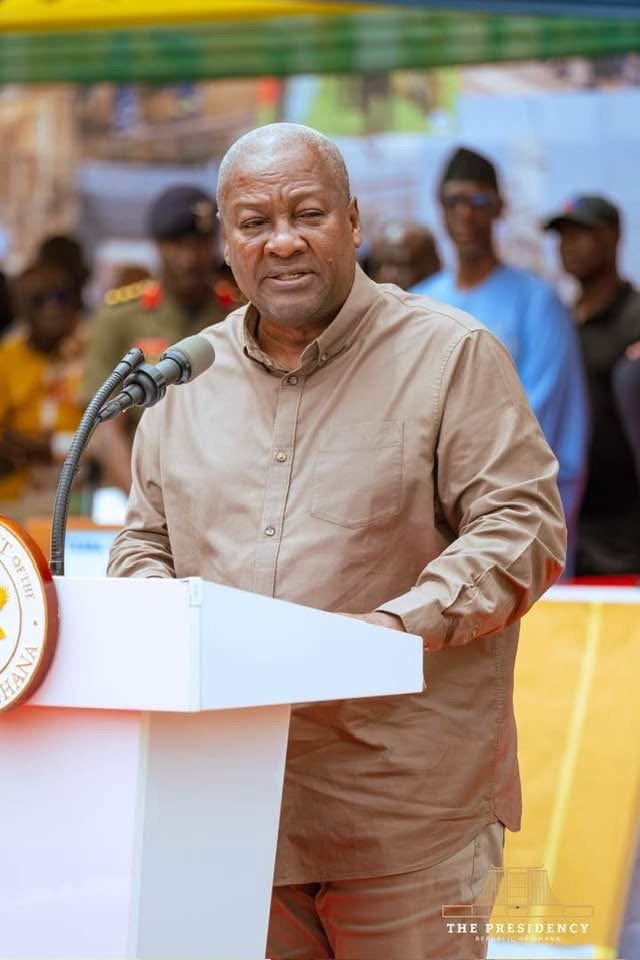
President John Dramani Mahama has commissioned the refurbished refining units of the Tema Oil Refinery (TOR), describing the milestone as a major step towards restoring Ghana’s industrial capacity, strengthening energy security and reducing dependence on imported petroleum products.


Speaking at a ceremony at the refinery in Tema on Sunday, President Mahama said the revival of TOR fulfilled a commitment he made to Ghanaians to restore the state-owned refinery to full operation after years of inactivity and financial difficulties.
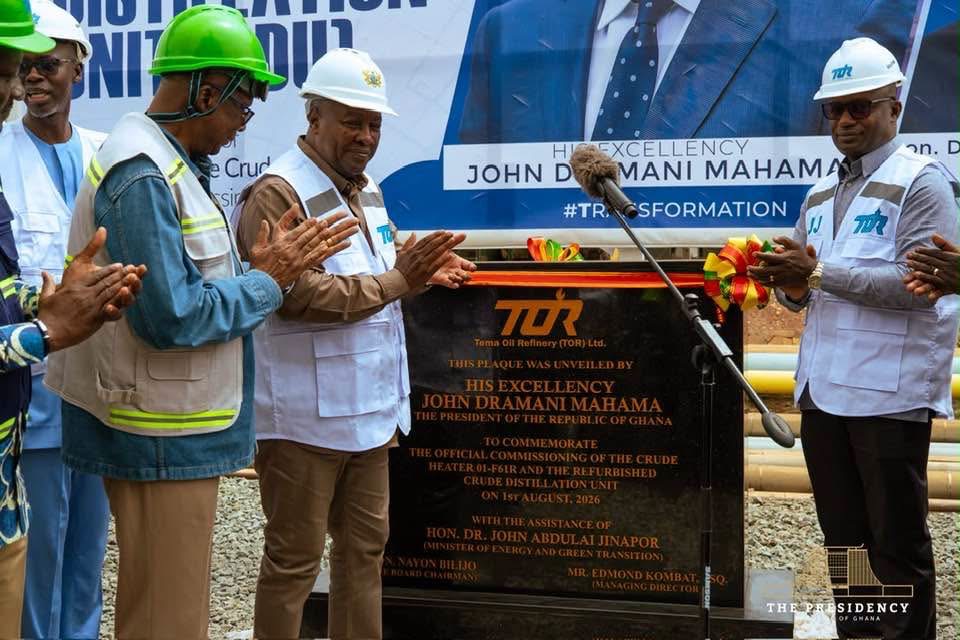
“Today, I have not come merely to speak about that promise. I have come to stand within its fulfilment,” the President said, adding that the event represented “the rebirth of one of Ghana’s most strategic industrial assets.”
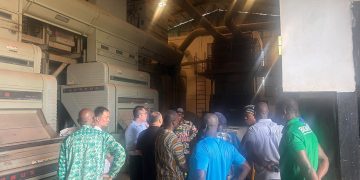
The commissioning covered the rehabilitated Crude Distillation Unit (CDU), the Residue Fluid Catalytic Cracking Unit (RFCC), Boiler Number Eight, the new F-61 Crude Heater, as well as refurbished administrative facilities, including the reception area, staff canteen and the refinery’s frontage.
President Mahama said the refinery had received three separate one-million-barrel cargoes of crude oil since May, comprising Bonga, Baleine and Ghana’s own Jubilee Medium Sweet Crude, signalling government’s determination to restore domestic refining.
According to him, the new crude heater has significantly increased processing capacity from about 28,000 barrels per stream day towards the refinery’s original design capacity of 45,000 barrels, with plans to eventually reach 60,000 barrels.
He noted that every barrel refined locally would reduce foreign exchange spent on imported petroleum products while supporting jobs, industrial growth and Ghana’s ambition to become a petroleum refining hub for West Africa.
“The revival of Tema Oil Refinery is not merely an energy project. It is a national development project. It is an industrialisation project. It is an economic sovereignty project,” he said.
The President said the decision to allocate Ghanaian crude to TOR was a strategic national policy aimed at ensuring the country’s natural resources generated value locally before export.
He also linked the refinery’s return to profitability to broader improvements in Ghana’s economy, including declining inflation, improving macroeconomic stability and the appreciation of the Ghana cedi.
According to President Mahama, TOR recorded its first profit in almost a decade, benefiting from foreign exchange gains resulting from the stronger local currency.
He urged the refinery’s board, management and staff to maintain operational discipline and avoid practices that previously contributed to the institution’s decline.
“Reviving a refinery is one thing. Keeping it operating efficiently, safely and profitably is another,” he said.
President Mahama reaffirmed government’s vision of transforming Ghana from a crude oil producer into a regional centre for refining and petroleum processing capable of exporting refined products across the ECOWAS sub-region.
He commended the board, management, staff, engineers, technical partners, contractors, financiers and the Ministry of Energy and Green Transition for their contributions to the refinery’s rehabilitation.
Addressing workers, the President praised their resilience during years of operational challenges.
“When production stopped, you stayed. When optimism disappeared, you remained. When others wrote off this refinery, you protected its knowledge, its equipment and its future. Today belongs to you,” he said.
The President concluded by formally commissioning the refurbished facilities and marking the successful receipt and processing of one million barrels of indigenous Jubilee Medium Sweet Crude, expressing confidence that TOR would once again become a symbol of Ghana’s industrial renewal.
This version follows a conventional news style with a strong lead, key developments at the top, supporting details, and relevant quotations.
Source:www.kumasimail.com